Solutions to all three questions and every optional part. The barrier formulas apply only while the contract is alive. In the above-strike barrier case, the terminal strike must be capped at the barrier before using reflection.
Write , and . Since both moves have positive physical probability, the binomial options pricing model is free of arbitrage exactly whenIf , borrowing the share price and buying one share gives terminal gain or , both nonnegative and at least one positive. If , shorting one share and investing its proceeds gives the opposite comparison, with gain or . Equality at either endpoint still permits arbitrage because the other outcome has positive probability.
Conversely, strict inequalities give a risk-neutral probability , for which the discounted share is a martingale. Any zero-cost self-financing portfolio with nonnegative terminal value has zero discounted expectation under this equivalent positive-probability law and hence cannot have a strictly positive payoff in either state. Applying this argument conditionally at each node proves no-arbitrage over the tree.
A replicating strategy holds shares and a current cash amount in the bank account. Matching the two next values givesSolving this linear system,By no-arbitrage, the claim costs . Collecting the coefficients of its two future values yieldsThe physical probability does not appear: replication fixes the price of this contingent claim from traded prices.
Using the risk-neutral probability from part c, the stock tree has values initially, after one step, and after two. The American put option has terminal financial payoffs . Work backwards, comparing the immediate exercise payoff with its discounted continuation value.
At , continuation is , exceeding the zero exercise payoff. At , continuation is , while exercise pays three. Therefore exercise at the down node and continue at . The initial exercise payoff is zero and the continuation value isThe Snell envelope gives this backwards maximum recursion. For comparison, restricting exercise to expiry would give , so early exercise genuinely adds value.
For the forward-start call option, the strike is fixed by the intermediate stock price. The four path payoffs areThe same final price eight has different payoffs on the two middle paths, so one must retain the history at expiry. At time one, risk-neutral pricing gives and . ThusEquivalently, its value at the strike-fixing date is by homogeneity, so the martingale property of discounted stock prices gives the initial value .
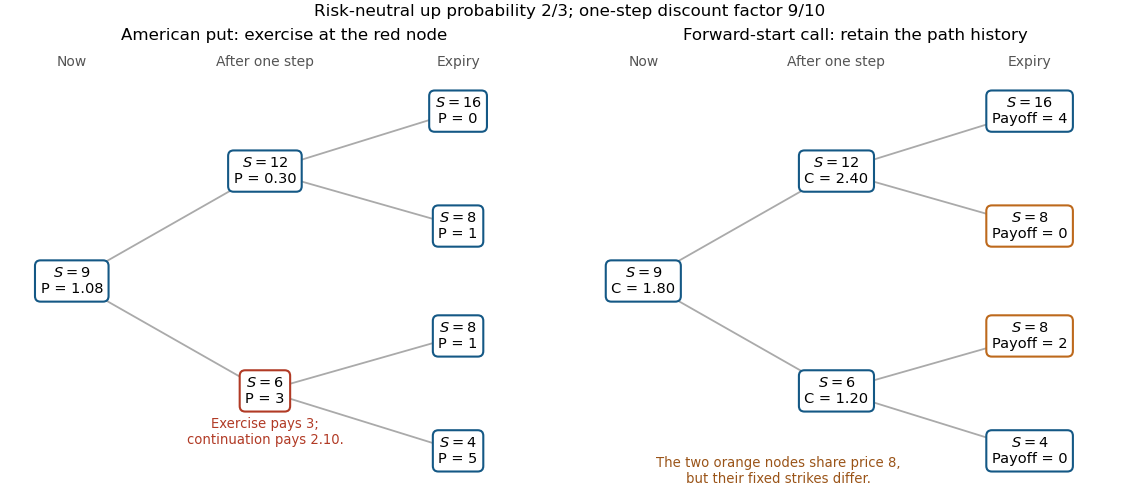
Two-step American-put exercise and forward-start call payoffs
. The American put is exercised at the down node after one step. The forward-start call has different payoffs on the two paths ending at stock price eight, because their strikes were fixed at different intermediate prices. Details.
Let . The product rule and Itô's formula givewhere the Black-Scholes equation cancels the drift. Under the usual pricing growth and integrability conditions this local martingale is a martingale. Its terminal value is , since the exponential factor becomes one at . Taking a conditional expectation givesThe dynamics already use the risk-neutral measure. This is the Feynman-Kac formula for the given pricing problem; a differential equation alone, without the relevant growth condition, would not justify upgrading a local martingale or uniqueness.
Apply Itô's formula to the logarithm of the positive geometric Brownian motion. The quadratic-variation correction givesIntegrating yieldsThe increment is a Gaussian random variable with variance , independent of current information. Writing it as means a fresh future Brownian motion , evaluated at ; it need not equal the original process at time .
Take the terminal financial payoff . The function satisfies the Black-Scholes equation: its time derivative and second stock derivative vanish, while . It also has the correct terminal value. Part a therefore givesThus the discounted stock is a martingale. The explicit lognormal distribution in part b supplies the necessary finite expectation, so here this is a true martingale identity.
Under the risk-neutral measure, set and . Then with a standard normal random variable, and . The log-call option is the discounted Gaussian positive-part expectation:since . ThereforeHere and are the standard normal density and standard normal distribution function. At expiry the continuous terminal limit is .
Let , so . Squaring givesExponentiation provesAt fixed , only depends on , so the partial derivatives are
Differentiate the Black-Scholes formula for the European put option with respect to its strike. The chain rule givesThe final two terms cancel by both identities in part i. Hence the put-price strike derivative is
For a terminal price distinct from , differentiating the put's financial payoff gives . The difference quotients are bounded by one, and the continuous lognormal distribution has zero probability at the strike. The dominated convergence theorem therefore permits differentiation inside its discounted expectation. The put-price strike derivative is exactly the price of the digital put option:Equivalently, risk-neutral pricing discounts the probability .
While the up-and-out digital put is alive, its pricing domain is , . Its Black-Scholes equation, terminal financial payoff, and absorbing boundary condition areFor completeness, the natural limiting condition is , with . A positive geometric Brownian motion cannot hit zero in finite time, and from a very small starting value the survival and below-strike terminal events have probability tending to one. If the barrier has already been hit, its value is zero regardless of the current stock price.
For , the terminal payoff tends to one from inside at , while an already hit barrier pays zero. Thus there is a terminal-boundary corner discontinuity; the terminal condition is imposed only for , not as a requirement of continuous extension at .
Let and . The Black-Scholes reflection symmetry gives another solution . Subtracting it enforces absorption:At the terms agree. At expiry the reflected argument satisfies , so its digital-put payoff vanishes; the first term supplies the required terminal payoff. These facts and the bounded pricing solution's uniqueness prove the formula. The up-and-out digital put price is zero once knocked out.
If , every surviving terminal price is already below the strike, so this is a barrier digital put paying one at expiry exactly when the upper barrier has been avoided. To use the Black-Scholes reflection symmetry, cap the free digital-put strike at , rather than continuing to use :Indeed, has terminal payoff one throughout the alive region, while its reflected argument exceeds and hence has zero terminal payoff. The barrier values again cancel. Using in both terms would generally leave an unwanted reflected terminal payoff near the barrier.
Writing makes the discounted survival probability explicit:The price is independent of in this case. Both cases combine by replacing the free strike with in the up-and-out digital put formula.
Articles by others on the same topic
There are currently no matching articles.