Write and . The European power put formula isHere has a lognormal distribution. Since is decreasing and is a convex function, its discounted expected value is also decreasing and convex as a function of . For it is smooth and strictly positive: the normal distribution assigns positive probability to whatever the current positive spot price. Its endpoints areThe dominated convergence theorem justifies the second limit, because . For a quantitative sketch, the binomial theorem and truncated lognormal moment givewhere is the standard normal distribution function. This finite sum is useful for drawing the curve; its positive expectation form makes its qualitative shape clearer.
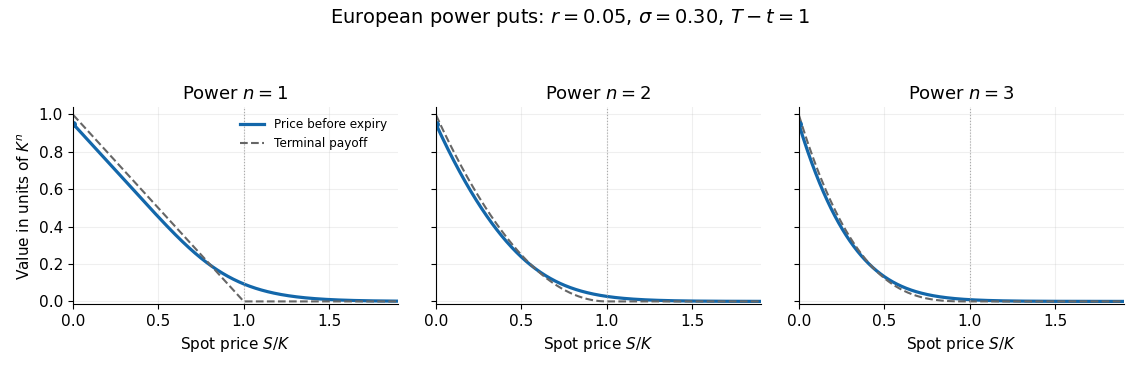

The solid curves use , , and ; the dashed curves show their terminal financial payoffs for comparison. Each price remains positive at and tends smoothly towards zero beyond it. At small , discounting gives a price below the undiscounted financial payoff; European exercise is permitted only at expiry.
Assume , put and let . In the continuation region , the time-independent Black-Scholes equation is a Cauchy-Euler equation. Substituting givesSet . The two powers are and . The boundary condition as removes the growing solution; value matching at sets the coefficient. Hence the fixed-trigger value isFor the policy exercises immediately, giving . The quoted continuation expression alone does not apply below the exercise boundary. Equivalently, the discounted boundary-hitting representation gives , which multiplies the exercise financial payoff.
For , maximize the coefficient of . Its logarithmic derivative isIt changes sign once, at . The perpetual power put option therefore has candidate valueThe same boundary follows from smooth fit, . To establish optimality among all stopping times, rather than only fixed barriers, we verify the candidate. Let be the infinitesimal generator. The maximum property of gives everywhere, and for . For , set . ThenThus the discounted candidate is a nonnegative supermartingale. The smooth fit removes the derivative-jump local time of a semimartingale term in the Itô formula. The optional stopping theorem and localization bound every exercise policy's discounted expected value by . Immediate exercise attains it below ; the first hitting time of attains it above . The terminal remainder vanishes since . This proves the displayed value.
For it reduces to the ordinary perpetual put option. Larger lowers the optimal trigger, because the more strongly curved financial payoff makes further downward moves more valuable. If , under the risk-neutral measure the stock tends to zero almost surely, so the supremum is , approached as the exercise time tends to infinity and not attained at a finite time when . If , the values at deterministic exercise times grow without bound; the perpetual value is infinite. These cases do not admit the positive-rate formula above.
Articles by others on the same topic
There are currently no matching articles.