Use the real magnetic field in the coupled equations; its leading periodic approximation will be . In the conducting incompressible flow, the magnetohydrodynamic momentum equation, resistive induction equation and solenoidal magnetic-field constraint areHere is pressure, is electric current density, and and are magnetic diffusivity and kinematic viscosity. The moving-conductor Ohm law gives .
In the insulating exterior, neglecting displacement current, the magnetic field is curl-free away from the wire and solenoidal. The imposed electric current density suppliesThe exterior electric field also satisfies Faraday's law. At the rigid wall, impose the no-slip boundary condition . At finite conductivity, the interface conditions for electromagnetic fields give continuous normal magnetic field, continuous tangential magnetic field for equal permeability and no prescribed singular surface current, and continuous tangential electric field. The normal electric current density is zero at an insulating wall; it is automatic for the present two-dimensional fields with current only along . The induced fields decay far from the wire and wall, and initial conditions, or selection of the periodic state after transients, complete the specification. In the limiting perfect conductor approximation a surface current can emerge, permitting a tangential-field jump.
The fully coupled solution need not remain monochromatic: a harmonic magnetic field produces both a mean and a twice-frequency Lorentz force density, and the resulting velocity can generate further harmonics. The following parts consistently use the leading magnetic response with fluid motion neglected.
The Biot-Savart law gives the complex amplitude of the field from the real wire asAn oppositely directed image current at givesThe method of images makes the normal oscillating magnetic field vanish at , as required when the alternating component cannot penetrate a perfect conductor. The two tangential components reinforce one another there. ConsequentlyOnly the oscillating field is being excluded. A pre-existing steady magnetic field is not erased by the perfect conductor limit.
Let and . Within the magnetic skin layer, differentiation across the layer dominates differentiation along the wall by the factor . The leading resistive induction equation is thereforeBecause and , its decaying solution isThe solenoidal magnetic-field constraint determines the first smaller component,Corrections to from longitudinal diffusion have relative order . Thus the zero normal boundary field from the perfect conductor calculation is a leading-order condition, not an additional exact condition at finite . A smaller exterior-field correction matches .
To leading order the electric current density is . For two real harmonic fields, the period average of their product is half the real part of the product of one amplitude with the conjugate of the other. Thus the mean Lorentz force in a magnetic skin layer isIts normal component isThe first possible tangential contribution from the smaller vanishes: it is , and . This cancellation matters in computing the tangential streaming flow.
Write for the outer pressure extrapolated to the wall. The normal balance in the thin boundary layer is , givingThe spatially varying magnetic pressure deficit drives a tangential pressure gradient. For fixed forcing as , layer inertia is small compared with viscous dissipation; explicitly the ratio is . The leading tangential balance isThe outer gradient contributes only at higher inner order. Matching the leading outer shear gives , and the physical no-slip boundary condition gives . Two integrations yield the magnetic skin-layer streaming slip:For the present field amplitude,Using incompressibility and also givesHence in the layer, except at symmetry zeros where a componentwise ratio is inappropriate. In the matching region , and , up to the smaller displacement term .
The effective outer boundary conditions are tangential slip and zero leading normal velocity . These describe the bulk flow extrapolated through the unresolved magnetic skin layer; the actual wall remains at rest. For the slip is negative, and for it is positive. Fluid converges along the wall toward the wire, turns upward near , and returns outward farther above the wall.
The following original streamline sketch uses the small-Reynolds number bulk Stokes flow for this slip. It illustrates that circulation without claiming that the unspecified bulk Reynolds number fixes a unique complete flow. With , , , a dimensionless stream function isIts factor in brackets is holomorphic in , so solves the biharmonic equation; its wall derivative is . Thus it satisfies both effective wall conditions and gives an exact creeping-flow illustration of the derived slip.
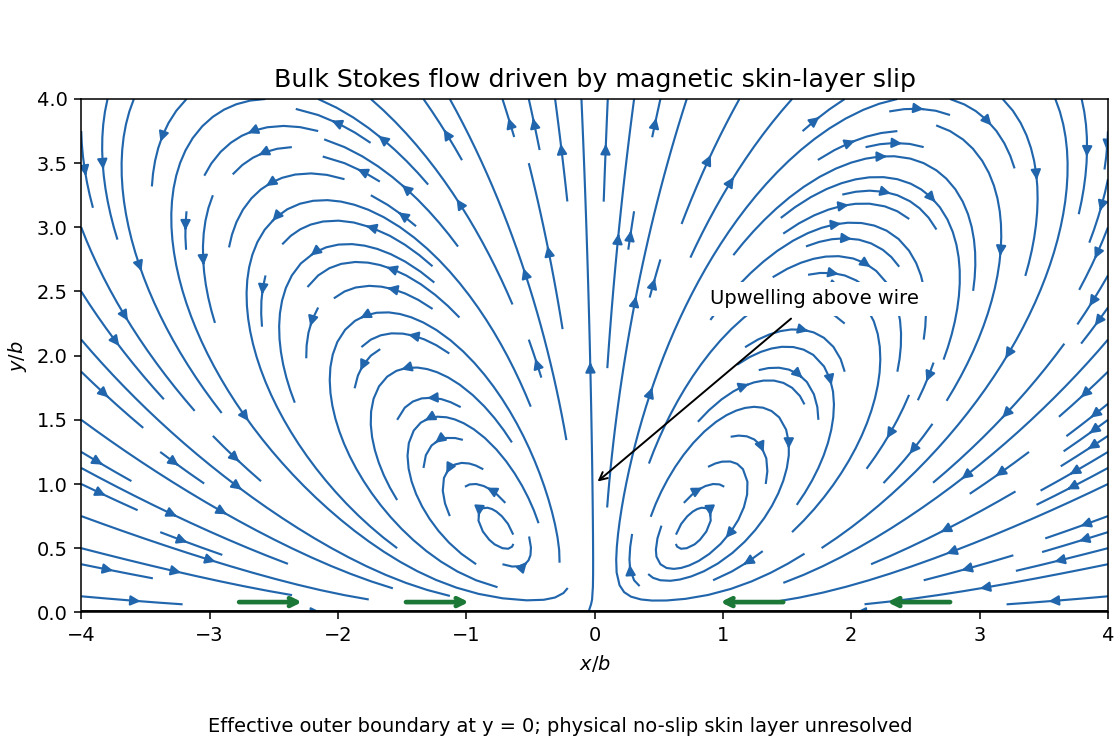
Bulk Stokes-flow streamlines driven by magnetic skin-layer slip, converging along the wall and rising above the wire
. Details. 
Articles by others on the same topic
There are currently no matching articles.