The canonical momentum is , so the Hamiltonian density and total energy areThe Euler-Lagrange field equation is . Multiplication by gives the local conservation of energy identityThus is conserved when the energy flux vanishes at spatial infinity. For finite energy with asymptotically constant fields, the endpoints must be scalar-field vacua, where .
Choose an antiderivative . For either sign , completing the square givesChoosing to make the boundary term nonnegative proves the Bogomolny boundThese Bogomolny equations obtained by square completion for a one-dimensional kink describe minima within a fixed endpoint sector when a saturating configuration exists. Differentiating the spatial equation gives wherever , with smooth extension to its limiting scalar-field vacua. The absolute minimum across all sectors is a constant zero-potential scalar-field vacuum when one exists; the nontrivial minima are sector-specific kinks.
For , write . The scalar-field vacua are . A static finite-energy solution has the first integralbecause differentiating its left side gives , and its value is zero at infinity. In either adjacent interval, . Set . The first-order equation becomes , with , and separation gives . HenceFor the endpoints are ; for they are . Thus there are four oriented static kink families, up to translation, namely two increasing kinks and two decreasing antikinks. Each has rest energyA static field joining directly to would have to pass through at finite . The first integral then gives , and the Picard-Lindelöf theorem applied to the smooth second-order equation with those initial conditions forces . Therefore there is no such additional kink; this is the intermediate-vacuum obstruction to a kink. The Bogomolny classification of a rescaled phi-six kink also shows that if , only the scalar-field vacuum remains and there is no nontrivial finite-energy static kink. Indeed the first integral gives a monotone field wherever it is nonzero, precluding a return to the same scalar-field vacuum.
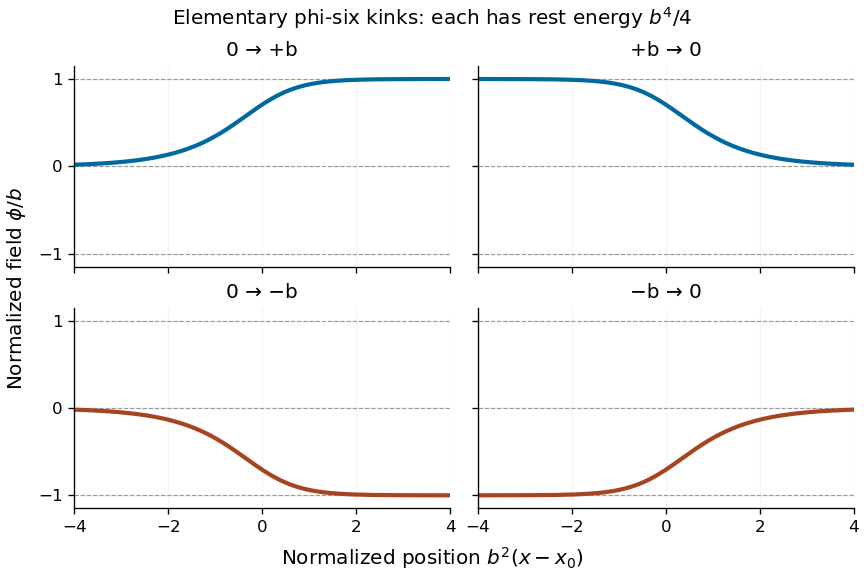
Four oriented elementary phi-six kink profiles connecting adjacent vacua, with equal rest energy
. Details. 
A Lorentz boost of the profile gives a moving solution with arbitrary :If denotes the static profile and , then , proving the Euler-Lagrange field equation directly. Its energy is : since , changing variable to in the energy integral gives the factor . Reversing or yields the other moving elementary profiles.
Use the Minkowski metric convention . On the Adjoint representation, the adjoint covariant derivative is . Set and . ThenThe trace obeys , and covariant integration by parts has the ordinary boundary term because the trace of a commutator is zero. Thus compactly supported variations giveThe trace pairing on is nondegenerate, so the Euler-Lagrange field equations areIn particular the sign of the scalar mass term follows from the plus sign in the supplied trace Lagrangian density; it should not be guessed from a different metric convention. This is the adjoint Yang-Mills-Higgs trace variation.
For the static Bogomolny-Prasad-Sommerfield monopole, take the usual purely magnetic extension and temporal gauge . At , the equations reduce towith the equation identically zero. We now verify both spatial equations from without assuming them. The gauge-theory Bianchi identity gives , hence immediately . Also , soHere . This proves that the Bogomolny equations imply all static zero-mass Yang-Mills equations and the scalar equation. The specification of matters: the spatial Bogomolny equations by themselves do not constrain an arbitrary extra electric potential, so the implication is for their standard purely magnetic static extension.
Let and , using the oriented Euclidean metric. For a self-dual two-form ,Apply this componentwise in the Lie algebra. Since the three span the self-dual subspace, their vanishing wedges force . Thus . The gauge-theory Bianchi identity is , so , the Euclidean Yang-Mills equations. This proves the implication locally; finite action would additionally be needed to call the solution an instanton.
Use the complex orientation for and . The real and imaginary parts of , and , span the self-dual two-forms. Accordingly the three gauge curvature equations areFor a spectral parameter , consider the Lax pairTheir commutator isIt vanishes for every exactly when all three coefficients vanish. The derivative directions and are mutually orthogonal null vectors for the complexified metric. Flatness on the corresponding two-planes makes the linear parallel-transport equations locally compatible. Conversely compatibility for an invertible fundamental matrix forces the commutator to vanish; a single zero solution would not establish it. This is the Euclidean complex-coordinate anti-self-dual Lax pair.
For an Abelian U(1) connection, all commutators of the connection components vanish, and the gauge curvature equations therefore readLocally the first two equations say that is -closed and is -closed. The Dolbeault-Poincaré lemma, and its complex conjugate, give scalar functions withSubstituting in the third equation givesIn a complex gauge transformation, use and the derivative-plus-connection convention . ThenThis is the scalar Laplace equation, since for the stated metric . The complex gauge transformation need not remain in .
A reduction using only a unitary gauge transformation is also available. Since is anti-Hermitian, and , so the potential for the barred components can be chosen as . Write with real . Then , and removes the last term. With this givesIts gauge curvature is . Thus the Abelian anti-self-dual connections from harmonic scalar potentials reduction is local and does not require silently enlarging the real gauge group.
Interpret triviality as holomorphic triviality. Choose a global holomorphic bundle frame for . Let have as its columns the coordinates of these sections in the prescribed local frame over , with the convention that a fiber coordinate vector transforms as . ThenEach is holomorphic and invertible because its columns form a basis in every fiber. This proves the requested holomorphic splitting of transition functions on a trivial bundle. Smooth or topological triviality alone would not justify holomorphic splitting.
For the line bundle on projective twistor space, pull its patching function back to the twistor line using the incidence convention of this problem, , without an extra factor of . Triviality on each line gives nonvanishing linewise holomorphic functions with . The factors can be chosen as holomorphic functions of locally: a degree-zero scalar transition function has zero winding on the overlap annulus, hence admits a logarithm there; splitting its positive and negative Laurent series parts gives factors whose coefficients are Cauchy integrals that are holomorphic functions of . The explicit splitting is worked out below. Their only common linewise ambiguity is multiplication by a nonzero function : the ratio is a global holomorphic function on the compact complex projective line, hence constant on that line.
Take , and raise a two-component spinor by left multiplication with . The derivative along an alpha-plane is . It annihilates the unsplit twistor function, becauseThusis holomorphic on the whole line and has projective weight one. A section of is linear in the homogeneous coordinates: in an affine coordinate, holomorphic regularity at infinity bounds its growth to at most first order, so the Cauchy integral formula excludes all higher powers. ThereforeThe inverse splitting functions obey . Commuting these two equations provesThe spinor decomposition of gauge curvature iswhere both two-component spinors are symmetric. Vanishing of the contraction for every forces . This is exactly the anti-self-dual Maxwell equations. Since the Abelian gauge curvature is , it is closed; its duality condition also makes it co-closed, giving the source-free Maxwell equations. Changing both splitting factors by changes by , the expected Abelian gauge transformation. This derives the rank-one Penrose-Ward correspondence in the needed local form.
For the exponential patching function, choose a representative of the Čech cohomology class, of homogeneous degree zero. On the overlap of the two line patches write . To compute the gauge potential explicitly, use a constant two-component spinor basis in which and the finite patch . Then , andFor a positively oriented contour in the overlap annulus, split its Laurent series asThe first is holomorphic inside the contour, the second outside including infinity; split . Since , coefficient comparison gives . Applying that operator separately to cancels all nonconstant terms and leavesThus yields and . MoreoverSubstitution gives , which in homogeneous form is preciselyThis is the Abelian Ward splitting by Laurent series. The factors have weights , respectively, so the integrand is invariant under a change of homogeneous representative. The contour avoids ; the basis chosen above places that point at infinity. One can keep the contour fixed for in a sufficiently small domain, allowing differentiation under the integral.
Finally differentiate the contour potential for an anti-self-dual Maxwell field. By the twistor incidence relation, . ConsequentlyThe second equality uses the elementary two-spinor identity in the declared convention. The remaining two-component spinor is symmetric in , and no primed symmetric gauge curvature part survives. This directly verifies is anti-self-dual. In complexified Lorentzian signature duality has Hodge star eigenvalues ; here the vanishing primed two-component spinor fixes the stated ASD convention rather than incorrectly imposing the Euclidean equation on that signature.
Articles by others on the same topic
There are currently no matching articles.