Take , real , and the real branch , with physical temperature . In hydrostatic equilibrium the pressure decreases with height :Thus an atmospheric thermal inversion means , equivalently . For , the logarithm of the given relation yieldsThe sign restriction must be retained after squaring. In particular, the inverted branch has , whereas the non-inverted branch has . By differentiation, on the interior of either branch,Consequently,At , the inverse temperature gradient vanishes at the branch endpoint, rather than producing a finite isothermal interval. If , the relation becomes independently of ; it is not a nontrivial vertical atmospheric pressure-temperature profile under hydrostatic equilibrium. These distinctions prevent the two sides of the squared parabola from being interpreted as one permissible atmosphere.
Assume a homogeneous ideal gas, constant specific-heat ratio , and an upward displacement that is an adiabatic process and maintains pressure balance with its surroundings. If the ambient temperature falls faster with decreasing pressure than the parcel's adiabatic temperature gradient, the parcel becomes hotter and less dense than its surroundings; buoyancy amplifies the displacement. This is the Schwarzschild criterion:The square-root exponential atmospheric profile hasAn atmospheric thermal inversion with has and is stable to these ordinary adiabatic displacements. For , put . The condition becomes the quadratic inequalityintersected with and . In the usual case , the maximum gradient occurs at , namely , and is . Hence a convectively unstable interval exists precisely whenEquality in the existence condition gives a single neutrally stable point. A molecular-hydrogen-dominated hot Jupiter with rotational modes active but vibrational excitation and dissociation negligible has approximately , so . The existence condition is then . For the general inequality above remains valid, but its roots must be intersected with the positive-temperature domain; the positive- maximum formula must not be reused. Composition gradients require the Ledoux criterion, and dissociation or variable heat capacities change . Sustained convection normally adjusts a superadiabatic profile toward an adiabatic temperature gradient.
Use the usual atmospheric plotting convention: temperature on the horizontal axis, logarithmic pressure increasing downward. To illustrate a physically plausible local range for a hot Jupiter, set and . The sign is not fixed by the fact that the planet is a hot Jupiter; irradiation and opacity determine whether an atmospheric thermal inversion is present.
The original sketch shows both admissible branches of the square-root exponential atmospheric profile, with separate assumed normalizations for the outward-cooling example and for the inverted example. Each extends from to and has . For , increasing depth increases both pressure and temperature, so the curve bends rightward downward. For , moving upward lowers pressure and raises temperature, so the curve bends rightward upward. Each branch meets with ; it must not be continued through that endpoint onto the other branch.
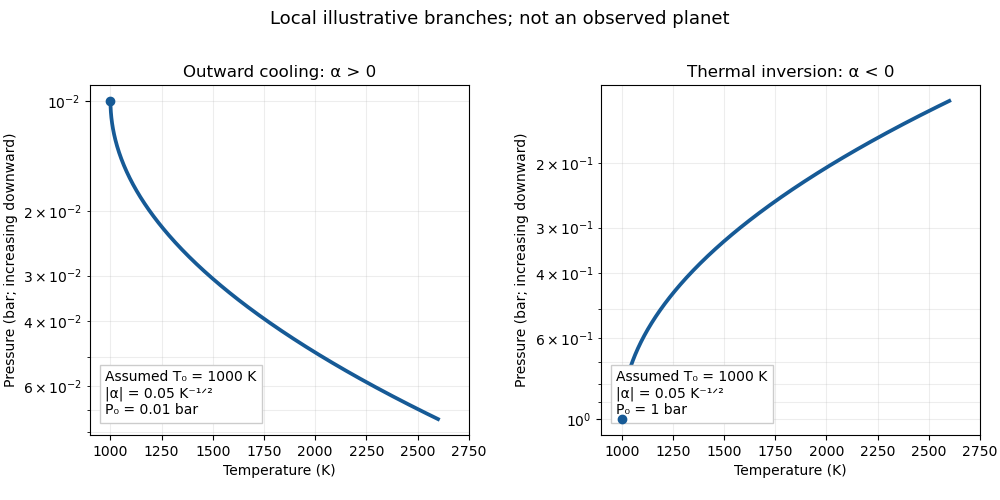
Illustrative branches of an atmospheric pressure-temperature profile
. Details. 
For the outward-cooling example, , so a section of the imposed profile is unstable for a homogeneous diatomic ideal gas. It should be interpreted as an illustrative retrieved radiative profile that would be modified by convection if realised, rather than a self-consistent deep convective atmosphere. The inverted branch is stable under the same assumptions.
The sketch must show only the sign-allowed pressure branch; either an inverted or an outward-cooling local profile is possible.
The functional form is not specific to exoplanets. With positive pressure normalization and physical temperature, a square-root exponential atmospheric profile can approximate a monotone interval of the terrestrial atmosphere. An outward-cooling interval, such as part of the troposphere or mesosphere, requires . An upward-warming interval, such as part of the stratosphere heated by ultraviolet absorption or the thermosphere heated by high-energy radiation, requires .
The local atmospheric lapse rate follows from the ideal gas relation and hydrostatic equilibrium:For dry terrestrial air, approximately and give the dry-adiabatic lapse rate . The familiar mean tropospheric value near is less steep; a local fit must satisfy to be dry-convectively stable. Moist convection needs the moist parcel thermodynamics instead, and the terrestrial atmosphere is not uniformly dry or chemically homogeneous at all heights.
The squared-logarithm shape cannot reproduce an exactly constant nonzero lapse rate over an arbitrary thick region, all the alternating atmospheric layers, or a finite exactly isothermal region. It is a local parametrization with a fixed sign of the temperature gradient; it has no terrestrial universality.
Take to be the radius of an opaque planetary disc and the geometric thickness of the model atmosphere, not necessarily one atmospheric scale height. Assume a uniform stellar specific intensity, a fully projected non-grazing transit, negligible planetary emission in the measured band, and no scattering or refraction returning light to the beam. The cylindrical approximation assigns the same slant optical depth to every ray through the annulus.
The opaque disc blocks area . The annulus has projected area , and the radiative transfer equation transmits fraction through it. Its blocked fraction is therefore . Dividing the missing light by the unobscured stellar-disc light gives the exoplanet transmission spectrumFor , the annulus model for transmission spectroscopy becomesThe optically thin excess is ; the optically thick limit is the area ratio before the thin-annulus approximation. For a realistic atmosphere, the slant optical depth varies with the ray's impact parameter , giving insteadLimb darkening replaces the simple area weighting by the local stellar specific intensity. The constant-depth model is therefore an explicit geometric approximation, not the slant-depth law of a spherical hydrostatic atmosphere.
A natural interpretation of the short-wavelength peak is reflected starlight, while the longer-wavelength peak is planetary thermal radiation. A reflected spectrum approximately follows the stellar spectrum multiplied by the wavelength-dependent geometric albedo; thermal radiative flux approximately follows the planet's Planck function, modulated by molecular opacity. Thus two peaks need not represent two planetary surface temperatures.
For a quantitative estimate assume both are broad peaks, reflection has a slowly varying geometric albedo, and star and planet have approximately blackbody spectral envelopes. Wien's displacement law then givesThe stellar estimate is compatible at order of magnitude with an old, relatively small main-sequence star; equal age does not mean equal temperature to the Sun. Assume the far-infrared signal is thermal and sufficiently long-wavelength that the Rayleigh-Jeans law applies to both bodies. The planet-star radius estimate in the Rayleigh-Jeans limit givesand thereforeThis is a small volatile-rich-planet-sized estimate, not a Jupiter-sized one. It is conditional: peaks caused by molecular windows, strongly chromatic reflection, or a spectrum expressed as rather than do not support those two Wien estimates. Without , the far-infrared ratio only fixes .
For a close-in hot planet around a small star, transit-based atmospheric observations are the natural route if the orbital geometry allows them. Exoplanet transmission spectra gain from the small stellar radius, with a limb signal scaling as ; they probe composition at the day-night terminator. The stated thermal contrast also makes exoplanet secondary eclipse measurements a particularly useful route to the dayside exoplanet emission spectrum. Resolving such a close-in small planet by exoplanet direct imaging is much harder. Transit and secondary-eclipse spectroscopy are favoured for a transiting close-in interpretation; the supplied spectrum alone does not determine the orbital geometry or a unique best technique.
Articles by others on the same topic
There are currently no matching articles.