The heat capacity ratio compares heat capacity at constant pressure with heat capacity at constant volume at the same equilibrium state and fixed composition:Here refer to the whole sample, in ; molar heat capacities and are per mole; specific heat capacities and are per unit mass. The amount of substance or mass cancels only when both capacities use the same normalization. Thus heat capacity ratio is dimensionless and independent of sample size. For a fixed-composition ideal gas with positive finite , Mayer's relation giveswhere is the molar gas constant. More ways to store internal energy make a given temperature increase require more heat, bringing heat capacity ratio closer to unity. [ref]
https://web.mit.edu/16.unified/www/FALL/thermodynamics/notes/node18.html. MIT Unified Engineering, Specific heats: definitions and ideal-gas relations
The equipartition theorem predicts when independent quadratic terms in molecular energy are thermally active and their number stays fixed; consequently . A classical monatomic gas with no appreciable electronic excitation has , giving and . For an ideal gas of diatomic molecules with three translational and two rotational terms active, but its vibrational normal mode effectively frozen, gives and . A fully classical harmonic vibration adds both kinetic energy and potential energy, giving and . These are model regimes, not universal constants of every gas: rotational freezing, electronic excitation, and changing composition invalidate the simple count.[ref]
The mechanical significance of heat capacity ratio follows from the first law of thermodynamics. For a fixed amount of ideal gas in a reversible adiabatic process, . Combining this with the ideal gas law gives the local relationThe partial derivative holds at fixed entropy and composition even when heat capacity ratio varies with temperature. The finite-path formulas and require the additional approximation of constant heat capacity ratio. A rapid compression also needs internal equilibration to approximate this path; rapid motion alone does not ensure reversibility. The same local response gives isentropic compressibility and, for small sound disturbances in this ideal gas regime, speed of sound , where is mass density. Thus thermal storage controls mechanical stiffness, sound propagation and the measurements in Rüchardt experiment and Clément-Desormes experiment.
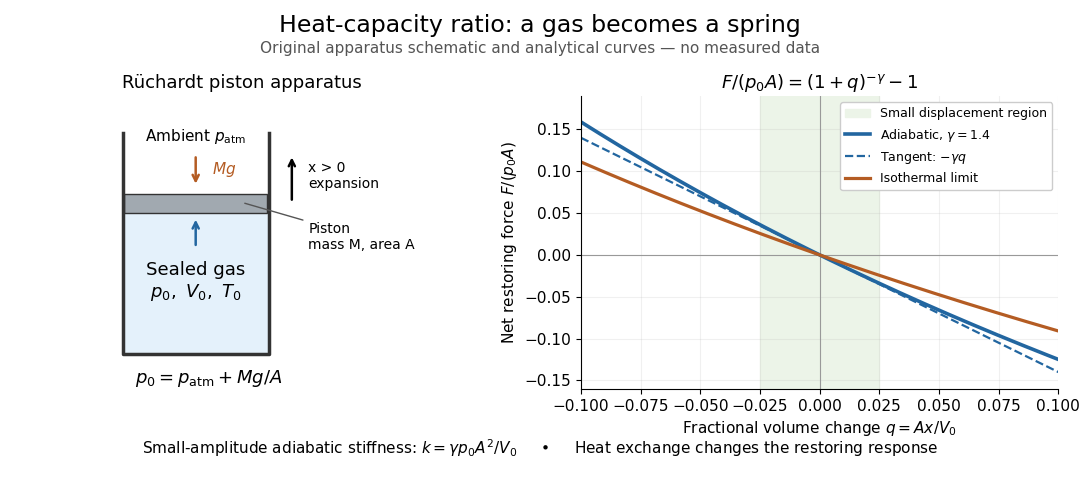
A frictionless piston of area and mass supported by gas has . Small displacement changes its volume by . The local isentropic compressibility gives , so Newton's second law becomes . The period follows. Gas inertia and heat leakage are neglected, and internal equilibration must be faster than the oscillation.
The Rüchardt experiment infers heat capacity ratio from the period of an oscillation of a piston supported by trapped gas. Use a vertical precision cylinder with a close-fitting movable piston, known moving mass , face area , trapped equilibrium volume , and local atmospheric pressure . With negligible static friction, force balance gives the absolute gas pressure , where is gravitational acceleration. Displace the piston slightly and release it: compression raises pressure, and expansion lowers it, producing a restoring force. The oscillation is a mechanical probe of thermal response, without separately measuring two heat inputs. [ref]
https://groups.ist.utl.pt/wwwelab/wiki/index.php?title=Determination_of_the_Adiabatic_Constant. Instituto Superior Técnico e-lab, Determination of the Adiabatic Constant: piston apparatus and period model
Let be upward displacement from equilibrium, so . For constant heat capacity ratio and a reversible adiabatic process, the net upward force, including the ambient load and weight, isThe linear approximation requires . Applying Newton's second law gives simple harmonic motion withHere is the undamped angular frequency and the undamped oscillation period, rather than temperature. Record repeated cycles, measure independently, and include all connected trapped volume. An illustrative model with , , , , and gives and . These stipulated values are not measurements.
In Shearwood and Sloan's implementation, piston-mounted magnets induce an electromotive force in a stationary coil through Faraday's law of induction; an oscilloscope records the signal. They observed faster oscillations at smaller trapped volume values and stronger damping at small cylinder volume values. The signal tracks velocity locally, so its amplitude is not directly piston displacement. Calibration also identified inlet dead space beyond the graduated cylinder volume. [ref]
https://arxiv.org/html/2209.03323v1. Chris Shearwood and Peter A. Sloan, The Rüchardt experiment revisited, §§3–4: signal, dead volume and observations
Repeat at smaller initial amplitudes to test the linear approximation, and compare several values. Heat transfer weakens the restoring force toward the isothermal process limit, biasing the inference toward . Check leakage through resting-piston drift and before-and-after trapped volume readings. For viscous damping with envelope , the measured angular frequency obeys ; this correction does not remove thermal leakage. Internal equilibration must be faster than an oscillation period, with heat transfer and leakage slow over a run. Large amplitude or sticking friction require a richer model. [ref]
The Clément-Desormes experiment infers heat capacity ratio from a rapid pressure reduction followed by reheating. Use a rigid bottle, pump or bellows, a quick release valve, and a U-tube pressure gauge connected to the bottle and atmosphere. First pump to a small excess pressure, close the inlet, and wait for thermal equilibrium with the room at . Measure , where is local absolute atmospheric pressure. Briefly open the release valve until the bottle reaches , then close it promptly. The remaining gas is cooler than the room. As it warms back to at fixed bottle volume, its pressure rises to , with in the ideal procedure. The rebound reveals cooling during release. [ref]
https://labs.physik.kit.edu/prakt-nebenfach-manuals/Experiments/Adiabatenexponent_Luft/. KIT Faculty of Physics, Clément-Desormes laboratory protocol: release and pressure rebound
The bottle loses molecules while the valve is open: it is not a closed system whose geometrical volume expands. In the well-mixed, negligible-heat transfer discharge model with constant heat capacity ratio, the remaining gas obeys . Subsequent heating at fixed amount of substance and bottle volume gives by the ideal gas law. Eliminating the unmeasured yieldsThe logarithms use absolute pressure ratios. The approximation requires small gauge pressures ; are signed height differences between the two liquid surfaces, and the final equality uses the same liquid in both readings with hydrostatic equilibrium. It is not an instruction to insert gauge readings into the logarithmic formula. For synthetic states generated with , and , the model gives . The logarithmic inference recovers ; the small-pressure approximation gives approximately .
Wait for a stable initial pressure after pumping and for a stable final pressure after closing. Vary the valve-open interval and initial excess pressure across repeated trials: closing too early leaves residual excess pressure, while leaving the valve open during warming lets more gas escape and suppresses the rebound. Test the seal for leaks, and read both liquid levels consistently. In a variant with incomplete release, measure the actual immediate post-release absolute pressure and replace the numerator by . The Zurich laboratory manual explains that liquid-column oscillations can delay this reading until appreciable reheating has occurred; its proposed backward extrapolation assumes an exponential thermal relaxation and must be checked against the recorded readings. These controls separate a thermal signal from valve timing, instrumental lag and leakage. [ref]
https://www.physik.uzh.ch/~matthias/espace-assistant/manuals/en/anleitung-cd_e.pdf. University of Zurich, PHY112/122 laboratory manual, §1.3 and Appendix 1.4(a): pressure readings and reheating correction

