Take , real , and the real branch , with physical temperature . In hydrostatic equilibrium the pressure decreases with height :Thus an atmospheric thermal inversion means , equivalently . For , the logarithm of the given relation yieldsThe sign restriction must be retained after squaring. In particular, the inverted branch has , whereas the non-inverted branch has . By differentiation, on the interior of either branch,Consequently,At , the inverse temperature gradient vanishes at the branch endpoint, rather than producing a finite isothermal interval. If , the relation becomes independently of ; it is not a nontrivial vertical atmospheric pressure-temperature profile under hydrostatic equilibrium. These distinctions prevent the two sides of the squared parabola from being interpreted as one permissible atmosphere.
Assume a homogeneous ideal gas, constant specific-heat ratio , and an upward displacement that is an adiabatic process and maintains pressure balance with its surroundings. If the ambient temperature falls faster with decreasing pressure than the parcel's adiabatic temperature gradient, the parcel becomes hotter and less dense than its surroundings; buoyancy amplifies the displacement. This is the Schwarzschild criterion:The square-root exponential atmospheric profile hasAn atmospheric thermal inversion with has and is stable to these ordinary adiabatic displacements. For , put . The condition becomes the quadratic inequalityintersected with and . In the usual case , the maximum gradient occurs at , namely , and is . Hence a convectively unstable interval exists precisely whenEquality in the existence condition gives a single neutrally stable point. A molecular-hydrogen-dominated hot Jupiter with rotational modes active but vibrational excitation and dissociation negligible has approximately , so . The existence condition is then . For the general inequality above remains valid, but its roots must be intersected with the positive-temperature domain; the positive- maximum formula must not be reused. Composition gradients require the Ledoux criterion, and dissociation or variable heat capacities change . Sustained convection normally adjusts a superadiabatic profile toward an adiabatic temperature gradient.
Use the usual atmospheric plotting convention: temperature on the horizontal axis, logarithmic pressure increasing downward. To illustrate a physically plausible local range for a hot Jupiter, set and . The sign is not fixed by the fact that the planet is a hot Jupiter; irradiation and opacity determine whether an atmospheric thermal inversion is present.
The original sketch shows both admissible branches of the square-root exponential atmospheric profile, with separate assumed normalizations for the outward-cooling example and for the inverted example. Each extends from to and has . For , increasing depth increases both pressure and temperature, so the curve bends rightward downward. For , moving upward lowers pressure and raises temperature, so the curve bends rightward upward. Each branch meets with ; it must not be continued through that endpoint onto the other branch.
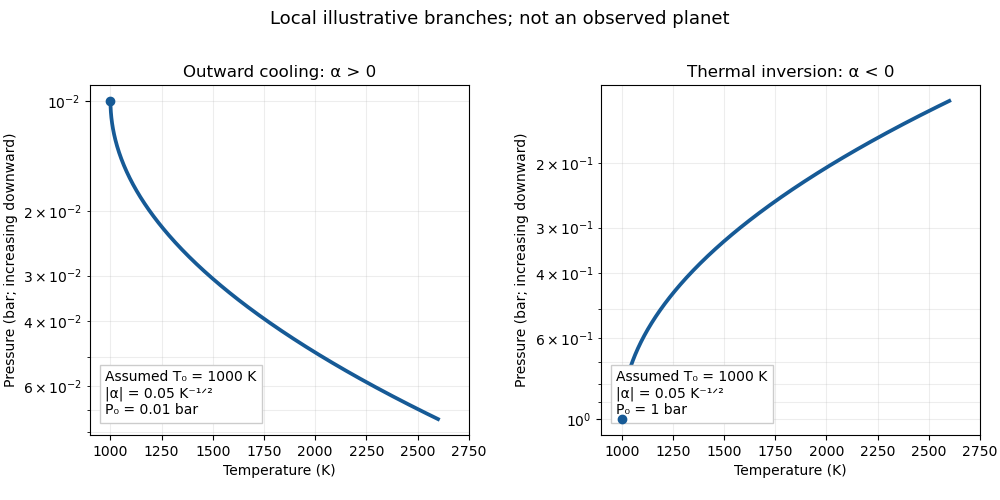
Illustrative branches of an atmospheric pressure-temperature profile
. Details. 
For the outward-cooling example, , so a section of the imposed profile is unstable for a homogeneous diatomic ideal gas. It should be interpreted as an illustrative retrieved radiative profile that would be modified by convection if realised, rather than a self-consistent deep convective atmosphere. The inverted branch is stable under the same assumptions.
The sketch must show only the sign-allowed pressure branch; either an inverted or an outward-cooling local profile is possible.
The functional form is not specific to exoplanets. With positive pressure normalization and physical temperature, a square-root exponential atmospheric profile can approximate a monotone interval of the terrestrial atmosphere. An outward-cooling interval, such as part of the troposphere or mesosphere, requires . An upward-warming interval, such as part of the stratosphere heated by ultraviolet absorption or the thermosphere heated by high-energy radiation, requires .
The local atmospheric lapse rate follows from the ideal gas relation and hydrostatic equilibrium:For dry terrestrial air, approximately and give the dry-adiabatic lapse rate . The familiar mean tropospheric value near is less steep; a local fit must satisfy to be dry-convectively stable. Moist convection needs the moist parcel thermodynamics instead, and the terrestrial atmosphere is not uniformly dry or chemically homogeneous at all heights.
The squared-logarithm shape cannot reproduce an exactly constant nonzero lapse rate over an arbitrary thick region, all the alternating atmospheric layers, or a finite exactly isothermal region. It is a local parametrization with a fixed sign of the temperature gradient; it has no terrestrial universality.
Take to be the radius of an opaque planetary disc and the geometric thickness of the model atmosphere, not necessarily one atmospheric scale height. Assume a uniform stellar specific intensity, a fully projected non-grazing transit, negligible planetary emission in the measured band, and no scattering or refraction returning light to the beam. The cylindrical approximation assigns the same slant optical depth to every ray through the annulus.
The opaque disc blocks area . The annulus has projected area , and the radiative transfer equation transmits fraction through it. Its blocked fraction is therefore . Dividing the missing light by the unobscured stellar-disc light gives the exoplanet transmission spectrumFor , the annulus model for transmission spectroscopy becomesThe optically thin excess is ; the optically thick limit is the area ratio before the thin-annulus approximation. For a realistic atmosphere, the slant optical depth varies with the ray's impact parameter , giving insteadLimb darkening replaces the simple area weighting by the local stellar specific intensity. The constant-depth model is therefore an explicit geometric approximation, not the slant-depth law of a spherical hydrostatic atmosphere.
A natural interpretation of the short-wavelength peak is reflected starlight, while the longer-wavelength peak is planetary thermal radiation. A reflected spectrum approximately follows the stellar spectrum multiplied by the wavelength-dependent geometric albedo; thermal radiative flux approximately follows the planet's Planck function, modulated by molecular opacity. Thus two peaks need not represent two planetary surface temperatures.
For a quantitative estimate assume both are broad peaks, reflection has a slowly varying geometric albedo, and star and planet have approximately blackbody spectral envelopes. Wien's displacement law then givesThe stellar estimate is compatible at order of magnitude with an old, relatively small main-sequence star; equal age does not mean equal temperature to the Sun. Assume the far-infrared signal is thermal and sufficiently long-wavelength that the Rayleigh-Jeans law applies to both bodies. The planet-star radius estimate in the Rayleigh-Jeans limit givesand thereforeThis is a small volatile-rich-planet-sized estimate, not a Jupiter-sized one. It is conditional: peaks caused by molecular windows, strongly chromatic reflection, or a spectrum expressed as rather than do not support those two Wien estimates. Without , the far-infrared ratio only fixes .
For a close-in hot planet around a small star, transit-based atmospheric observations are the natural route if the orbital geometry allows them. Exoplanet transmission spectra gain from the small stellar radius, with a limb signal scaling as ; they probe composition at the day-night terminator. The stated thermal contrast also makes exoplanet secondary eclipse measurements a particularly useful route to the dayside exoplanet emission spectrum. Resolving such a close-in small planet by exoplanet direct imaging is much harder. Transit and secondary-eclipse spectroscopy are favoured for a transiting close-in interpretation; the supplied spectrum alone does not determine the orbital geometry or a unique best technique.
In the collisionless exosphere, an atom escapes if its outward trajectory has positive total mechanical energy. Neglect tides and stellar forces and use Newtonian gravity at exobase radius :With thermal speed , the Jeans escape parameter isA thermal distribution always has an escaping tail; Jeans escape is exponentially suppressed for , with Jeans escape flux proportional to . Efficient escape requires of order a few or smaller, with an order-unity energetic estimate .
Assume a Neptune-like mass and radius, , and atomic hydrogen. Using the supplied rounded constants givesHenceUsing the mean kinetic energy instead gives an order-unity coefficient and . An expanded exobase has weaker binding and lowers the estimate by . A comet-like tail can also be shaped by radiation pressure and stellar-wind interactions; it does not by itself measure or prove that a hydrostatic Jeans model is valid. At , and hydrostatic equilibrium fails as a global description: substantial mass loss must usually be treated as hydrodynamic atmospheric escape.
The exobase is defined by mean free path , not by a universal pressure. For a neutral hydrostatic gas with collision cross-section ,For example, explicitly assuming gives , or . These are representative extremely dilute neutral-exobase pressures, with orders of magnitude varying with composition, cross-sections and expansion. The supplied constants contain no collision information, so they cannot uniquely determine an exobase pressure; ionization or a non-hydrostatic density profile changes this estimate.
Three physically distinct mechanisms are as follows.
- Jeans escape: particles in the high-speed tail of the local thermal distribution escape collisionlessly from the exobase. The Jeans escape parameter determines the exponentially small tail fraction when binding is strong. Light atoms escape more readily at fixed temperature.
- Hydrodynamic atmospheric escape: stellar extreme-ultraviolet or X-ray heating raises atmospheric pressure and drives an expanding bulk wind. A sufficiently strong wind entrains heavier species. An approximate energy-limited atmospheric escape estimate equates useful absorbed power to gravitational work, , but radiative losses, recombination and tides can invalidate this scaling.
- Nonthermal atmospheric escape: photodissociation or charge exchange produces fast atoms, while stellar-wind ion pickup and sputtering transfer energy to ions or neutrals independently of the local gas temperature. Magnetic geometry and stellar activity affect these channels. Radiation pressure can accelerate escaping neutral hydrogen into a tail.
Thermal-tail escape, a bulk hydrodynamic wind, and nonthermal particle energization are three distinct channels; a detected tail need not distinguish them alone. Jeans escape and hydrodynamic atmospheric escape are both thermal mechanisms in the broad sense, but have different distribution functions and dynamical assumptions.
Let the closed atmospheric parcel exchange heat and volume work with reservoirs at fixed temperature and pressure , while reactions rearrange its conserved elemental inventory. For a reversible differential between equilibrium states, the first law of thermodynamics, with chemical work included, isThe Gibbs free energy therefore obeysThe first law of thermodynamics supplies this differential but does not alone choose the direction of a reaction. The Second law of thermodynamics does: for the parcel plus its reservoirs, at fixed and with no non-volume work,Thus spontaneous reactions decrease Gibbs free energy, and stable thermochemical equilibrium is its constrained minimum. For an allowed reaction of extent , let , with positive stoichiometric vector entries for products and negative entries for reactants. At an interior minimum,The condition must hold for every independent allowed reaction, with fixed total atoms of each element and any relevant charge constraint. At a boundary with absent species, only feasible one-sided variations are permitted. These are the hypotheses of constrained Gibbs minimization for chemical equilibrium.
For an ideal gas mixture, , where is the volume mixing ratio and the molar gas constant. ThereforeThis is a dimensionless activity-based equilibrium constant, not a bare product of dimensional pressures.
Assume a single-phase ideal gas mixture in a closed parcel, with common temperature , total pressure , and molar species amounts . Define and volume mixing ratios , so . Ideal mixing makes partial pressure .
For a pure ideal species, , with molar volume . At fixed temperature, integration from standard pressure givesThe same logarithmic composition term follows from the ideal mixing entropy . Extensivity gives . Hence the Gibbs free energy of an ideal-gas mixture isEquivalently, write each standard chemical term as , using molar enthalpy and entropy. For zero abundance the limit defines the extensive expression continuously.
The fractions alone do not specify the extensive Gibbs free energy: the total amount or an equivalent elemental inventory must also be fixed. Moreover, in a chemically closed reacting system need not remain constant; for example, hydrogenation of carbon monoxide changes the total molecular count while conserving atoms. Minimization is therefore over species amounts subject to elemental constraints, rather than over fractions with an artificially fixed molecular count. Nonideal gases require activities or fugacities; condensates contribute separate phase terms.
Assume an isothermal terminator, constant gravity and mean molecular weight, and use the stated nightside atmospheric scale height as the terminator value. Hydrostatic equilibrium gives . A band radius three atmospheric scale heights above a measured continuum at therefore corresponds toThis is the band's characteristic pressure, not automatically the top of an exoplanet cloud deck. The distinction matters because an opaque cloud generally raises the continuum and removes the lower part of a molecular feature; it does not cap the height of a strong molecular line above the cloud.
If the quoted is the actual observed continuum and the cloud dominates its opacity, the consistent estimate is insteadIf refers to a clear-atmosphere reference continuum, an additional clear band height is necessary. Let that height be . A cloud at height leaves a residual feature of when . Thus the cloud pressure degeneracy of a transmission feature givesFor example, a cloud estimate requires the extra assumption that the clear band spans six scale heights, so the cloud raises the continuum by three. Identifying the cloud with the level three scale heights above the original continuum gives the same numerical value, but is not justified by the observed band height alone. Without a clear-band opacity or equivalent reference radius, there is no unique cloud-top pressure. A strong dayside emission feature also does not supply that missing terminator information.
The two measurements sample different atmospheric regions and different radiative transfer geometries. An exoplanet emission spectrum probes the dayside; an exoplanet transmission spectrum probes the morning and evening limbs of the day-night terminator. Several alternatives to an exoplanet cloud deck can therefore suppress the transmission feature.
- A cooler terminator has a smaller atmospheric scale height , so the same change in slant optical depth produces a smaller transit-area change. A larger mean molecular weight has the same geometric effect. The assumption that the nightside temperature sets both limbs may itself be wrong.
- Genuine chemical heterogeneity can reduce terminator carbon monoxide. At lower temperature, thermochemical equilibrium can favour methane through , if local reaction times are sufficiently short. Atmospheric photochemistry, elemental abundance differences, and horizontal chemical quenching can modify this simple picture.
- The feature depends on a band-to-continuum opacity ratio, not abundance alone. A continuum enhanced by other gas absorption or a partly covered heterogeneous limb can mute the feature; the two-limb transmission spectrum illustrates this averaging. Stellar surface heterogeneity and measurement systematics can also bias an inferred feature amplitude.
- A strong CO emission feature can be amplified by an atmospheric thermal inversion, because the line forms in hotter gas than the continuum. It is consequently not an unambiguous abundance measurement without a simultaneous atmospheric pressure-temperature profile fit.
Temperature, mean molecular weight, limb chemistry, continuum opacity and the dayside temperature gradient are alternatives or degeneracies to test. In particular, the three-scale-height amplitude alone cannot establish different CO abundances between the hemispheres.
Convection mixes material vertically where the Schwarzschild criterion or Ledoux criterion allows it. Its chemical effect is controlled by competition between transport and reaction, rather than by a direct alteration of the equilibrium constant. Parametrize vertical transport by a vertical eddy diffusion coefficient ; the eddy mixing time over a scale height isLet be the chemical relaxation time of the relevant interconversion. If reactions are faster, the gas follows local thermochemical equilibrium. If transport becomes faster, composition can be carried upward faster than it re-equilibrates. A chemical quench level is approximately where the two times match:For example, hot deep gas may contain abundant carbon monoxide. Strong mixing can maintain it in cooler layers where equilibrium would favour methane; this is carbon monoxide–methane quenching. Similar reasoning applies to nitrogen–ammonia quenching. The cooler nightside commonly has slower reaction rates and can preserve such quenched composition more readily, whereas sufficiently rapid dayside chemistry can restore local equilibrium. Neither statement is universal without the actual reaction network and temperature.
The observable atmosphere of a strongly irradiated hot Jupiter may be radiative and stable even if the deeper interior is convective. Deep convection influences the photosphere only if some mixing crosses the intervening radiative region, for example through overshoot or other dynamical transport. Moreover, transport from day to night is horizontal circulation, not vertical convection; its relevant competition is atmospheric advection time versus chemical relaxation time, giving horizontal chemical quenching. Convection can affect either hemisphere indirectly through connected vertical transport; strong deep convection alone does not guarantee a quenched observable composition.
For a quasi-static self-gravitating object of fixed mass, negligible surface pressure, and no accretion, nuclear source or additional deep heating, conservation of energy gives the intrinsic planetary luminosityHere is internal energy, and is negative gravitational potential energy. Gravitational contraction makes more negative and releases power . Some of that release raises the internal energy; it cannot all be radiated while the object maintains hydrostatic equilibrium.
To quantify the split assume thermal gas pressure with constant specific-heat ratio and negligible rotation or magnetic support. This excludes the dynamically unstable gas-supported regime. The stellar virial theorem givesIt follows thatFor a monatomic ideal gas, , so : half the released gravitational energy heats the gas and half escapes. If the density profile remains homologous, write , with a fixed structure constant. Thenup to the structure and virial coefficients, where is the Kelvin-Helmholtz cooling time.
For a diatomic gas with the idealized fraction is , already demonstrating that the half-factor is not universal. Partial electron degeneracy pressure, dissociation, changing structure, accretion and deep heating require the full energy equation. The general link between luminosity and Kelvin-Helmholtz contraction is , with any genuine source terms added explicitly.
Assume the planet and present-day Jupiter have the same mass, comparable composition and initial cooling normalization, and both can be described by the supplied power-law planetary cooling over the relevant ages. Take the age of present-day Jupiter to be and the young planet's age to be . The normalization cancels:The 5-AU orbit is used to regard stellar irradiation as modest compared with a hot-Jupiter orbit; the ratio is specifically intrinsic cooling, not the sum of intrinsic and reradiated luminosity. Initial entropy and irradiation can change the assumed normalization, so this estimate is not independent of formation conditions.
Such a young self-luminous giant is a favourable target for near-infrared exoplanet direct imaging. The increased intrinsic luminosity improves its contrast with the host star, and a wide physical orbit is more readily separated on the sky than a hot-Jupiter orbit. Two essential observing considerations are:
- Angular separation: at distance parsecs, a projected 5-AU separation is at most roughly arcseconds. It must exceed the instrumental inner working angle; orbital projection can make it smaller. Nearby targets and adaptive optics help.
- Planet-star contrast and wavelength: the band must balance the young planet's thermal radiation, stellar leakage, detector sensitivity and thermal background. Suppression with a coronagraph and stable calibration are required; a large intrinsic bolometric ratio to old Jupiter is not itself the measured contrast with the star.
Thus direct imaging of a nearby young system, with sufficient angular resolution and contrast, is the natural discovery method, subject to the actual stellar brightness and instrumental limits.
Assume the present epoch has the same age as present-day Jupiter, the host now has solar luminosity, and moving inward did not change the stipulated intrinsic cooling law or its normalization. This neglects persistent tidal heating and irradiation-induced suppression of cooling. The intrinsic planetary luminosity is then approximately , not its value at the migration epoch.
Define incident irradiation as intercepted power before reflection,Comparing with present-day Jupiter at givesFor equal radii,Retaining unequal radii multiplies the right side by . If irradiation instead denotes incident radiative flux per area, the orbital factor is still , but it must be compared with an intrinsic flux consistently. Absorbed power also includes , so comparisons of absorbed irradiation require the two Bond albedos.
Close-in gas giants motivate planetary migration when compared with formation models. Two useful observational diagnostics are then orbital eccentricities and spin-orbit geometry. An eccentric population of wider potential progenitors together with circular short-period orbits supports eccentricity excitation followed by tidal dissipation. The second diagnostic is stellar obliquity, including misaligned or retrograde orbits measured through the Rossiter-McLaughlin effect; these can favour scattering or secular pathways over smooth coplanar migration. Conversely, aligned resonant architectures are compatible with disc-driven migration. None is unique: primordial disc tilt or alternative formation can mimic some signatures. The expected present-day ratio is suppressed by the inverse-square orbital factor, while eccentricities and spin-orbit geometry test migration pathways.
Assume a Newtonian, spherically symmetric, nonrotating body in hydrostatic equilibrium, supported by a polytropic equation of state with constant and . The enclosed mass and hydrostatic pressure support equation areEliminate by first writing and then differentiating:Let be central mass density, and introduce the Lane-Emden variables for a stellar polytropewhereThen . Substitution cancels the dimensional factors and yields the Lane-Emden equationThe central conditions enforce the chosen central mass density and regular spherical symmetry. The local regular expansion is . If a finite first zero exists and surface pressure is negligible, the physical radius is , and the Lane-Emden mass formula is . For the standard isolated solution has a finite surface; has infinite extent, so a finite surface must not be assumed for all indices. Irradiation, composition stratification and non-polytropic equations of state require more general structure equations.
Three complementary methods available in the setting of this 2017 paper are:
- Exoplanet transmission spectra during primary transit. The planet's atmosphere filters stellar light at the day-night terminator. Its advantages are a bright background source and sensitivity to atomic, molecular and aerosol opacity; its limitations are the need for a transit, a small annular signal, exoplanet cloud masking, and degeneracies among abundance, reference pressure, temperature and mean molecular weight. The useful physical range is ultraviolet through near- and mid-infrared, subject to instrumentation. The Hubble Space Telescope is an appropriate example, with ultraviolet/optical instruments and near-infrared transit spectroscopy, particularly around -- with WFC3.
- Exoplanet secondary eclipse spectroscopy or photometry. Subtracting the stellar-only light in eclipse from the combined light outside eclipse isolates the dayside thermal and reflected spectrum. It measures dayside brightness temperature and composition and can reveal an atmospheric thermal inversion. Limitations include eclipse geometry, a weak planet-star contrast, and the joint dependence of features on opacity and the atmospheric pressure-temperature profile. Reflection is most useful in the optical, and thermal emission in the near- to mid-infrared. The Spitzer Space Telescope is a major example: earlier cryogenic observations included infrared spectroscopy, while in 2017 the warm mission provided 3.6- and 4.5-micrometre photometry.
- Exoplanet direct imaging. Spatial separation isolates the planet's own spectrum without requiring a transit, and favours young hot giants on wide orbits. Limitations are small angular separation, overwhelming stellar leakage, restricted inner working angle and instrument contrast. Near-infrared spectra of young giants are especially useful, with optical reflected light and thermal infrared also possible for suitable targets. The Very Large Telescope, for example with its SPHERE imager, provides optical/near-infrared high-contrast observations using adaptive optics and stellar-light suppression.
Transmission probes the limb, eclipses probe the dayside, and direct imaging isolates spatially resolved planetary light. Radial velocities alone measure orbital motion rather than atmospheric composition; high-resolution planetary Doppler spectroscopy can instead detect atmospheric spectral lines if planetary light is isolated statistically.
Take an unresolved spherical planet at Euclidean distance , with uniform surface temperature , stationary isotropic emission, and no intervening extinction. Isothermality does not by itself imply blackbody radiation; first derive the geometric result for a uniform emergent specific intensity .
The observer sees the projected disc with apparent solid angle . Integrating its specific intensity over that angle gives the observed spectral radiative fluxwhere is the small angle to the detector normal. For a blackbody, , and the Stefan–Boltzmann law gives . HenceEquivalently, the surface radiative flux is and the luminosity of a spherical blackbody is , leading to the same result by inverse-square dilution. A uniform wavelength-dependent emissivity multiplies the spectral formula; an atmospheric spectrum can require a full angular radiative transfer integral rather than a single Planck function.
Consider a narrow bundle of rays between two surface elements separated by in a transparent, stationary Euclidean vacuum. Let the ray make angles to the respective surface normals. The receiving element subtends solid angle at the emitter. By the definition of specific intensity, the beam power in frequency interval isAt the receiving end the source subtends , so the identical power isIn the absence of absorption, emission or frequency shifts, conservation of energy equates these expressions:This vacuum conservation of specific intensity also follows directly from the radiative transfer equation . The apparent solid angle of an unresolved source shrinks as , so its integrated observed radiative flux still follows the inverse-square law. Specific intensity and unresolved flux are different quantities.
The vacuum and frequency assumptions are essential: absorption and emission change specific intensity, and gravitational or cosmological redshift conserves along a ray instead of itself. A fixed telescope aperture observing an unresolved object also cannot infer constant total received power from intensity conservation.
Let an isothermal non-scattering atmospheric layer of temperature lie above an optically thick continuum source with brightness temperature . Assume local thermodynamic equilibrium, so the layer emits with Planck function . Its vertical optical depth is ; a ray with direction cosine has slant depth .
The formal solution of the radiative transfer equation givesThe two terms are attenuated background and layer emission. Compare a line and nearby continuum at the same wavelength to adequate approximation, with . The one-layer spectral contrast isThe second bracket is positive, and increases with temperature. Therefore a cooler upper layer produces absorption, a hotter upper layer produces emission, and an isothermal source-plus-layer produces no line contrast:This is why higher opacity sampling a cooler altitude creates absorption in an outward-cooling atmosphere, whereas an atmospheric thermal inversion can create emission. If both line and continuum are very optically thick in the same layer, their contrast tends to vanish even with a different deeper temperature. Scattering, non-LTE excitation, and nonuniform layers require a more general radiative transfer treatment.
The three parameter groups are local temperature, local pressure, and elemental composition. The elemental composition includes both atmospheric metallicity of a giant planet and atmospheric carbon-to-oxygen ratio; these are independent compositional controls, so a specification by and alone is incomplete. Given these inputs, thermochemical equilibrium minimizes Gibbs free energy with element conservation.
- The carbon monoxide-to-methane partition. For , cooler gas and, at fixed mole fractions, larger pressure favour the side with fewer molecules, whereas hotter gas generally favours CO. Thus relatively hot photospheres commonly show CO near and , while cooler conditions favour methane bands near . The exact boundary depends on composition and pressure; carbon monoxide–methane quenching can invalidate an equilibrium diagnosis.
- Water absorption, for example around and , traces the oxygen left after CO forms. In oxygen-rich gas with , water is often prominent; carbon-rich gas can have much less water and relatively more methane or hydrogen cyanide. Condensation and high-temperature dissociation are exceptions to a simple elemental bookkeeping argument.
- Carbon dioxide, with a strong band near , is sensitive to enrichment and oxidation chemistry. In a hydrogen-dominated trace-species regime, gives at fixed , so CO2 can grow roughly quadratically with heavy-element enrichment before the trace approximation fails.
CO/CH4, H2O, and CO2 bands provide complementary temperature and elemental-abundance diagnostics, but their observed strengths also depend on the atmospheric pressure-temperature profile, exoplanet clouds and observing geometry. A spectral feature is not by itself a direct equilibrium abundance.
Three routes away from local thermochemical equilibrium are:
- Vertical transport and quenching. When the eddy mixing time becomes shorter than the chemical relaxation time, gas retains a deeper composition. In cool, directly imaged giant exoplanets, carbon monoxide–methane quenching can preserve CO and suppress the methane expected in cool equilibrium layers. In Jupiter, CO carried from deeper hot layers, and phosphine maintained against upper-atmosphere chemical loss, are examples of transported disequilibrium species.
- Horizontal transport and quenching. Atmospheric advection time shorter than the local chemical relaxation time carries abundances between regions of different temperature. A hot Jupiter can carry CO-rich dayside gas into cooler nightside gas that would otherwise favour methane. In the Solar System, upper-atmosphere CO produced on the illuminated side of Venus can be redistributed to its dark side by circulation; this is an example of nonlocal production and transport, rather than local dark-side thermochemical equilibrium.
- Atmospheric photochemistry. Ultraviolet photons dissociate or ionize molecules and initiate reaction networks. Models of irradiated hydrogen-rich exoplanet atmospheres can produce enhanced hydrogen cyanide and hydrocarbon precursors from methane/nitrogen chemistry; whether these products accumulate depends on ultraviolet flux and transport. The terrestrial atmosphere gives a clear Solar-System example: oxygen photodissociation and subsequent reactions maintain the ozone layer, which is not a purely thermochemical-equilibrium abundance.
Vertical mixing, horizontal advection, and photochemistry supply three mechanisms and examples in both exoplanets and Solar-System atmospheres. A photochemical steady state balances production and loss; it is different from a Gibbs free energy minimum. These examples describe mechanisms and model expectations rather than asserting unique observational attribution for every planet.
- Muted molecular-band amplitudes in the near-infrared, for example weak water structure around : an optically thick exoplanet cloud deck raises the continuum and hides part of the gas column.
- A nearly grey transit-radius continuum across optical/near-infrared wavelengths, roughly --, when particles are large relative to the wavelengths. Suppressed optical atomic-line wings provide a related indication that deep high-pressure layers are hidden.
- A radius increasing toward blue/ultraviolet wavelengths, roughly --, for small-particle scattering of light. In a simple Rayleigh scattering limit, , and the scattering slope of a transmission spectrum is .
A second approach uses the dayside spectrum and brightness obtained with exoplanet secondary eclipses, optionally supported by orbital phase variations. Its three useful aerosol signatures are:
- Enhanced reflected-light geometric albedo or characteristic colour in the visible, roughly --, for a scattering exoplanet cloud. Absorbing atmospheric haze can instead lower the reflected flux, so high albedo is not a universal aerosol rule.
- Weak near-/mid-infrared gas features and a cloud-set continuum brightness temperature, roughly --, when an opaque cloud moves the thermal photosphere to a different pressure. Changes in the exoplanet thermal phase curve can support a spatially patchy cloud interpretation, though circulation also affects it.
- Broad condensate-dependent infrared spectral structure, for example a silicate resonance around , if particles are sufficiently small and the optical-depth/temperature geometry permits the feature. Its presence and sign depend on particle composition, size and vertical thermal structure.
Transmission measures aerosol extinction along the limb; eclipse/reflection measurements test dayside scattering and emission. No single flattened feature proves clouds: small atmospheric scale height, low molecular abundances, stellar heterogeneity and thermal-gradient degeneracies must be considered. Joint wavelength coverage and geometries make the inference stronger.
Hot-Jupiter radius inflation is the excess radius of many irradiated gas giants relative to standard cooling models of the same mass, composition and age. A young gas giant starts with high entropy and a large radius, but ordinarily contracts through Kelvin-Helmholtz contraction. An old inflated object must either retain that thermal reservoir unusually well or receive power that affects the deep interior.
The first class is delayed cooling of an inflated giant planet. Two specific mechanisms are increased atmospheric opacity, which makes internal radiation escape less readily, and inhibited interior convection caused by composition gradients, potentially with layered transport. Both slow entropy loss. Stellar irradiation can also maintain an outer radiative blanket, but an appropriate irradiated boundary is already included in many baseline models and does not alone explain every extreme radius.
The second class is heating of an inflated giant planet. Two mechanisms are tidal heating from eccentricity, obliquity or other time-dependent tidal forcing, and Joule heating from wind-driven electric currents in an ionized atmosphere coupled to the magnetic field. Mechanical energy carried inward from atmospheric circulation is another candidate. Heating must be deposited sufficiently deeply and with sufficient power; superficial absorption that is promptly reradiated is not equivalent to deep interior heating. A circular synchronized isolated orbit does not automatically provide a persistent tidal source.
The classes can coexist and are tested through radius-age-irradiation trends, orbital properties and the required energy budget. Merely changing an observed transit altitude by a few atmospheric scale heights is generally distinct from inflating the bulk giant-planet interior.
- Bulk composition and material compressibility. A larger iron-core fraction usually makes an exoplanet interior denser and smaller, whereas silicate or water-rich interiors are larger. The planetary mass-radius relation therefore differs among compositions; mass and radius alone retain an exoplanet interior-composition degeneracy.
- A gaseous envelope and its retention. Even a modest hydrogen-helium mass fraction can substantially increase radius through the transit-radius contribution of a gaseous envelope. Its mean molecular weight, total atmospheric mass and opacity determine how far the slant-optical-depth surface lies above the condensed interior. Atmospheric escape can strip that envelope, producing a much smaller object without a comparable loss of core mass.
- Thermal and irradiation history. Higher interior entropy, youth and stellar heating tend to expand an envelope; Kelvin-Helmholtz contraction reduces its size over time. Stellar high-energy exposure affects the envelope through atmospheric escape. Exoplanet clouds and wavelength-dependent opacity shift the measured transit radius even when the deep interior is unchanged.
Bulk composition, envelope fraction/composition, and thermal/irradiation history are three independent controls. If mass is not fixed, the mass itself is an additional major variable. The label super-Earth does not ensure a rocky composition or an Earth-like atmosphere, and a radius alone does not determine which of these effects dominates.
Three research directions natural in the 2017 setting are:
- Atmospheric characterization of small planets, extending beyond bright hot Jupiters to super-Earth-sized and terrestrial bodies. The aim is to determine whether they retain light envelopes or heavier secondary atmospheres and to understand exoplanet habitability. Potential exoplanet biosignatures require a chemical and stellar context because abiotic processes can mimic individual molecules; future infrared observatories such as the then-planned James Webb Space Telescope offered a route to better spectra, without guaranteeing a biological interpretation.
- Connecting measured composition to planet formation and planetary migration. Atmospheric metallicity of a giant planet, atmospheric carbon-to-oxygen ratio, orbital architecture and bulk mass-radius measurements can constrain accretion of gas and solids. Atmospheric condensate rainout, disequilibrium chemistry in an exoplanet atmosphere and exoplanet interior-composition degeneracy make a one-to-one mapping from a measured ratio to a birth location unreliable; comparative samples and coupled models are needed.
- Resolving atmospheric structure in space and time. Exoplanet thermal phase curves, repeated spectra, high-resolution planetary spectroscopy and exoplanet direct imaging can test day-night heat redistribution, winds, patchy exoplanet clouds, atmospheric escape and chemical heterogeneity. The challenge is to distinguish actual variability or circulation from changes in stellar light and instrumental calibration.
Articles by others on the same topic
There are currently no matching articles.