For this stellar population, let denote initial mass in units of the solar mass, and let denote present stellar age. Constant formation of equal numbers of stars per unit time makes the stellar age a uniform distribution on Gyr, so is uniform on . The normalized initial mass function has probability density function for , since . ConsequentlyThese formulae have the stated age and mass domains; outside them the relevant cumulative fractions saturate at zero or one. The probability integral transform makes uniform on : gives . The time-independent initial mass function and constant number formation rate give independence of and . All fractions here count objects, including white dwarfs, using the stipulated stellar evolution law.
A red giant hasThus the mass boundaries are and for positive . Equivalently, for the red giant region runs from to the age cap , and for it runs from to . There are no red giants with . Boundaries have zero probability and their endpoint convention does not affect the fractions. In the uniform square the red giant region is , with triangle vertices , and . The white dwarf region is the triangle .
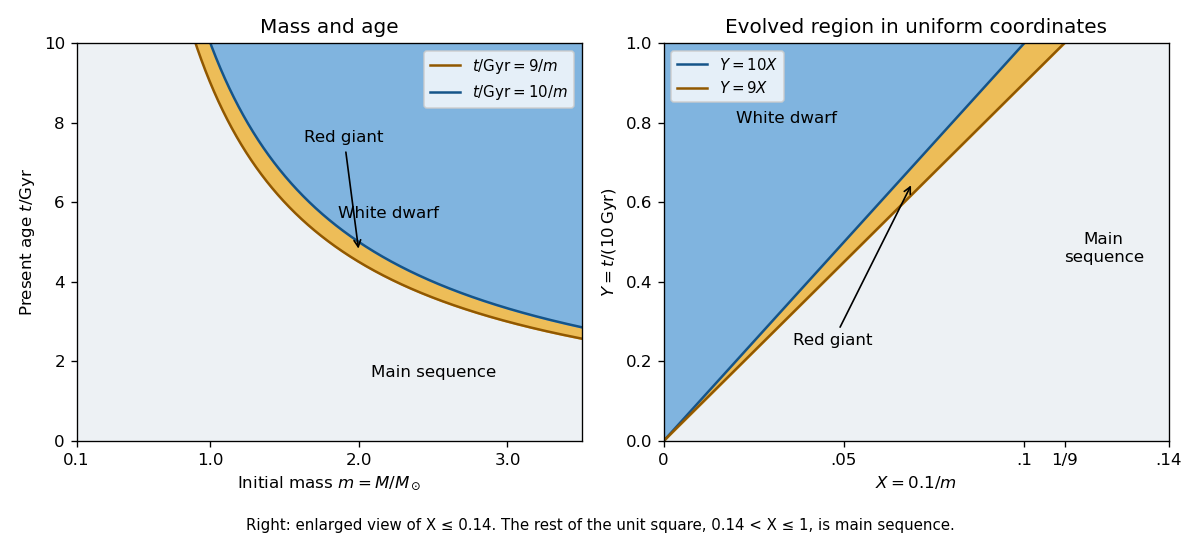

At fixed , define the conditional probabilities of a red giant, white dwarf and main sequence star by , and . Their interval widths areIntegration over the uniform distribution of age gives the individual-star fractionsThe systems form a coeval binary population: the two binary star components have the same age. Their masses are independent, so has uniform probability density function on and their states have conditional independence given . Unconditional independence of their states would be incorrect: older systems make both evolved states more likely. The law of total probability now givesThe subtraction removes the double counting of systems containing two red giants.
Use conditional independence at the common age . A system with a red giant and a second evolved component is either a pair of red giants, with conditional probability , or a red giant and a white dwarf, with conditional probability . The factor two counts which component is the white dwarf; a pair of red giants is counted only once. Since , the unconditional probability of this event isThis event is contained in the event of at least one red giant. Therefore the requested conditional probability, among systems selected for containing a red giant, isIn particular the denominator is a fraction of systems, not the individual-star fraction .
The common-age conditional probabilities giveHere includes both possible component orders. Hence the binary star fractions have the concise ratioAs a check on the role of shared age, rather than . This is covariance induced by a shared latent variable: the red giant indicator random variables have covariance equal to the variance of , namely .
For a starburst galaxy with age , put . There is no age averaging. The component masses remain independent, so the fraction of systems with two red giants isThe last comparison is ambiguous in the printed question. Literally, the fraction of individual red giants in the first galaxy is . Since , no allowed starburst age satisfies that literal comparison. If the intended comparison is instead between systems containing two red giants in the two galaxies, compare with ; the answer isFor completeness, the individual red giant fraction in the burst is , which exceeds precisely for . This is a third, different comparison; it does not change the computed fraction of two-giant systems.
Articles by others on the same topic
There are currently no matching articles.