For this stellar population, let denote initial mass in units of the solar mass, and let denote present stellar age. Constant formation of equal numbers of stars per unit time makes the stellar age a uniform distribution on Gyr, so is uniform on . The normalized initial mass function has probability density function for , since . ConsequentlyThese formulae have the stated age and mass domains; outside them the relevant cumulative fractions saturate at zero or one. The probability integral transform makes uniform on : gives . The time-independent initial mass function and constant number formation rate give independence of and . All fractions here count objects, including white dwarfs, using the stipulated stellar evolution law.
A red giant hasThus the mass boundaries are and for positive . Equivalently, for the red giant region runs from to the age cap , and for it runs from to . There are no red giants with . Boundaries have zero probability and their endpoint convention does not affect the fractions. In the uniform square the red giant region is , with triangle vertices , and . The white dwarf region is the triangle .
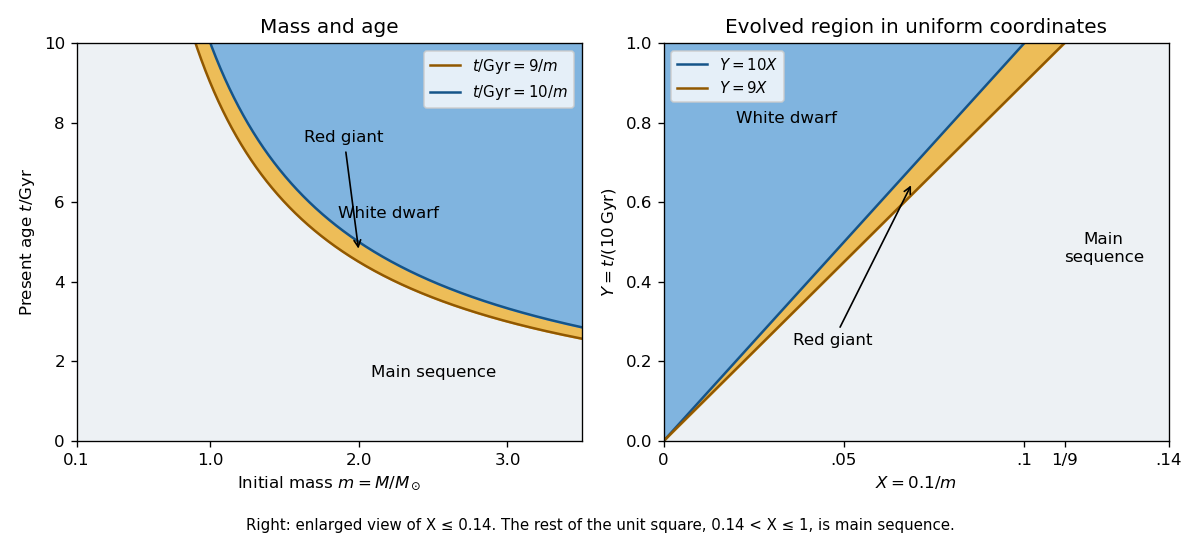

At fixed , define the conditional probabilities of a red giant, white dwarf and main sequence star by , and . Their interval widths areIntegration over the uniform distribution of age gives the individual-star fractionsThe systems form a coeval binary population: the two binary star components have the same age. Their masses are independent, so has uniform probability density function on and their states have conditional independence given . Unconditional independence of their states would be incorrect: older systems make both evolved states more likely. The law of total probability now givesThe subtraction removes the double counting of systems containing two red giants.
Use conditional independence at the common age . A system with a red giant and a second evolved component is either a pair of red giants, with conditional probability , or a red giant and a white dwarf, with conditional probability . The factor two counts which component is the white dwarf; a pair of red giants is counted only once. Since , the unconditional probability of this event isThis event is contained in the event of at least one red giant. Therefore the requested conditional probability, among systems selected for containing a red giant, isIn particular the denominator is a fraction of systems, not the individual-star fraction .
The common-age conditional probabilities giveHere includes both possible component orders. Hence the binary star fractions have the concise ratioAs a check on the role of shared age, rather than . This is covariance induced by a shared latent variable: the red giant indicator random variables have covariance equal to the variance of , namely .
For a starburst galaxy with age , put . There is no age averaging. The component masses remain independent, so the fraction of systems with two red giants isThe last comparison is ambiguous in the printed question. Literally, the fraction of individual red giants in the first galaxy is . Since , no allowed starburst age satisfies that literal comparison. If the intended comparison is instead between systems containing two red giants in the two galaxies, compare with ; the answer isFor completeness, the individual red giant fraction in the burst is , which exceeds precisely for . This is a third, different comparison; it does not change the computed fraction of two-giant systems.
For Roche-lobe overflow in the stipulated stellar thermal equilibrium, . Using the mass-radius relation and Kepler's third law,The total mass cancels, givingHere is the solar radius. This is the Roche-lobe-filling period-density relation specialized to .
Neglecting spin, the angular momentum of a circular orbit is . Between classical novae the transfer conserves total mass, so and . Its logarithmic derivative givesIn particular, for conservation of angular momentum,The source PDF has here; the TeX's is a transcription defect. For , the Roche-lobe radius response exponent exceeds the equilibrium stellar radius response exponent . Since , the Roche lobe then shrinks faster than the donor star; the overfill increases and drives more transfer, giving positive feedback. Equality at is marginal in this linear response test.
Two qualifications matter. First, is a formal extrapolation outside the stated range, and the supplied Roche lobe approximation need not remain accurate there. Second, true dynamical stability of binary mass transfer compares with the adiabatic stellar radius response exponent , not . The stellar thermal equilibrium argument supplies the displayed feedback threshold under the imposed radius law, rather than a necessary and sufficient physical dynamical threshold. For example, the polytropic mass-radius relation for a fully convective adiabatic stellar polytrope with index gives ; within this same Roche lobe approximation its dynamical threshold is . Thus by itself does not guarantee dynamical stability.
Gravitational-wave emission from a binary system removes orbital energy and angular momentum. Magnetic braking of a binary star provides another important loss: a magnetized stellar wind carries away donor spin, while tidal locking couples that spin to the orbit. Tides alone redistribute angular momentum and are not an external sink. Matter expelled from the system can also carry orbital angular momentum, although appreciable continuous mass loss would require nonconservative modifications of the preceding equations. Setting gives the binary mass-transfer contact equationFor , a negative external therefore sustains negative along the stipulated stellar thermal equilibrium contact sequence, provided the system is otherwise stable and can remain thermally relaxed.
During the classical nova, the ejecta carry the white dwarf's specific angular momentum, not zero angular momentum. With and the accretor's distance from the centre of mass , isotropic escape givesThe slow ejection relative to the orbital period permits the adiabatic circular orbit approximation; the donor star does not transfer appreciable additional mass during it. Take , and . Differentiating givesSince , this yieldsThese are first-order formulae with errors of order . The orbital widening agrees with Jeans-mode mass loss. The donor star's radius is unchanged to this order by the assumed ejection, so its Roche lobe expands away from it, causing nova-induced binary detachment. This idealization neglects changes in the donor from irradiation or interaction with ejecta; those are not supplied in the model.
Let be the fixed external loss rate. During the detached binary phase both component masses are fixed, and . Closing the fractional gap takesIn the subsequent semidetached binary, the binary mass-transfer contact equation gives . Accumulating a fresh layer of mass therefore takesThroughout these first-order estimates can be evaluated at the start of the cycle: their fractional changes during it are of order . The limit is excluded, since no finite reconnection time follows without an external shrinkage mechanism.
Set , and , the reduced mass. Newton's law of universal gravitation gives and . Subtraction establishesFor fixed masses, the orbital energy and angular momentum areTaking derivatives gives and . These are conservation of energy and conservation of angular momentum in the unperturbed Kepler orbit. To see directly that the orbital eccentricity is fixed, put and . The eccentricity vector isSince , the cross product identity gives , so . Its magnitude is the orbital eccentricity. Equivalently,Thus the semi-major axis and orbital eccentricity of a bound noncollision Kepler orbit are constant, including .
Take the centre of mass as origin. The two positions are and . For , a Taylor expansion givesThe mass dipole vanishes because , and the second mass moment tensor is . The gravitational quadrupole potential of a point-mass binary is consequentlyBoth printed tensors are trace-free. Contracting them with the Kronecker delta summed over three spatial dimensions givesThis proves the requested expression through second order. In particular the printed convention is , where is the standard mass quadrupole moment; the radiation coefficient must be adjusted accordingly. No mass dipole term may be retained in centre of mass coordinates.
To evaluate the quadrupole formula without assuming a circular orbit, put , and . Differentiating the gravitational acceleration gives the kinematic jerkFor , the product rule then givesInserting these into the printed mass quadrupole moment convention yieldsThe two tensors in brackets are orthogonal in their tensor contraction, because . Their squared norms are and , respectively. HenceThe instantaneous quadrupole luminosity of a Kepler binary is thereforeThe radial derivative is not the vector speed. The bracket equals , so the radiated luminosity is nonnegative for every instantaneous velocity.
For a slowly evolving circular orbit, there is no preferred orbital phase at which to excite a persistent eccentricity vector. More precisely, the rotating mass quadrupole moment emits at twice the orbital frequency, with angular harmonic number two; its gravitational-wave energy and angular-momentum balance is . The circular Kepler orbit sequence has and , so this loss is tangent to the sequence. At leading adiabatic order it preserves zero secular orbital eccentricity. This is a circular gravitational-wave inspiral, with a small radial drift rather than an exactly fixed-radius Newtonian circle. The energy flux alone would not establish circularity without this symmetry and angular momentum balance.
To leading radiation order use , and in the loss formula. Combining it with givesKeeping the fixed masses and leading quadrupole formula, integration givesThis formal coalescence time displays the strong dependence: gravitational-wave emission from a binary system matters far more for close binary stars than for wide ones. The orbital period decreases as and the gravitational-wave frequency increases, producing a chirp. A detached binary can be driven into Roche-lobe overflow; further evolution then depends on mass-transfer stability. A sufficiently close compact pair may merge. The weak-field, slow-motion, point-mass approximation ceases to apply before literal ; finite stellar radii or strong relativistic effects determine the final interaction.
Articles by others on the same topic
There are currently no matching articles.