For distinct eigenvalues, the formula holds for . If the lower-left entry of is , multiplication by gives . This proves by mathematical induction thatSumming the absolutely convergent matrix exponential series givesFor the repeated eigenvalue , the continuous limit is . This is also the exponential of a two-dimensional Jordan block.
Termwise differentiation of the matrix exponential gives and . Thus satisfies and the prescribed initial condition. Uniqueness for a linear differential equation makes it the solution.
For real , computeThus is a non-normal matrix. For distinct eigenvalues, takeThese satisfy but have inner product . The eigenvectors are therefore nonorthogonal. When the eigenvalues coincide, only the direction remains as an eigenvector; is a defective Jordan block.
Differentiate the quadratic energy:For , put . Immediate energy growth occurs precisely when . With both eigenvalues negative, such directions exist iff . Writing , the growing initial conditions are the two opposite open wedgesIf , energy decreases. No energy growth at any time, for any initial condition, is possible exactly whenIndeed, this makes the symmetric part of a matrix a negative semidefinite matrix, so along every trajectory. If the product is smaller, the wedges already supply counterexamples at . This is the instantaneous energy-growth criterion for a linear system.
At each fixed time, the maximum over nonzero initial conditions is the optimal energy amplification of a linear system:Write , and . The symmetric matrix has trace and determinant . Its largest eigenvalue isAn optimal initial condition is a right singular vector of associated with its largest singular value.
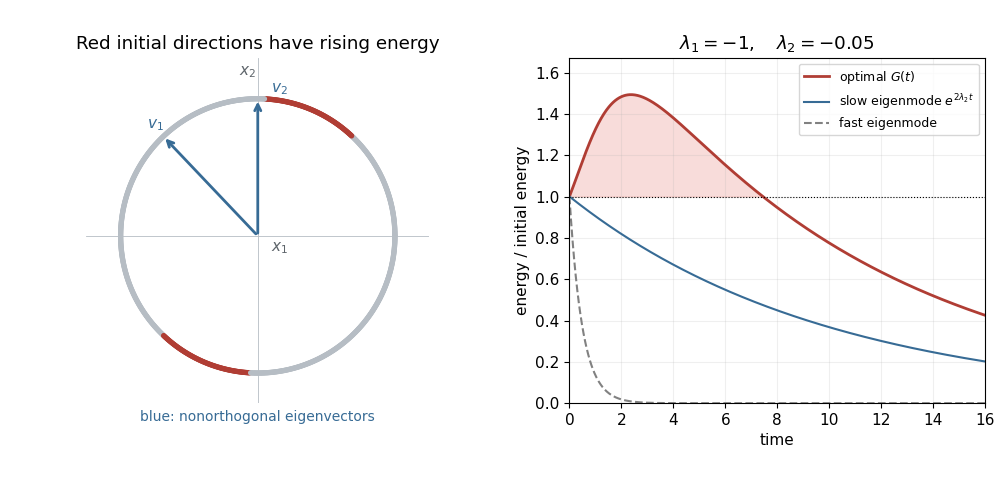
Stable eigenmodes can combine to produce transient energy growth
. For and , the red directions on the unit circle have positive instantaneous energy derivative. The eigenvectors are nonorthogonal. The right panel compares the optimal energy amplification of a linear system with the monotonically decaying energy of each eigenmode. Details.
If , let . Then , so the precise long-time asymptotic statement isThe Cauchy-Schwarz inequality shows that the unit initial conditions achieving this leading factor areThis is an adjoint eigenvector, since . It differs from the right eigenvector : the initial condition maximizes the projection onto the slow mode, whereas the eventual state aligns with that right eigenvector. For , even the optimal energy ultimately decays to zero; the prefactor describes enhanced excitation of the slow mode.
Articles by others on the same topic
There are currently no matching articles.