Write , , , and let be the first fundamental form. Sincedifferentiating and , or equivalently taking the two inner products of the second formula with , givesThe matrix is invertible because is a regular embedded surface parametrization. Consequently the two geodesic equations hold exactly when is orthogonal to both tangent vectors and , which says precisely that is a normal vector. This is the ambient acceleration criterion for a surface geodesic.
Because is tangent and is normal,Thus an affinely parametrized geodesic has constant speed, as recorded by constant speed of an affinely parametrized geodesic.
For a surface of revolution, use profile arc length and azimuth . Its Riemannian metric isThe azimuth is an ignorable coordinate, so the corresponding geodesic equation has the first integralIf and is the oriented angle with the parallel, then the component of velocity along the parallel isSince is constant,This is the Clairaut first integral for a surface of revolution.
Take the parallel at height one,It has constant speed . Its distance from the axis is the constant , and its tangent is parallel to the parallel, so and it satisfies the Clairaut first integral for a surface of revolution.
However,whereas a normal vector to at isThese vectors are not parallel. By the ambient acceleration criterion for a surface geodesic, is not a geodesic. Thus constant speed together with Clairaut's relation is not sufficient for the geodesic equations.
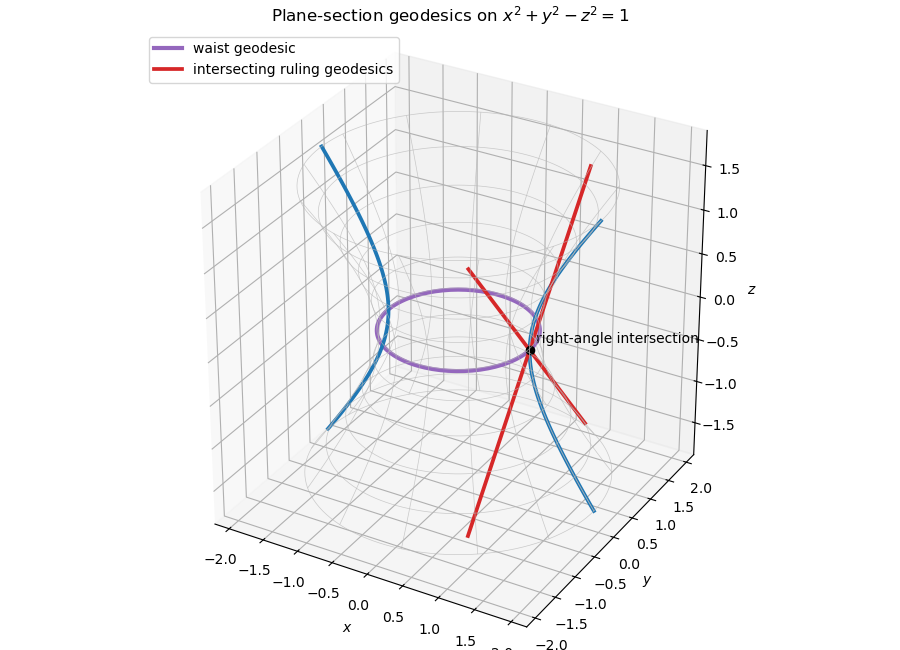
The planemeets the one-sheet hyperboloid in the two disjoint curvesThey are the two opposite meridians of the surface of revolution. Parametrize the generating profile by arc length. Its acceleration lies in the meridian plane and is orthogonal to the profile tangent; it is also orthogonal to the azimuthal tangent. It is therefore normal to the surface, so both meridians are geodesics. This is the disjoint case in plane-section geodesics of the unit one-sheet hyperboloid.
The tangent planecuts the hyperboloid inso its intersection is the pair of straight linesTheir accelerations vanish, hence are normal to the surface, so both lines are geodesics. Their tangent vectors at their intersection are and , whose inner product is zero. They therefore intersect at a right angle, giving the second case of plane-section geodesics of the unit one-sheet hyperboloid.
There are also geodesics entirely contained in . In the coordinatesthe metric isFor a unit-speed geodesic, the Clairaut first integral for a surface of revolution is , and the constant-speed equation becomesChoose and initial height . The geodesic initially tangent to the parallel has , and the displayed identity prevents it from entering . Since the parallel at is not itself a geodesic, the curve turns there and otherwise has . Hence it remains entirely in ; this is a geodesic trapped in one half of the unit one-sheet hyperboloid.
Finally, the waistis a geodesic and is preserved setwise by every isometry of the hyperboloid. Indeed, its Gaussian curvature isThe value occurs exactly at . Since Gaussian curvature is intrinsic and therefore preserved by isometries, every isometry preserves the waist. Thus the answer to the final question is also yes, with the isometry-invariant waist geodesic of the unit one-sheet hyperboloid as an example.
Articles by others on the same topic
There are currently no matching articles.