By Newton's second law, the central force obeysDifferentiating the cross product givessince the acceleration is parallel to . Hence is constant. Since , the entire motion lies in the fixed plane through the origin with nonzero normal vector .
Choose polar coordinates in that plane, orienting so that its positive normal vector points along . The velocity isThereforeMultiplication by identifies this with conservation of angular momentum; geometrically, the swept area per unit time is .
Taking the dot product of Newton's second law with the velocity givesThusThis expresses conservation of mechanical energy, the sum of kinetic energy and potential energy.
Finally, for and a prime denoting a derivative with respect to , the chain rule givesSubstitution into the conserved energy yields
The initial transverse velocity gives . The initial mechanical energy isSince and , the terms cancel in the conserved energy equation:The initial radial velocity fixes the sign, because gives . The continuous derivative cannot change sign while its square remains . As , this givesThe future orbit is a hyperbolic spiral: it starts at , turns counterclockwise and winds indefinitely towards the origin. Its radial distance decreases on every turn. The positive- continuation has , but only is needed after release.
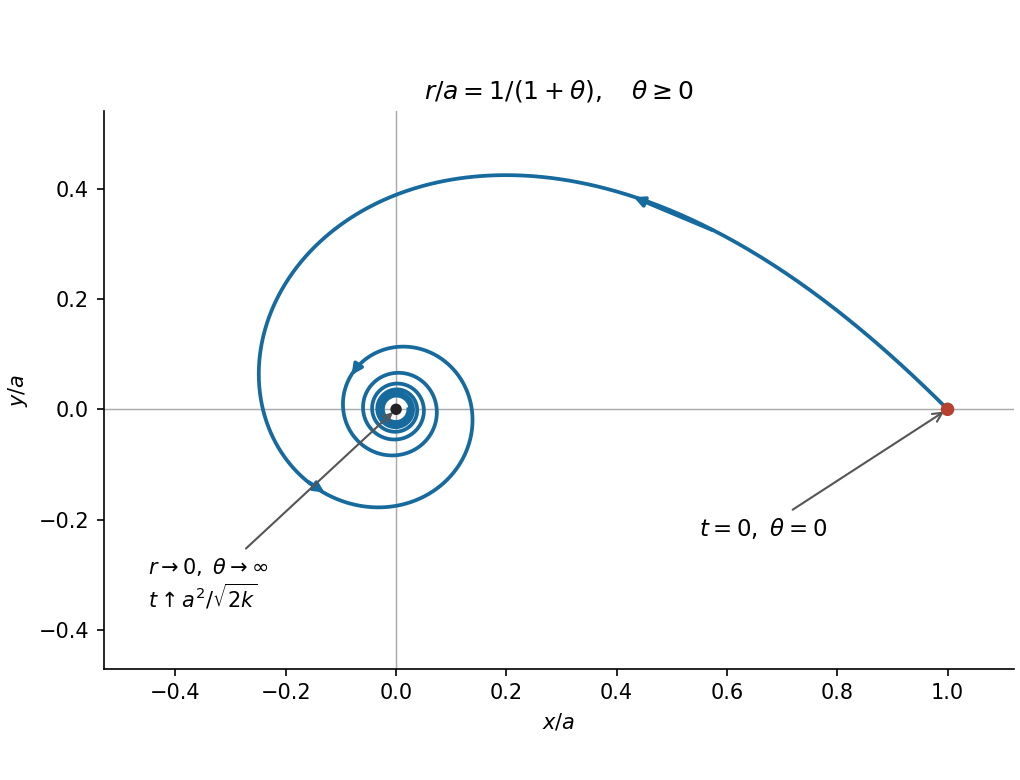

To decide whether infinitely many turns require infinite time, use the conserved angular momentum:Integrating from givesConsequentlyThe particle reaches the origin in finite time, in the sense that as . Meanwhile . The central force is undefined at the origin, so these formulas describe motion up to collision. This is finite-time collision in an inverse-cube central force.
Articles by others on the same topic
There are currently no matching articles.