LetThe vector triple product identity shows that . Moreover, exactly when is a scalar multiple of . Thus the given line isAlso , so . The assumption says precisely that is outside . Consequently and determine a unique plane, with normal vector .
To identify its equation, use cyclic invariance of the scalar triple product:For , this equals , while . Hence throughout . The point also satisfies that equation because . Since , the required plane is therefore exactlyThis also proves the reusable plane through a point and a line given by a cross product construction.
The three lines have the convenient parametric equationsFor , substitute , in the plane through a point and a line given by a cross product formula. Its normal vector is . Cyclically permuting the coordinates gives all three planes:Each normal vector is nonzero because is not on the corresponding line. Thus these are genuine planes, and each is unique.
Suppose a line through meets each . Its intersection with is different from , so lies in . A nonzero direction vector for must therefore satisfyA square matrix admitting a nonzero vector with has zero determinant. Expanding givesThus the necessary condition isThe condition is not sufficient. Take , which is on none of the three original lines. It satisfies the condition, since . The three plane equations becomeTheir common intersection is the single line . Any proposed line through meeting all three original lines would have to be this . But never meets : their second and third coordinates differ. The zero determinant guarantees a common direction for the three planes; it does not guarantee the required intersections. This is a parallel obstruction to a transversal of three skew lines.
By Newton's second law, the central force obeysDifferentiating the cross product givessince the acceleration is parallel to . Hence is constant. Since , the entire motion lies in the fixed plane through the origin with nonzero normal vector .
Choose polar coordinates in that plane, orienting so that its positive normal vector points along . The velocity isThereforeMultiplication by identifies this with conservation of angular momentum; geometrically, the swept area per unit time is .
Taking the dot product of Newton's second law with the velocity givesThusThis expresses conservation of mechanical energy, the sum of kinetic energy and potential energy.
Finally, for and a prime denoting a derivative with respect to , the chain rule givesSubstitution into the conserved energy yields
The initial transverse velocity gives . The initial mechanical energy isSince and , the terms cancel in the conserved energy equation:The initial radial velocity fixes the sign, because gives . The continuous derivative cannot change sign while its square remains . As , this givesThe future orbit is a hyperbolic spiral: it starts at , turns counterclockwise and winds indefinitely towards the origin. Its radial distance decreases on every turn. The positive- continuation has , but only is needed after release.
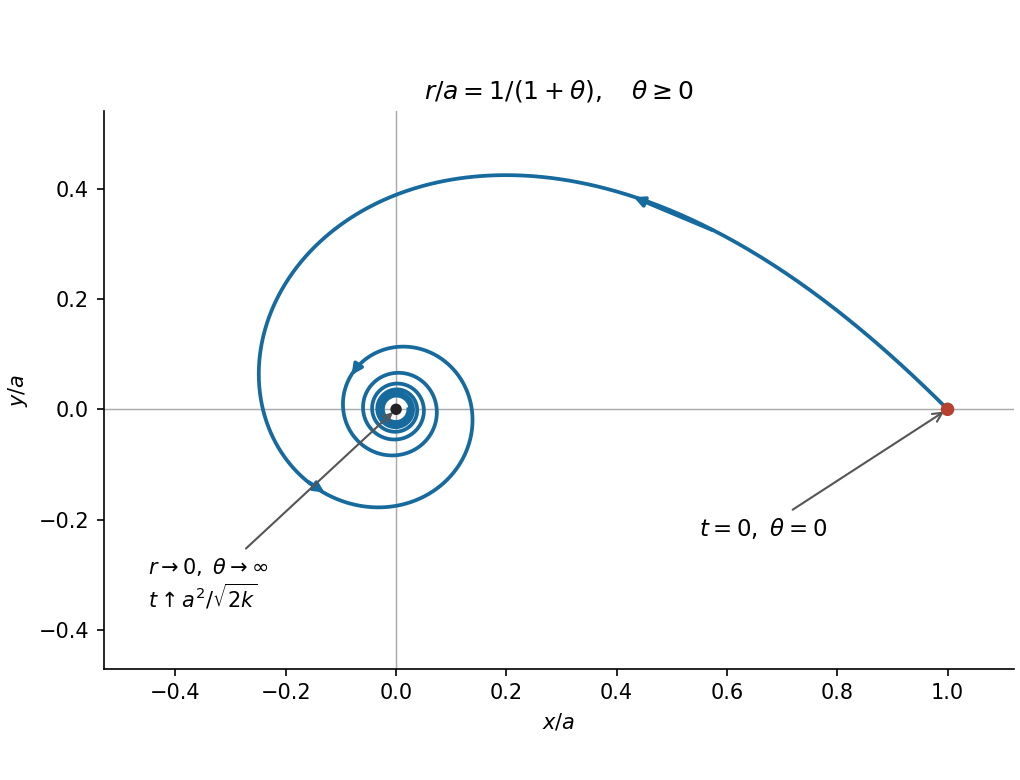
To decide whether infinitely many turns require infinite time, use the conserved angular momentum:Integrating from givesConsequentlyThe particle reaches the origin in finite time, in the sense that as . Meanwhile . The central force is undefined at the origin, so these formulas describe motion up to collision. This is finite-time collision in an inverse-cube central force.
In cylindrical coordinates,Differentiating the position vector twice gives the velocity and accelerationThis derives acceleration in cylindrical coordinates rather than assuming it.
At a fixed time, the wire has parametrization . Its derivative is the nonzero tangent vectorA smooth wire exerts a constraint force with . Because is the gravitational acceleration, the gravitational force is ; the printed is interpreted per unit mass. Projecting Newton's second law, , along eliminates :The chain rule gives . Rearrangement yieldsThis is the governing equation for a bead on a uniformly rotating wire. Its azimuthal acceleration contributes nothing to the projection because .
Here equilibrium means fixed position relative to the rotating wire: and are constant, while continues to change. Substituting into the equation givesFor the linear stability calculation, set and retain terms of first order in and . The term contributes only at second order, and variation of the factor multiplying also contributes only at second order. ThusThe two strict sign cases are treated in the following parts. If , this linearization has no restoring term and higher orders are needed to classify the equilibrium.
For the specified wire,Hence the complete set of positive equilibrium radii isAt ,Therefore odd give a stable equilibrium, and even give an unstable equilibrium. There is no degenerate sign case in this example. The corresponding heights are .
If , defineThe linearized equation is , with bounded simple harmonic motionThus the strict stable equilibrium condition isThis is also a sufficient condition for local nonlinear Lyapunov stability. Indeed the equation for the bead on a uniformly rotating wire has the conserved quantityIts derivative is times the governing equation moved to one side, so it vanishes. At , the last two terms have zero first derivative and positive second derivative . Their strict local minimum traps sufficiently small perturbations. The motion is bounded rather than asymptotically returning to rest.
If , putThe linearized equation becomes , soArbitrarily small initial perturbations can have and grow exponentially. Hence the strict unstable equilibrium condition isFor the particular wire, this occurs precisely at , ; the alternating radii satisfy the stable equilibrium condition.
Define the classical axial spin by the axial angular velocity of a symmetric top,Since is a unit vector, . The vector triple product identity applied to givesThe inertia tensor multiplies the component perpendicular to by and the component along by . Therefore the angular momentum about isIts time derivative isbecause .
The gravitational torque about is , and the applied torque is . The support force acts at , so has zero torque about . The angular momentum equation is consequently
Write . Since , the total torque simplifies toTaking the dot product of the equation of motion with gives : both torque terms are perpendicular to , as are the other terms on the left. HenceTaking the dot product of with the fixed vector givesThese are conservation of the axial spin and of the vertical component of angular momentum.
For energy, the kinetic energy and potential energy areDot the equation of motion, with , with . The cross product identity givesIt follows thatsoThe applied force is conservative even if is negative: its potential energy is . This is a symmetric top with a quadratic alignment potential.
For steady precession at rate about the fixed vertical unit vector ,Consequently and . Since the axial angular velocity of a symmetric top is constant, substitution in the equation of motion givesAs , the cross product can be cancelled. For a specified axial spin, the required value isThe corresponding total angular velocity isIf the stated angular velocity is the total angular velocity of the top, then and the requested value specializes toThis specialization permits a direct check: , whose time derivative is , exactly the required torque. The first formula keeps the separate axial spin explicit when is understood as the rate of precession.
If has rows and columns, attach a nonnegative dual variable to each of the upper-bound constraints. The dual linear program isHere is the transpose of , and all vector inequalities hold componentwise. Nonnegative dual variables preserve the direction of the original inequalities when taking weighted sums.
For feasible solutions , nonnegativity givesThe first inequality uses and ; the second uses and . This is weak duality.
For every primal feasible solution , weak duality givesThus no primal feasible solution improves on . Similarly, for every dual feasible solution ,Therefore both candidates are optimal, with the same objective function value. Equality is a linear programming optimality certificate and does not require a separate existence argument.
The complementary slackness conditions areTo see their role, decompose the duality gap asEvery summand is nonnegative for feasible solutions, so the gap is zero exactly when every displayed product vanishes. Zero gap implies optimality by weak duality. Conversely, strong duality states that primal and dual optima, when both are attained, have equal values, and hence satisfy these conditions.
There are two primal inequalities, so there are two nonnegative dual variables. The five primal variables yield five dual inequalities:Each coefficient column of the primal linear program becomes one row of this dual linear program.
The inequality , together with , impliesAlso impliesThus both inequalities are strictly slack throughout the feasible region. They are redundant: the remaining inequalities imply them, even with strict inequality. By complementary slackness, any primal optimum must therefore have ; this is the principle that strictly slack dual constraints force zero primal variables.
After removing the two redundant inequalities, the feasible region isIts lower boundary consists of three line segments or rays: for , then for , then for . The feasible region is everything on or above this boundary in the first quadrant.
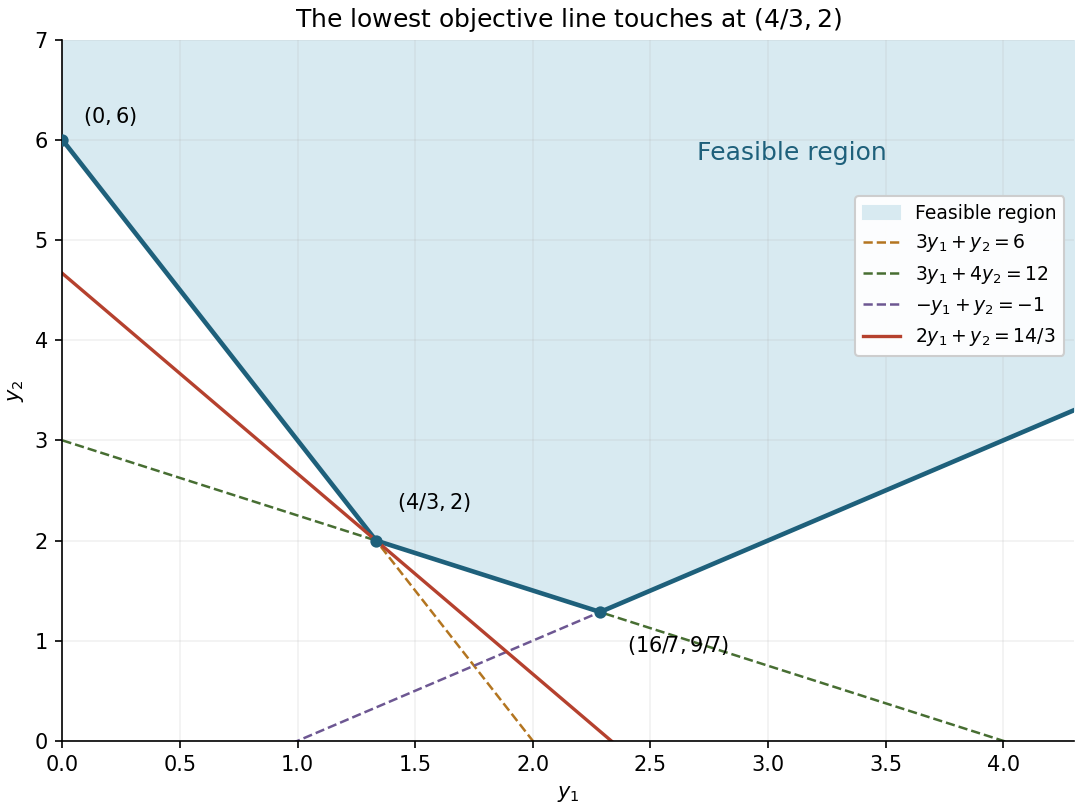


The boundary extreme points areAlong its three successive pieces, the objective function has respective slopes , and as increases. Thus it decreases to the middle extreme point and increases thereafter. For fixed , moving above the boundary only increases the objective function. HenceAs an algebraic check of the graphical answer, the active inequalities givewith equality at the stated extreme point.
At , the first three dual left sides are , and , strictly above their bounds , and . Thus complementary slackness forces . Both dual variables are positive, so both primal inequalities are equalities:Solving this linear system givesAll components are nonnegative, the two original upper bounds are met exactly, and the objective function equals the dual value. The weak duality bound therefore certifies optimality. The forced zero components and unique solution of the two remaining equalities also prove that the primal optimum is unique.
The divisions in the Euclidean algorithm areThe last nonzero remainder is , soAs a check, and ; back-substitution also gives .
At any division step , an integer divides both exactly when it divides both : one direction uses , and the other uses . HenceStarting with , , the Euclidean division producesThe nonzero remainders form a strictly decreasing sequence of positive integers. Such a sequence must terminate, since there are only finitely many positive integers below . Suppose is the last nonzero remainder, so . The unchanged greatest common divisor at each step givesThe final equality holds because the positive common divisors of and are precisely the positive divisors of . This proves both termination and correctness of the Euclidean algorithm.
Apply the Euclidean algorithm to and :Back-substitution gives the Bézout's identityThus is one solution of the Diophantine equation. Subtracting this solution from any other givesSince and are coprime, divides . To justify that step directly, multiply by : both terms on the right are divisible by , because . Write ; substitution then gives . Therefore the complete solution set isEvery such pair satisfies the original Diophantine equation, since the terms cancel.
First recall why the two-variable Bézout's identity follows from the Euclidean algorithm. The initial values are integer linear combinations of . At every subsequent step, is again an integer linear combination of . Therefore the last nonzero remainder, which is their greatest common divisor, has that form.
Put . The preceding argument supplies integers with . Applying the same argument to gives integers such thatAn integer divides exactly when it divides : if it divides , it divides , while itself divides both . Hence . Substituting the expression for provesThusare integers satisfying . This also explains how to construct the coefficients using two applications of the Euclidean algorithm.
For , we have . Taking the nonnegative square root givesThe derivative issoIn particular, the mean value theorem makes a contraction mapping on this interval.
Set . This function is continuous on . Since takes values in ,The intermediate value theorem therefore supplies with , equivalently . This includes the possibility that one endpoint is already a fixed point.
For uniqueness, the mean value theorem gives, for any ,If both and are fixed points, thenSince , this forces . Thus there exists exactly one fixed point. When , the conclusion follows immediately from ; otherwise the argument above applies. The contraction mapping estimate also proves convergence of the associated fixed-point iteration, as used next.
The fixed-point iteration stays inside because maps that interval to itself. A fixed point satisfies , so andOnly is admissible; fails the unsquared equation. With , the mean value theorem gives the error boundInduction yields , since . Therefore, for every allowed starting value,This estimate proves convergence directly, without assuming in advance that the sequence has a limit.
For Newton's method for nonlinear systems, solve and set . The Jacobian matrix here isAt ,The correction linear system is , . Hence , , and one iteration givesAt the alternative starting value ,This Jacobian matrix is a singular matrix: its first row is twice its second. In fact the correction equations would bewhich are inconsistent, since twice the second left side equals the first while twice its right side is , rather than . Thus Newton's iteration cannot take its first step from . This is failure of the correction linear system, not merely nonuniqueness of a possible correction.
Articles by others on the same topic
There are currently no matching articles.