The spectral theorem for a real symmetric matrix gives real eigenvalues and an orthonormal eigenbasis. Compute the roots of , find a basis for each eigenspace, and orthonormalize within any repeated-eigenvalue eigenspace. Eigenvectors belonging to distinct eigenvalues are already orthogonal: if and , symmetry gives .
Putting the normalized basis vectors in the columns of an orthogonal matrix yieldsFor repeated eigenvalues, the choice of axes inside their eigenspace is not unique.
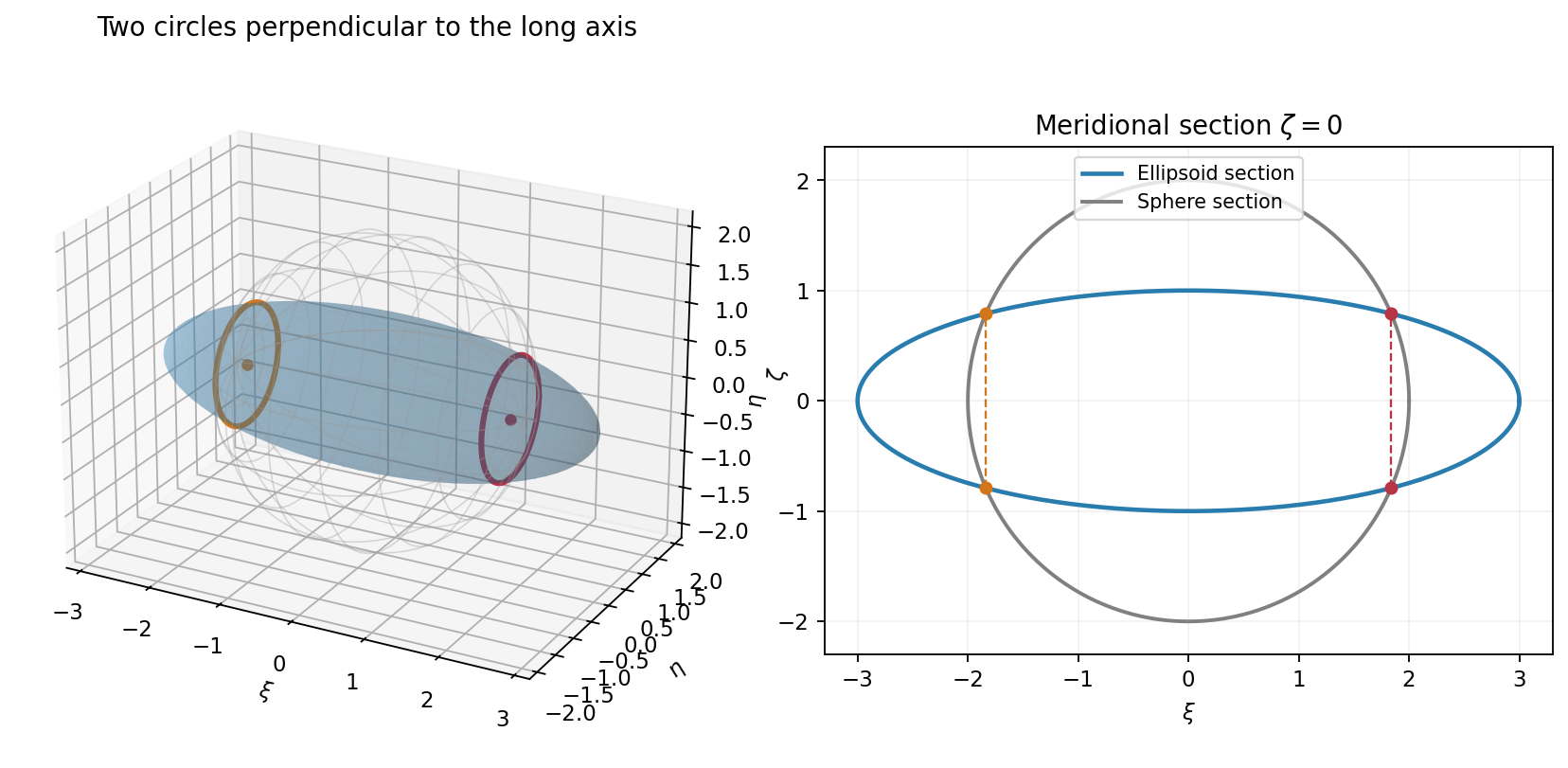
The quadratic-form matrix has eigenvectorswith eigenvalues . In the principal axes coordinates , and , the equation becomesIt is a prolate spheroid, centred at the origin, with semiaxis three along and one in every perpendicular direction. The displayed are one choice of short principal axes.
The sphere has equation . Combining it with the ellipsoid equation givesThe intersection of a prolate spheroid and a concentric sphere therefore consists of two circles in planes perpendicular to . Each has radius , and their centres areTheir plane equations in the original coordinates are .

Minimize or maximize subject to . A Lagrange multiplier givesThe constraint excludes and implies , so it is a regular constraint surface. Multiplying the stationarity equation by gives . Thus the distance extrema on a real quadratic surface satisfyEvery constrained extremum lies in a positive-eigenvalue eigenspace, with squared distance . If is positive definite, the global minimum is and the global maximum is . For an indefinite or singular form the surface need not be bounded; eigenvector directions give stationary candidates, which may be saddles and need not supply both global extrema. With a repeated positive eigenvalue, there can be an entire family of equally distant stationary points.
Articles by others on the same topic
There are currently no matching articles.