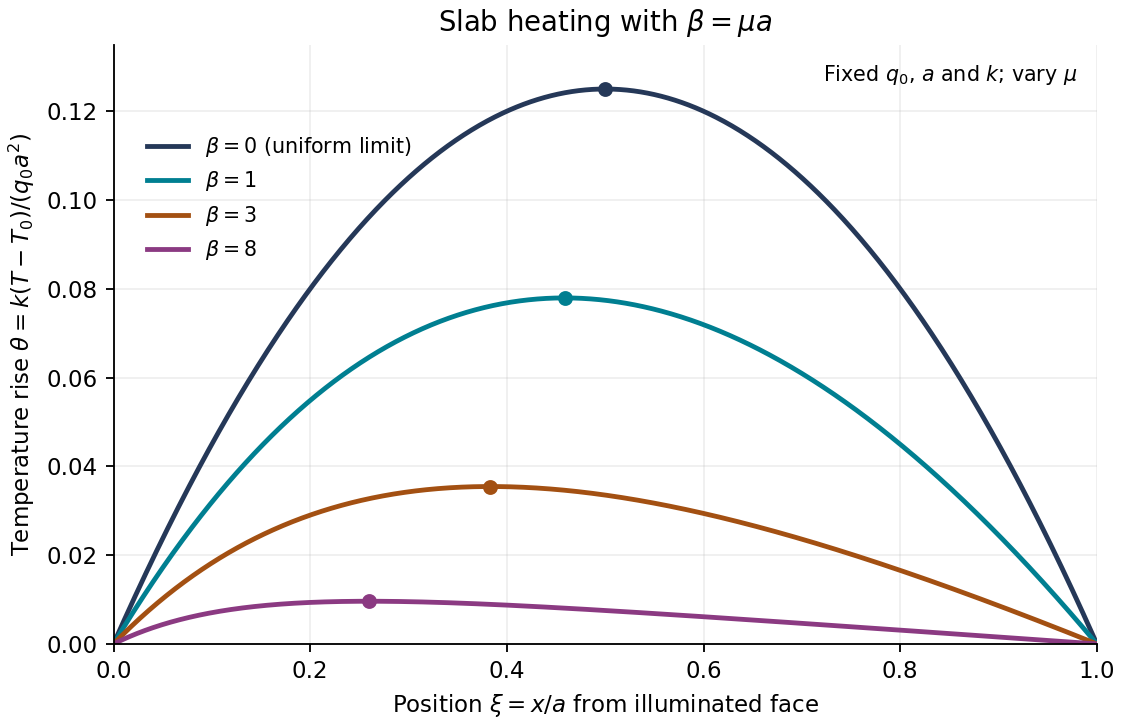
The graph holds the normalization q0a2/k fixed. Its decreasing peaks with increasing β reflect a decreasing source away from the illuminated face under that comparison; they do not assert the same trend at fixed total absorbed power.
The illuminated face removes more heat because heating is concentrated nearer it. Equivalently, weighting each source slice by the fraction of its heat conducted to either equal-temperature boundary gives
A decreasing source weights the left face more strongly. In the uniform-heating limit, each face removes q0a/2. If aheat removal rate rather than aflux is wanted, multiply the relevant expression by the face area.
Reduce incident photon intensity, intercept part of the beam in a separately cooled upstream shield, or distribute the deposited power over a larger cooled region. These reduce the relevant volumetric heat generation rate or local heat load. Intermittent exposure can reduce average heating, but the peak then requires a transient heat equationcalculation; a smaller average alone does not establish a safe pulse maximum.
Increase the effective thermal conductivity, for example through a suitable material or a well-bonded conductive path to aheat sink. Reduce contact thermal resistance in any added path. Material substitution must also satisfy shielding, mechanical and environmental constraints.
Shorten the maximum conduction distance by introducing cooled internal surfaces or dividing the shield into thinner, separately cooled layers. Reducing the thickness of a single slab lowers its temperature rise at fixed q0 and μ, but also reduces attenuation; it is not automatically an acceptable shield modification. A layered arrangement can preserve the required total shielding while changing the thermal boundary-value problem.
Do not change the attenuation coefficient independently of the heat-source normalization without explaining the comparison. At fixed incident photon energyflux, the entrance deposition q0 generally changes with absorption properties. A larger μ with artificially fixed q0 is a different experiment. Similarly, increasing total slab heat capacity delays heating but does not lower the steady state maximum for an unchanged source and unchanged thermal boundary conditions.
Use a common comparison for all of question2: retain the same number and height of fuel rods and approximately the same normalized rod-powershape; reduce fuel lattice pitch by making the active core cross-section smaller. Compare otherwise similar operating states of an initially under-moderated reactor, typical of a pressurized water reactor. Rod number, core height, reflector and control settings are not all fixed explicitly by the question, so these are stated assumptions. Keeping the external core envelope fixed while inserting more rods would be a different comparison.
Neutron leakage would usually tend to increase. The smaller transverse core extent increases the geometric tendency to leak, and reduced moderation generally increases the slowing-down distance. There are competing changes in fuel absorption, transport lengths and reflection. Thus a definite leakage fraction needs the actual core and reflectorarrangement; the usual increase is a qualitative tendency, not a geometric theorem for every redesign.
Continue the same-rod-number and same-height comparison from part(a), and assume unchanged pumpspeed, similar inlet conditions and single-phase forced flow for the normal-operation hydraulic argument.
The core pressure drop normally increases for the usual pumpcurve. Its resistance at any given flow is higher. At the new, smaller flow, unchanged external piping and component losses are smaller, whereas a conventional falling pump head-versus-flowcurve gives greater available head. The core takes the difference. This conclusionuses the stated pump-curve assumptions; holding flow fixed or holding pump head fixed would be different models. The exact new flow and pressure drop need both system and pump characteristics.
Fuel temperature would normally tend to rise, especially downstream, if the loss of flow increases coolant heating without a compensating improvement in filmheat transfer. At fixed inlet state,
A tighter core is likely to have a more demanding cooling response, but the specification does not determine a unique peak cladding temperature or reflood time in a loss-of-coolant accident. Several effects compete.
At the same pre-accident power and comparable irradiationhistory, the total decay heat source remains of broadly comparable scale; increasing core power density does not multiply the total decay power by the inverse change in core volume. The core nevertheless has less water within its tighter rod lattice. Its local thermal buffer is smaller, and the same heat must be removed through narrower passages. If the normal-operation fuel temperature is higher, more stored fuel thermal energy must also be removed after shutdown.
Reduced passage size and increased hydraulic resistance can impede emergency-coolant penetration and steam discharge during reflood. Local two-phase flow, entrainment and boilingheat transfer can change, so single-phase pump-curve reasoning is insufficient during blowdown and reflood. Less local water can favor earlier uncovering, but blowdown flow and the much larger inventory elsewhere in the unchanged primary circuit also matter. It would be unjustified to infer a proportionate reduction in the entire primary-circuit inventory.
A quantitative comparison needs break characteristics, initial states, emergency injection performance, bypass paths and a transient two-phase calculation. The defensible conclusion is potentially reduced thermal margin and more difficult reflood, requiring reassessment of the emergency core cooling system, rather than an unconditional prediction that every large-break transient becomes worse in every metric.
Higher conversion can support greater discharge burnup and a longer nuclear fuel cycle length, but neither follows automatically. The improvement tends to slow the loss of useful fissile inventory during irradiation. The same change of lattice, however, lowers beginning-of-cycle reactor reactivity under the usual under-moderated assumptions. With enrichment unchanged, the available initial reactivity margin may become inadequate before any later benefit from improved conversion can be realized.
For a constant-powerirradiation interval t, B=Pt/MHM. A longer achievable interval would consequently increase the burnup accumulated in that interval. This relation alone says nothing about whether that interval remains possible.
If sufficient initial reactor reactivity, shutdown capability and thermal margins are retained, slower depletion can allow increased discharge burnup and a longer cycle. If initial reactivity is too low, or the reduced boiling margin or fuel limits become controlling, either can instead decrease. Discharge burnup also depends on batch residence and refuelling strategy, so it is not generally identical to burnup accumulated in one operating cycle.
The appropriate qualitative answer is therefore conversion tends upward; achievable discharge burnup and cycle length are conditional on the full reactivity history and operating limits. An increased conversion ratio by itself does not determine a longer cycle.