A linear spline is a continuous function whose restriction to every interval is a polynomial of polynomial degree at most one. With and , linear interpolation givesIntegrating the two linear polynomials and adding the contributions givesThis is the composite trapezoidal rule applied to the nodal values, and it is exact for the linear spline itself, including nonuniform spline knots.
A cubic spline on this partition of an interval is a function that restricts to a polynomial of polynomial degree at most three on every interval . Thus its second derivative is continuous and piecewise of polynomial degree at most one: is a linear spline on the same spline knots. Its third derivative is constant on each open interval and can jump across the spline knots; its fourth derivative vanishes inside each open interval.
Put . Matching interpolation data and endpoint derivatives givesThe endpoint slope constraints make a clamped cubic spline. The decisive step in its minimum roughness property of a clamped cubic spline is the orthogonality identityProve it separately on each interval. Two applications of integration by parts, using the vanishing fourth derivative of the cubic piece, giveThe second boundary term is zero because vanishes at both endpoints of this interval. Sum over . At each interior spline knot, the two values of agree because both factors are continuous, so the contributions cancel. The remaining outer boundary terms vanish because is zero at both outer endpoints. This proves the identity.
Expanding the square now gives the stronger exact equalityThe last integral is nonnegative, proving the required inequality. It measures the excess second derivative roughness penalty of over .
The argument applies directly to twice continuously differentiable competitors. More generally it holds when is an absolutely continuous function and is square-integrable, the usual finite-energy class for this second derivative roughness penalty. Mere existence of pointwise second derivatives does not by itself guarantee that all displayed integrals exist; the variational statement is understood for admissible competitors with this regularity.
Let be a second cubic spline matching the same values and endpoint derivatives. The minimum roughness property of a clamped cubic spline applied with as the minimizing cubic spline gives , where . Applying the same argument with their roles exchanged gives . Hence equality holds, and the exact identity from part (i) yieldsThe integrand is continuous and nonnegative. If it were positive somewhere, it would have a positive integral over a small interval. It follows that everywhere. Consequently is an affine function. Its value and derivative vanish at , so it is identically zero. Thus , proving uniqueness of the clamped cubic spline with the prescribed data. Existence was assumed in the question; this argument establishes the remaining uniqueness claim.
Fix , write , , and let on this interval. The Hermite interpolation conditions give bothTwo applications of integration by parts therefore giveOn this single cubic piece, the same calculation also givesHere inside the interval, and all four endpoint values of are zero. Since , we obtain the exact identityThis is an integral inequality, with no assertion that the integrand on the left has one sign pointwise. The stronger nodal derivative conditions make the boundary terms vanish on each interval separately; part (i) only needed their cancellation after summing.
The stated Hermite interpolating polynomial exists uniquely in . Indeed, a polynomial in the kernel of a linear map of the value-and-derivative data map has a double root of a polynomial at each of distinct interpolation nodes. A nonzero such polynomial would have polynomial degree at least , which is impossible. The map is therefore an injective function and a linear map between vector spaces of the same finite dimension of a vector space, , and hence is a linear isomorphism. No higher smoothness of the original function is required to construct it.
An explicit illustration uses interpolation nodes , values , and zero derivatives at every interpolation node. The clamped cubic spline is on and its reflection on . Its Hermite interpolating polynomial is the quartic polynomial . On , , and the corresponding reflected formula holds on . Direct integration gives , , and , exactly as the energy identity predicts.
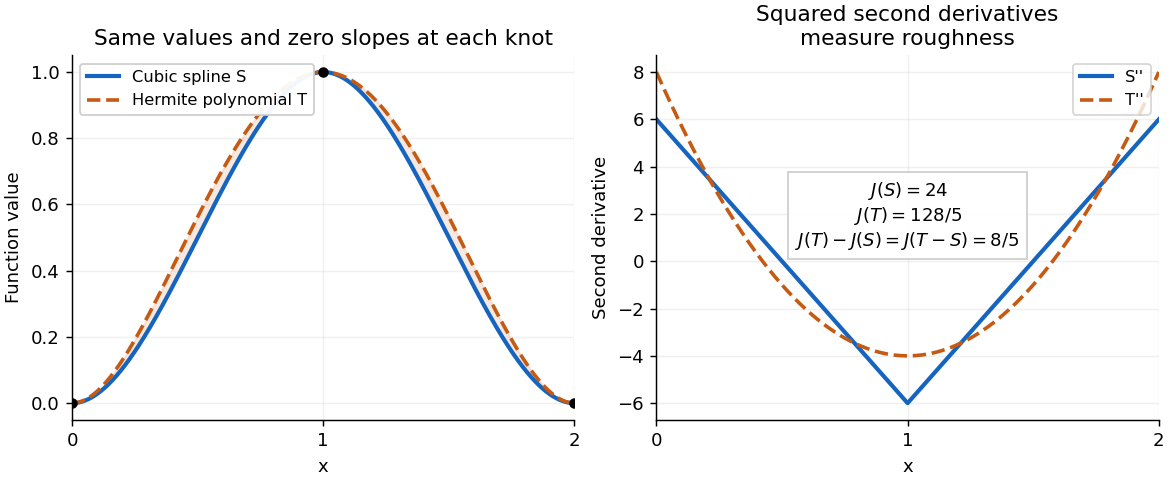
A clamped cubic spline and a Hermite interpolating polynomial with the same nodal values and derivatives: the excess second derivative roughness penalty is
. Details. 
Articles by others on the same topic
There are currently no matching articles.