In the magnetic Aharonov-Bohm effect, coherent electron paths enclose inaccessible magnetic flux even though the field vanishes along the paths. The magnetic vector potential contributes relative phaseRecombination turns this phase into a fringe displacement. For an electron , changing flux by gives one full fringe period. Reversing the loop orientation reverses the phase sign. A gauge change modifies each path's phase convention but leaves the closed-loop phase and observed interference unchanged. The accessible region surrounds excluded flux, so a globally trivial gauge cannot remove that phase.
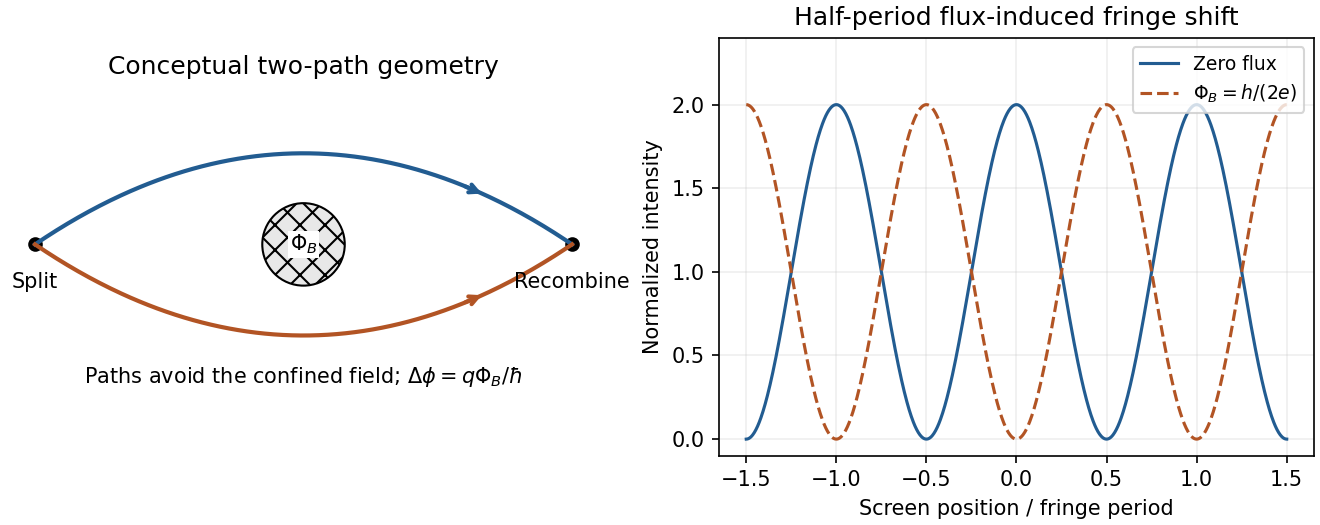
Original two-path Aharonov-Bohm schematic and the half-period fringe shift from half an electron flux period; paths avoid the flux region
. Details. 
A shielded toroidal magnet provides a concrete test: electron holography compared waves passing through its hole and outside it. Superconducting and copper coatings confined the field and excluded electrons from the magnet; the measured relative phase tested enclosed flux rather than a classical Lorentz deflection along the paths.[ref]
Evidence for Aharonov-Bohm effect with magnetic field completely shielded from electron wave by Akira Tonomura and others. Physical Review Letters 56, 792 (1986), primary abstract: shielded toroid and electron-holographic relative phase
Photonic structures control light through the spatial arrangement of dielectric material. Waveguides confine transverse modes; periodic photonic crystals combine interference and scattering to produce a photonic band structure . A photonic band gap excludes propagating modes in specified directions and polarizations. A one-dimensional stop band is not automatically a complete three-dimensional gap.
A simple example is a distributed Bragg reflector with alternating high- and low-index layers. At normal incidence, the quarter-wave choicelets successive interface reflections reinforce near the design wavelength. A departure from periodicity can create a localized defect mode inside the stop band. An isolated defect forms a cavity; a line defect can guide light through otherwise forbidden bulk propagation. Finite structures leak and real materials absorb, so ideal band arguments do not ensure infinite confinement.
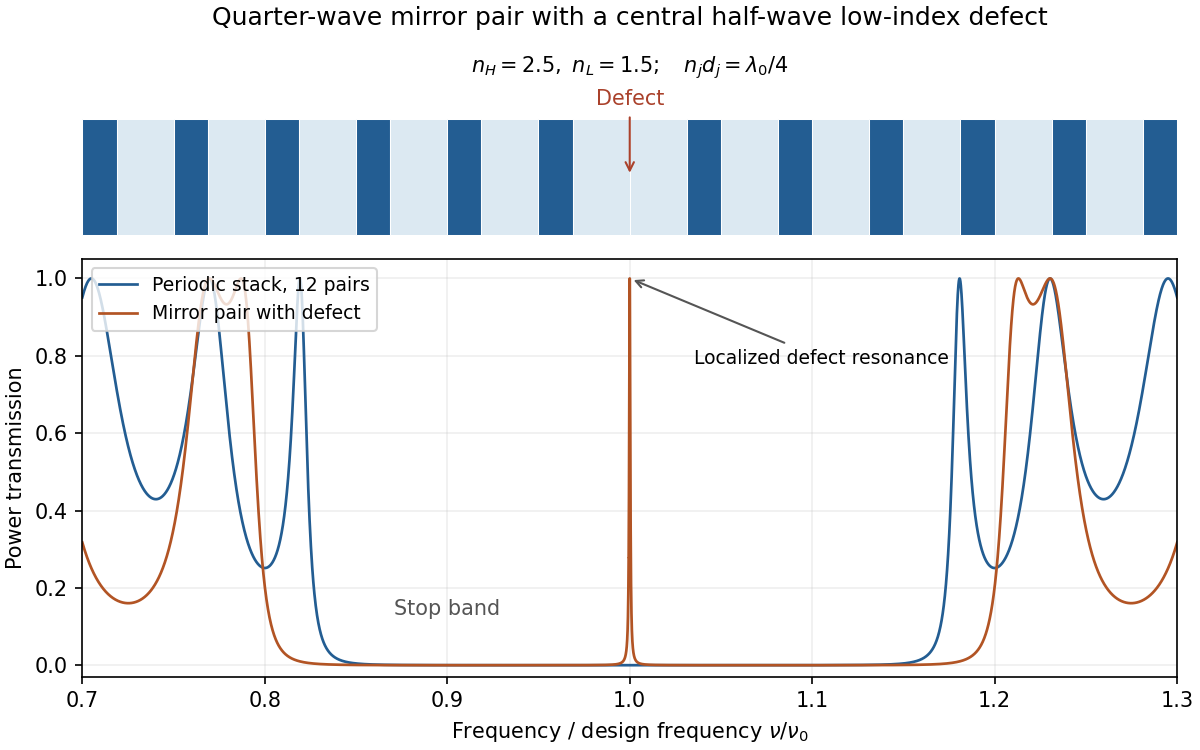
Original transfer-matrix calculation for lossless quarter-wave dielectric stacks, showing a stop band and a transmission resonance from a central defect
. Details. 
Changing the photonic density of states can suppress or enhance spontaneous emission and control how emitters couple to selected modes. This is distinct from electronic band-gap engineering: it is the electromagnetic modes that are being structured. A complete electromagnetic gap overlapping an emitter's transition is the ideal mechanism proposed for suppressing otherwise allowed spontaneous emission.[ref]
Inhibited Spontaneous Emission in Solid-State Physics and Electronics by Eli Yablonovitch. Physical Review Letters 58, 2059 (1987), primary abstract: three-dimensional periodic dielectric and overlapping electromagnetic gap
Synchrotron radiation is emitted by relativistic charges accelerated along curved paths. A magnetic field can supply the transverse acceleration while doing no work on the charge; the radiated energy must ultimately be replenished if the orbit energy is to remain constant. Relativistic beaming confines much of the radiation to angles of order about the instantaneous velocity.
For circular motion of curvature radius and ,The exact classical circular-orbit power contains an additional factor . A distant observer sees short pulses as the beamed direction sweeps past, producing a broad high-frequency spectrum. Radiation is predominantly linearly polarized in the orbital plane and becomes elliptically polarized off it. The critical frequency is a spectral scale, not a monochromatic emission frequency or a hard cutoff.
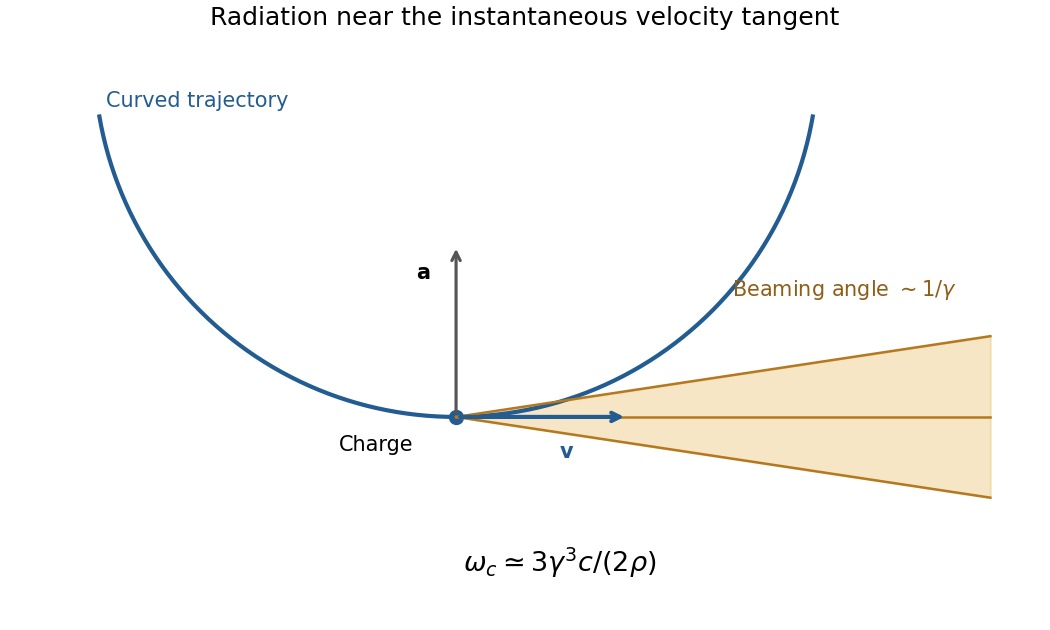
Original geometric synchrotron-beaming schematic: radiation near the velocity tangent, cone angle of order inverse Lorentz factor and curved electron trajectory
. Details. 
Storage rings provide intense radiation for spectroscopy and diffraction, while relativistic electrons in astrophysical magnetic fields also produce synchrotron emission. The classical theory relates total power, angular beaming and spectrum to the particle's trajectory; sufficiently strong quantum recoil requires corrections.[ref]
On the Classical Radiation of Accelerated Electrons by Julian Schwinger. Physical Review 75, 1912 (1949), primary abstract: total radiation, angular preference and high-frequency spectrum of accelerated energetic electrons
Articles by others on the same topic
There are currently no matching articles.