Parity is full spatial reflection, , represented by a parity operator . A polar vector, such as momentum, reverses, whereas an axial vector, such as spin, does not. A state of definite parity has , with in the usual convention. A multiparticle state's parity includes both the product of its intrinsic parities and its orbital spatial factor, for example for relative orbital angular momentum .
An interaction conserves parity when its dynamics are invariant under this transformation, equivalently for a time-independent Hamiltonian. Parity violation means that a process and its fully reflected counterpart need not have the same probability. It is more than a left-right asymmetry in an unreflected laboratory apparatus.
The electromagnetic and strong sectors of the Standard Model conserve parity to the accuracy relevant here, taking the strong-sector Yang-Mills theta term to vanish. The weak charged current selects left-chiral fermions and right-chiral antifermions, as defined by fermion chirality; the reflected right-chiral charged current is not equally present. The neutral weak current also generally has different left- and right-chiral couplings. Consequently the weak sector violates parity; this does not mean that every individual weak decay must have opposite initial and final parity. For a massive particle, helicity and fermion chirality should be distinguished.
In the Wu experiment, Chien-Shiung Wu and collaborators studied beta-minus decay of polarized cobalt-60,A thin cobalt-60 layer on a cerium magnesium nitrate crystal was cooled by adiabatic demagnetization to a few millikelvin. A polarizing magnetic field produced nuclear polarization. An anthracene scintillation counter and photomultiplier detected the emitted Electrons; angular gamma ray observations from the daughter de-excitation monitored whether the nuclei remained polarized.[ref]
Experimental Test of Parity Conservation in Beta Decay by Chien-Shiung Wu and others. Apparatus and polarization controls, pp. 1413–1414
The Electrons were emitted preferentially opposite the parent nuclear spin. Reversing the nuclear polarization reversed the asymmetry, while warming the sample removed both polarization and the effect. Those controls distinguished a spin-correlated asymmetry from a fixed detector bias.
The relevant angular correlation is a polarized beta-decay angular distribution of the formUnder parity, but , so the spin-momentum correlation changes sign. Parity conservation would require equal rates for these two directions relative to the same spin. The observed nonzero coefficient therefore demonstrated parity violation in beta decay. An unpolarized source would average this correlation to zero and could not provide the same test.
For both modes, a leading weak quark transition in is , followed by , with the original acting as a spectator quark. This produces the four quarks needed for , using the component of . Producing three pions additionally requires a pair from strong hadronization. A representative quark-line diagram draws it as gluon emission and splitting.
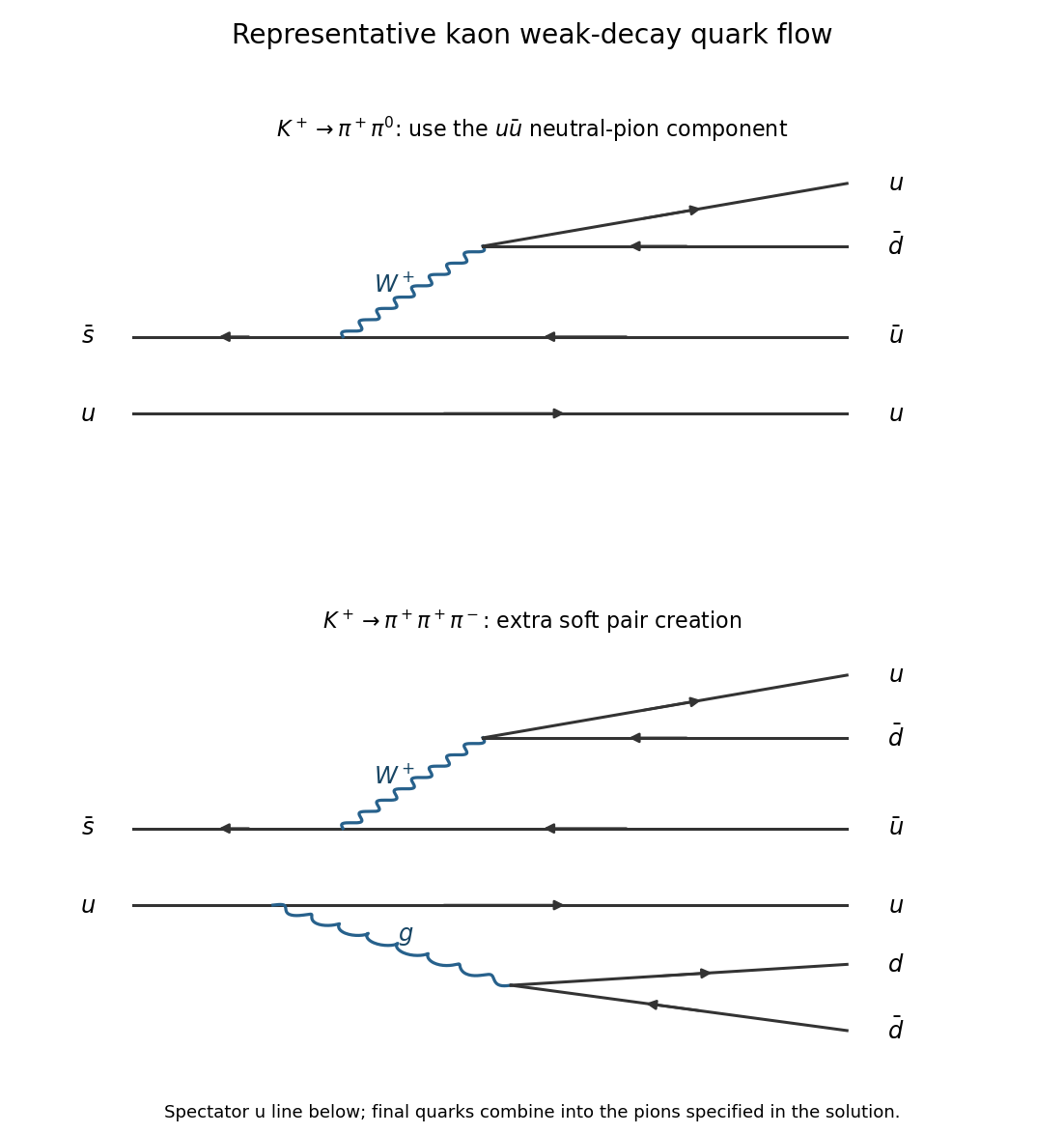
The three-pion assignment is , , and , matching . The extra soft pair creation is a schematic representation of hadronization, not a controlled perturbative prediction of the relative decay rates. Both processes are first order in the effective weak interaction.
There is an explicit error or hypothetical assumption to address: the original PDF assigns to all these mesons. Taken literally, the two-pion final state has , because all particles have zero spin and the initial is zero. Its parity is . For three spinless particles, use two Jacobi orbital angular momentum quantum numbers . Coupling to total zero requires , so the orbital parity is and the three-particle parity is also . Thus under the printed assignment, both channels conserve parity.
The named physical pions and kaons are instead pseudoscalar mesons with . With those physical assignments,ThereforeThese two opposite-parity final states from the same physical kaon are a classic illustration of parity violation in a weak decay. The physical conclusion requires correcting the printed parity assignment explicitly.
The antiquark in the specified is a spectator. For the charmed final state the leading external-W boson tree iswith and . For the charmless final state replace the active transition by , giving and the same . Their weak amplitudes have factors and , respectively, up to an irrelevant overall conjugation convention.
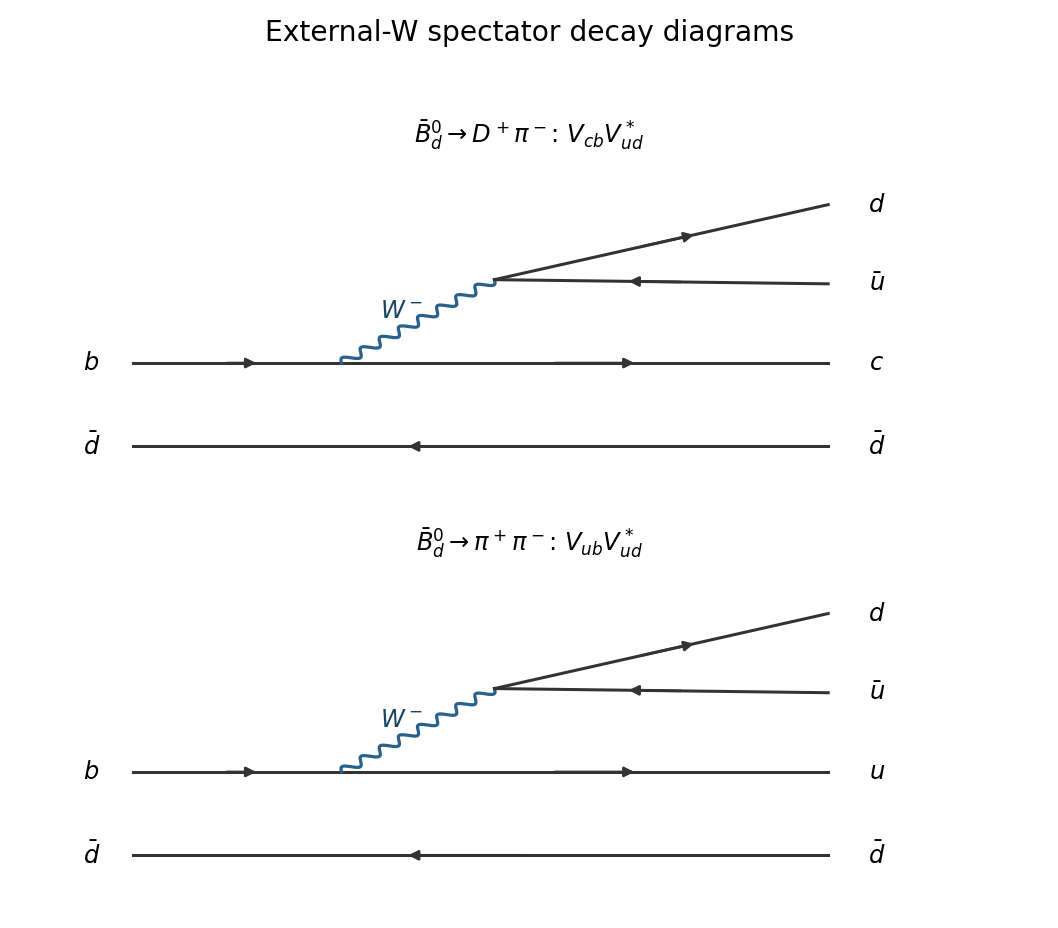


The diagrams determine the leading weak flavour factors. Strong-interaction matrix elements and, particularly for the charmless channel, additional loop diagrams can also contribute to physical branching fractions.
Ignoring the requested final-mass difference and initially taking equal hadronic matrix elements, the common factor cancels. A decay width is proportional to the squared decay amplitude, soWith the supplied Cabibbo angle,The quoted measurement, about , is larger by a factor . If that whole difference were attributed to a ratio of other amplitudes, it would require a factor .
This does not invalidate quark mixing. The supplied Cabibbo-Kobayashi-Maskawa matrix is only a schematic hierarchy in powers of , particularly for ; its omitted coefficients matter greatly after squaring. Equal phase space also does not imply equal hadronic decay amplitudes: the two transitions have different hadronic form factors and strong-interaction dynamics, and loop contributions can interfere with the charmless tree amplitude. Thus the calculation correctly predicts enhancement of the charmed channel, but the supplied CKM hierarchy alone does not quantitatively predict the measured ratio. It would be unjustified to treat as a precision prediction with only the quoted experimental error.
Articles by others on the same topic
There are currently no matching articles.