The basic Feynman diagrams have followed by , , or , with the latter pairs undergoing hadronization. See the charged-current diagrams in a. Neglect all daughter masses, QCD corrections and inaccessible charm final states, and assume lepton universality. Each leptonic mode then has one unit of decay width; the two accessible quark combinations have three color charge states and total CKM weight . ThereforeThe result is an inclusive parton model estimate. Perturbative QCD corrections increase the hadronic contribution, while muon mass, nonperturbative dynamics and radiative corrections also matter; the physical fraction is roughly .
Every ordinary hadronic mode already contains a tau neutrino, so it contains a lepton as well as hadrons if invisible particles are counted. For an additional visible charged lepton, a virtual photon can internally convert in a hadronic mode, for example . The extra electromagnetic vertices suppress such modes; they are not a large fraction of the inclusive width. Alternatively a daughter pion or kaon can decay semileptonically or leptonically in flight, for example followed by a semileptonic neutral-kaon decay. Those are secondary decay chains, not independent primary tau lepton branching fractions. Lepton-flavour-violating neutrinoless modes such as do not contribute appreciably in the Standard Model.
At the Z boson pole, the accessible primary fermion pairs are , , , the three channels, and . The top quark is too heavy. The charged channels also have photon exchange, and the electronic channel has a substantial nonresonant Bhabha scattering contribution. On-shell W boson pairs are above threshold; they are not primary decays.
A tau lepton pair gives two approximately back-to-back narrow low-multiplicity cones, usually one or three charged tracks per cone, with overall charge zero and missing energy and momentum from neutrinos. Opposite hemispheres can show electron, muon or hadronic tags. A decay vertex or track impact-parameter information helps establish the short tau lepton flight. Reject Bhabha scattering and dimuon events by their nearly full visible beam energy, particle identification and little missing momentum; reject ordinary quark multijets by their broader high-multiplicity activity and larger visible invariant masses. Control two-photon backgrounds with visible transverse momentum, forward activity and event geometry. Selection efficiencies depend on decay mode and must be calibrated.
In , charge and missing four-momentum show an invisible neutral component beyond the visible charged lepton. The distributions are consistent with three-body V-A interaction decay; hadronic modes such as instead have two-body missing-mass kinematics. Production and decay accounting assigns and their antiparticles minus one. Searches for wrong-flavour and neutrinoless channels constrain violations. These observations establish a useful approximately conserved tau-family number in ordinary interactions, rather than proving an exact law from missing energy alone.
To establish that the invisible particle is distinct from and , combine decay evidence with the absence of unsuppressed tau production by conventional electron- and muon-flavour beams, and direct tau neutrino charged current interactions. DONUT observed the short displaced tau lepton decay in nuclear emulsion after a neutrino interaction. [ref]
Observation of Tau Neutrino Interactions by DONUT Collaboration. DONUT first direct tau-neutrino interaction report
Neutrino oscillation means individual family numbers are not exact conserved quantities during propagation, even though they are an excellent approximation for these local decay assignments.Write the leptonic partial decay width asHere is defined from muon decay, so the coupling denominator fixes the convention. Measure . The ratio tests after the known phase space and radiative corrections. Comparing with the muon lifetime and the fifth power of the mass ratio tests . Hadronic comparisons such as tau-to-pion versus pion-to-muon decay supply additional universality tests with their own hadronic and electromagnetic corrections.
Use a high-multiplicity hadronic mode with only one invisible neutrino, and reconstruct the total visible four-momentum . In the tau lepton rest frame,Fit the endpoint of the hadronic invariant mass distribution, preferably together with its laboratory energy boundary at known beam energy. The two-dimensional boundary uses more information than the single largest observed mass. Detector smearing, unseen neutral products, backgrounds, beam radiation and hadronic spectral modeling must be included. Absence of a displaced endpoint generally sets an upper bound rather than a positive neutrino mass measurement. Strictly the flavour state contains several mass eigenstates; an unresolved endpoint constrains the corresponding weighted mass spectrum.
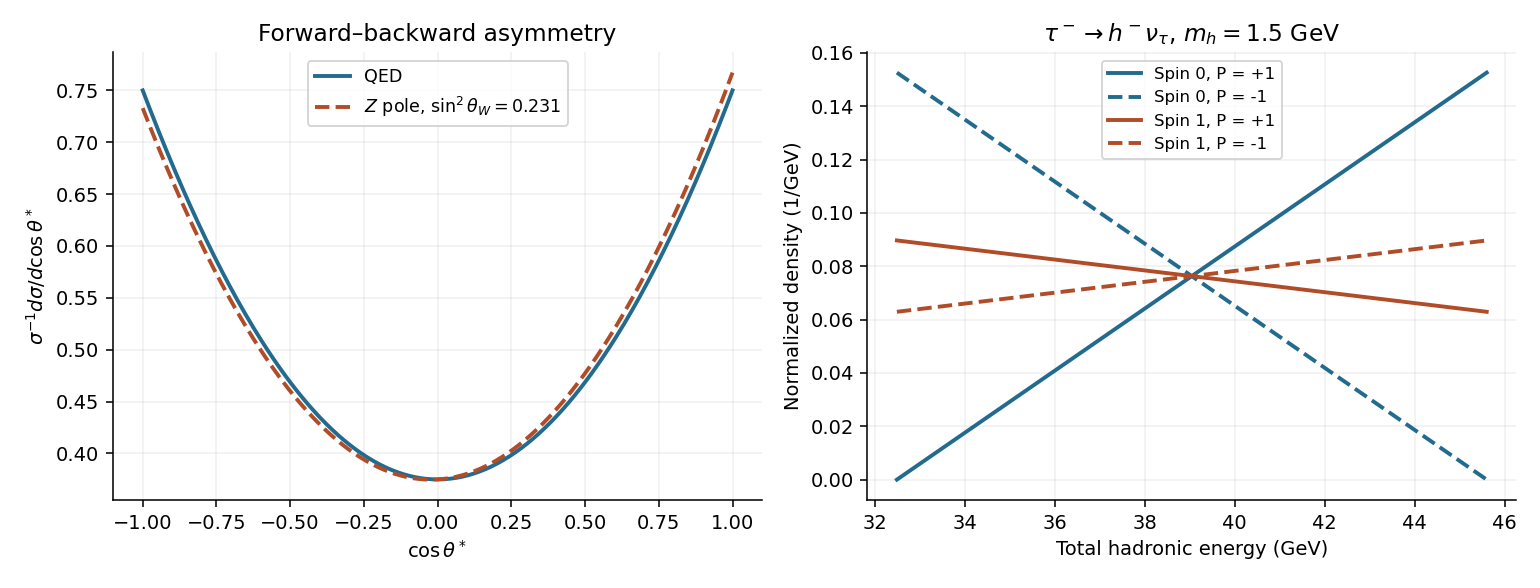
Neglect radiation, take , , and treat a fixed hadronic invariant mass as a single recoil system in . With negligible neutrino mass,Thus , numerically approximately to . In the ultrarelativistic limit the range is . A spread of hadronic invariant masses broadens these endpoints; an average mass alone is not a strict endpoint specification for the whole sample.
Let denote a positive-helicity , and measure from its laboratory flight direction in its rest frame. For a spin-zero hadronic recoil, the left-helicity tau neutrino and angular momentum conservation giveFor example a tau lepton with spin along can emit a left-helicity neutrino along , carrying spin along , with the spin-zero recoil along . A positive-helicity tau lepton then gives a harder visible recoil. If , and , the more general tau hadronic polarimetry formula isFor spin-zero recoil . For a spin-one system produced by the V-A interaction, the longitudinal and transverse weights are , with opposite angular slopes; summing gives . At this is about , so the negative-helicity tau lepton has the higher mean total hadronic energy, about versus , within that spin-one model. [ref]
Tau polarization and correlated decays in neutrino experiments (2023). Polarized tau decay: longitudinal and transverse spin-one recoil distributions, Eqs. (5)–(6)
The supplied mean invariant mass does not specify the recoil's spin composition or its helicity amplitudes. Consequently the last sign cannot be universal: positive helicity is harder for a spin-zero recoil, negative helicity is harder for the specified spin-one recoil, and a mixture requires its measured spectral weights. Polarization of an intermediate vector or axial-vector meson also changes the division of energy among its daughter hadrons; that information is not fixed by the total jet invariant mass alone.

Articles by others on the same topic
There are currently no matching articles.