Use dimensionless physical helicity , with spin eigenvalues in natural units. In the Dirac representation,The entries in the supplied transformation denote two-by-two identities. Since its matrix acts only on the upper/lower spinor blocks, it commutes with the repeated Pauli block. Therefore andThe eigenvalues remain the physical spin projection along the direction of motion, or . A convention omitting the factor one half instead labels them ; this changes no measurement probabilities. A change of gamma-matrix representation cannot change the spin observable.
The two Weyl spinors transform in the inequivalent left- and right-chiral representations of the proper Lorentz group. They are selected by and have different boost transformation laws; parity exchanges the two. A massive Dirac equation couples them, whereas in the massless limit they can propagate independently.
For the particular printed in this paper, transforming its supplied Dirac givesThus the upper block is right chiral and the lower block left chiral in this convention. Many references use the opposite block order; neither convention changes physics, but they must not be mixed. Chirality is not generally the same as helicity for a massive electron. The weak charged current selects the left-chiral electron component, reducing to negative helicity at high energy.
Put and assume . The common plane wave has unit modulus. The component norm isFor unit spinor probability density choosewhere was used. This is spinor normalization, not square normalization of a plane wave over infinite space; a box or wavepacket gives the corresponding spatial normalization. If the convention is instead , use .
For momentum along , the positive-helicity components are the first and third, while the second and fourth have negative helicity. HenceBoth are independent of speed. In the source's chiral block order the exact left-chiral weight is , tending to at high energy; helicity and chirality probabilities agree only in that limit.
The charged-current process iswith a -channel emitted at the electron-to-neutrino vertex and absorbed at the antimuon-to-antineutrino vertex. It is not an -channel Annihilation of the unlike-flavour charged leptons into one .
At high momentum transfer the incident electron's left-chiral fraction tends to . In the collision centre-of-mass frame, the incoming antimuon moves along and its charged-current allowed right helicity has spin along . A rest-frame spin at Angle to projects onto that spin direction with probability . Therefore, if denotes the cross section for a pure left-helicity electron and fully selected antimuon spin,It vanishes at in the ultrarelativistic selection limit and is maximal at . Finite-mass corrections can fill the suppressed orientation. The absolute normalization depends on beam energy and the exchanged-boson propagator; the spin-angle dependence is what is fixed here.
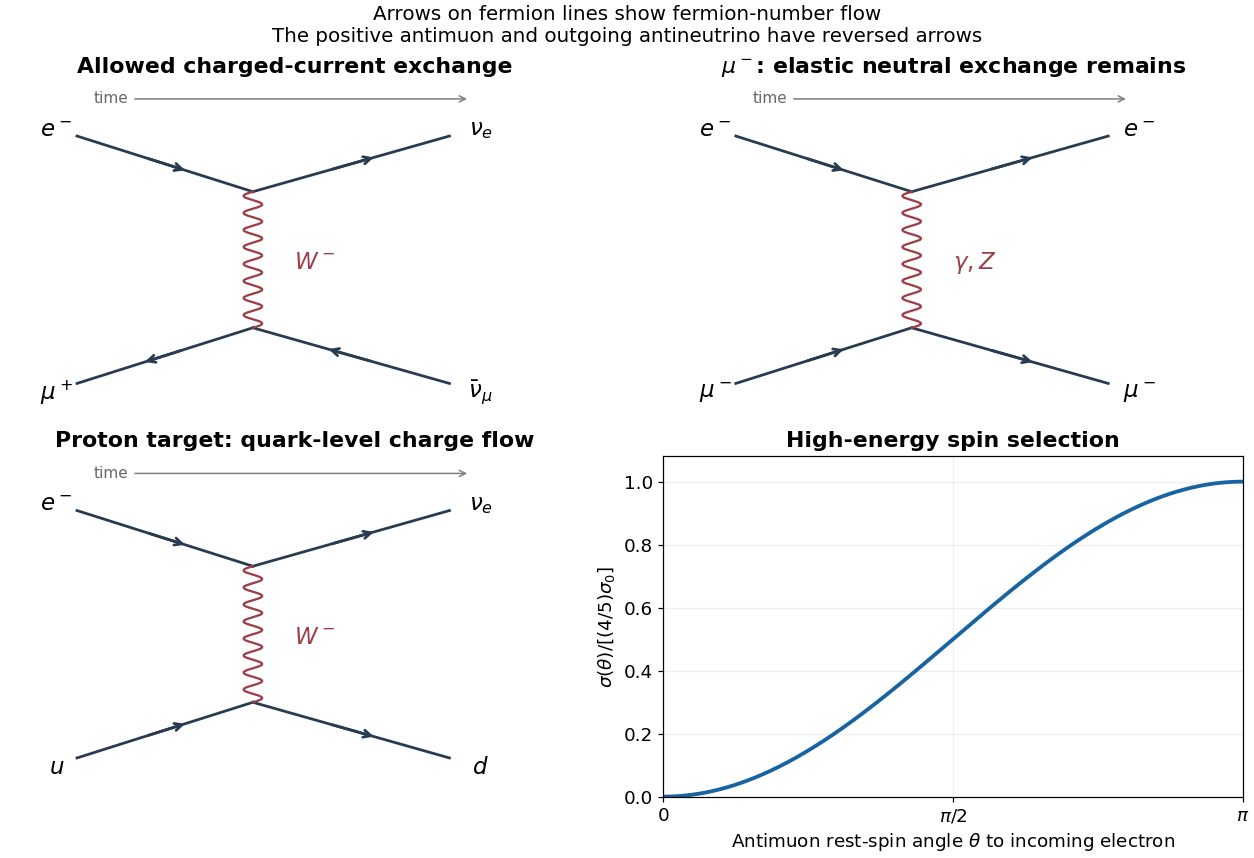
Leptonic and quark-level exchange diagrams and polarized charged-current angular dependence
. Details. 
For an incoming , a putative process would change total electric charge from to zero. It is forbidden: both negative charged leptons would have to emit a , and a single exchanged charged boson cannot connect those two emission vertices. Ordinary elastic scattering remains possible through -channel photon or exchange, shown in the figure, but this is not the charged-current reaction of part d. The neutral-current weak contribution is distinct from the electromagnetic one.
A proton contains up quarks on which the charged current can act:through exchange, weighted by . Spectator quarks complete the hadronic final state. At the exclusive nucleon level the charge assignment is ; at the high momentum transfers specified, the generally dominant description is inclusive with proton structure and hadronic breakup, not an unsuppressed pointlike proton-to-neutron transition. The quark-level diagram in the figure displays this allowed charge flow. The electron's left-chiral selection is the same as in part d.
Articles by others on the same topic
There are currently no matching articles.