Descent equation. Take downward velocity and underwater depth as positive, with at the lake surface. For a sphere of radius , the pebble mass is and the frontal area is . Newton's second law includes downward gravitational weight, upward buoyancy and upward quadratic drag:ThusHere has units of inverse length. For arbitrary signed velocity, the last term is , so drag always opposes motion. The displayed downward form suffices for this trajectory.
Limiting speed. At terminal velocity, the net force and vanish. For ,Use , , , and . ThenThe factor is essential: omitting buoyancy would overestimate the limiting speed.
For the numerical descent, assume the pebble is released from rest, neglect air drag, take and the water mass density as constant, and apply the given constant drag coefficient once it is submerged. Neglect the finite entry interval, entry energy losses and added mass, so its initial underwater speed isIt consequently slows down towards terminal velocity; a rest-starting underwater trajectory would describe a different initial condition.
For superterminal descent under quadratic drag, use in . Equivalently,The speed approaches asymptotically from above. There is no finite exact distance at which it first equals the limiting speed. A practical estimate must specify an accuracy. Define “reached” as . ThenFor one-percent accuracy, givesA five-percent criterion gives . The characteristic decay length of the excess squared speed is , but several such lengths are needed because the entry speed is so far above the limiting value. These estimates depend on the stated water-entry idealization; the source gives no finite tolerance or entry-loss model.
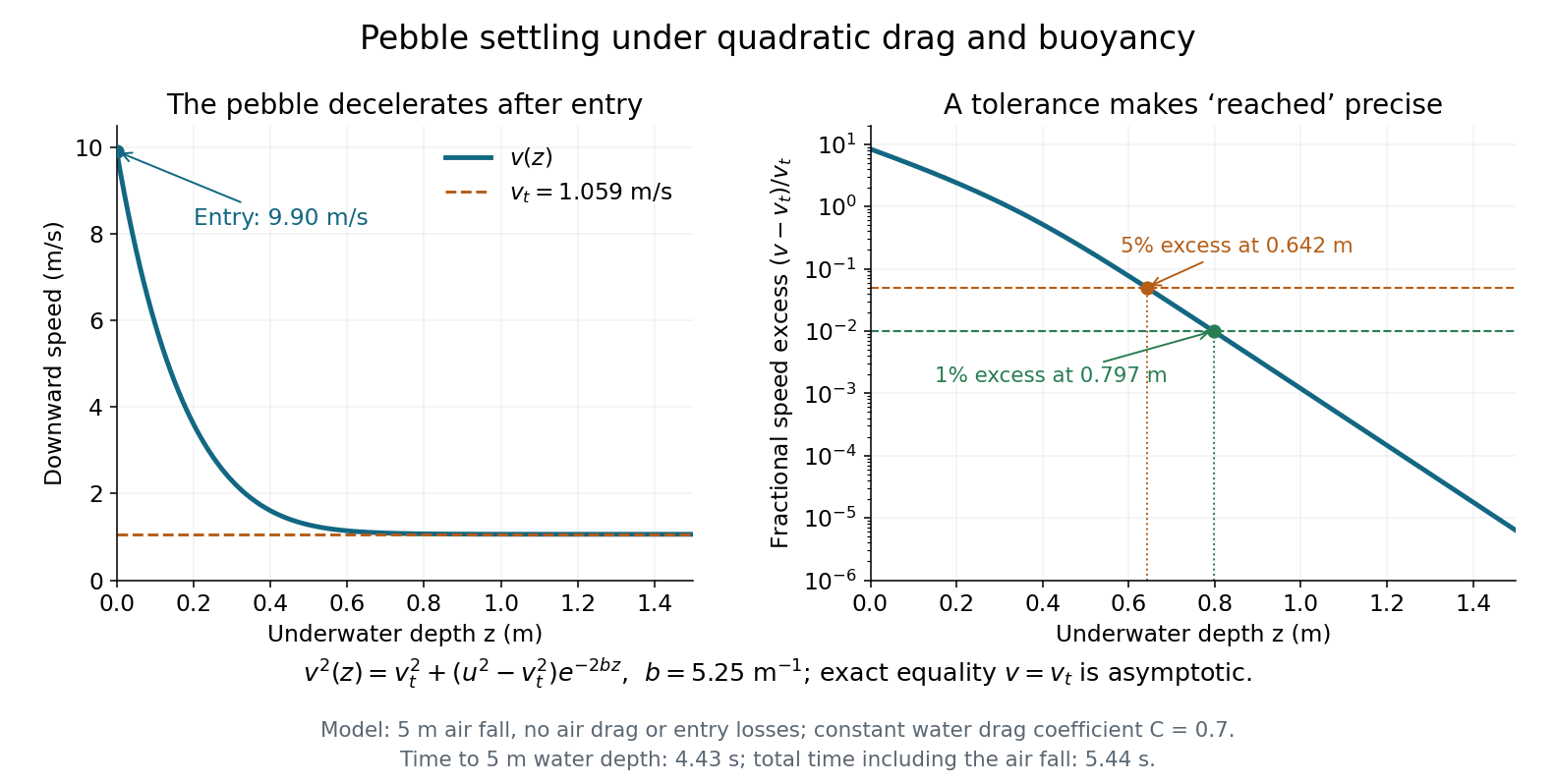

The air fall lastsRetain the underwater deceleration rather than replacing the whole water trajectory with motion at terminal velocity. DefineSeparation of the descent equation gives the hyperbolic cotangent solution and its integrated depth:where now means water entry. The derivative of the logarithm verifies , while . At water depth , inversion using the inverse hyperbolic sine yieldsThe total elapsed time is thereforeFor an estimate without evaluating the exact expression, permits here, givingThis gives the same to the quoted precision. The simpler overestimates the underwater time because the pebble initially moves faster than .
Articles by others on the same topic
There are currently no matching articles.