Source paper: www.whatdotheyknow.com/request/physics_preliminary_examinations/response/1162943/attach/3/Twain.7z?cookie_passthrough=1
Other held scans reproduce this examination. The cleaner copy with native text is used here. The sitting was on 7 September 2015. The paper asks for all of Section A, Questions 1–7, and three of Section B, Questions 8–11; solutions to all eleven questions follow. Lettered headings below reproduce the source's actual subparts. In particular, the last two requests in Question 10 are unlettered continuations, not parts (e) and (f).
For a sphere with uniform mass density, . Its moment of inertia of a uniform solid sphere is , and rotation about a diameter gives angular momentum magnitude . The spheres have the same angular frequency , soThe mass grows by a factor of two, and the extra squared lever arm supplies a further factor of four. Equal angular frequencies alone do not mean equal angular momenta.
The disc carries mass and the thin rim carries . About the wheel's central normal axis, add the moment of inertia of a uniform disc and the thin rim's moment of inertia:Treat the wheel as a thin planar lamina, as implied by the disc-and-thin-rim model. Interpret the requested perpendicular axis as perpendicular to the wheel's original axis and tangent to the rim: if the wheel lies in the plane, choose the tangent line , parallel to the diameter. By rotational symmetry, the two diametral moments of inertia are equal. The perpendicular axis theorem therefore givesThe parallel axis theorem then gives the tangent-axis inertia of an axisymmetric lamina:The axis direction matters. If “perpendicular” were intended to mean perpendicular to the wheel's plane, an axis through a rim point would instead be parallel to the original wheel axis, giving . The answer uses a tangent axis perpendicular to the original axis; the value belongs to the different, explicitly identified normal axis. Finite wheel thickness would require additional information for the in-plane moment of inertia.
Let be the orbiting point mass's position relative to the attracting body, and let its velocity be . Its angular momentum isConservation of angular momentum keeps both the magnitude and direction of fixed. Since is perpendicular to , a nonradial orbit lies in a fixed plane. During a short interval , the radius vector sweeps a thin triangle of areaThus the areal velocity is constant:Equal time intervals give equal swept areas: this is Kepler's second law. In plane polar coordinates, the same statement is and . The attracting body is at the relevant focus of the ellipse, not its geometric centre. The area argument needs conserved angular momentum, not specifically an ellipse; a central force provides this conservation because its torque vanishes.
Choose the ball's initial velocity as ; the ball then has velocity . Both have Lorentz factor . Their total relativistic energy and signed relativistic momentum areThe laboratory frame is not the centre-of-momentum frame, despite the equal and opposite speeds. Four-momentum conservation and the relativistic energy-momentum relation give the invariant mass of the combined incoming system:The relativistic collision mass threshold for a final object of rest mass is . At the threshold,At equality, the outgoing object has laboratory velocity , directed towards the initially heavier ball's motion. Its nonzero final kinetic energy is why setting would give the wrong threshold.
For the literal rest mass of a coalescing relativistic collision, if there is exactly one outgoing object of exactly fixed rest mass and no radiation or other products, four-momentum conservation selects the equality above, rather than allowing every larger . Speeds above this threshold require a larger final invariant mass or additional outgoing energy carriers.
Take the initial internal pressure as negligible and the external atmospheric pressure as . The window has frontal area . Before appreciable air has entered, its inward pressure force is approximately . Newton's second law therefore gives the initial collective inward accelerationHere and . Neglect gravity in this much larger pressure-driven acceleration, together with supports and elastic stresses once the glass has broken. The given thickness implies a plausible average glass mass density . Equivalently, a fragment retaining the original thickness has acceleration , independent of its frontal area while it experiences the full pressure difference.
For a vacuum-window implosion energy estimate, the ideal pressure-work scale for filling vessel volume is . Assigning all that pressure-volume work to the glass's kinetic energy givesThe same result follows from retaining acceleration over an effective swept distance , so that . This is an ideal upper energy-budget estimate for the common speed, or mass-weighted root mean square speed, of all the glass. It assumes an atmospheric reservoir maintains the driving pressure and that the whole vessel's pressure-work budget can accelerate the glass. In practice, air motion, fragmentation, heating and collisions share that energy, the pressure difference falls, and fragments may hit the vessel after a much shorter path. The unspecified vessel shape and fragment trajectories prevent a unique actual maximum speed; concentrating energy into one small fragment also prevents interpreting this collective estimate as a strict bound on every individual fragment.
There is no external horizontal force, so momentum conservation keeps the student–punt centre of mass fixed if the system starts at rest. Let the student's walking direction be positive. If the punt's displacement relative to the water is , the student advances , where is measured relative to the punt. Constancy of the centre of mass givesThe punt moves opposite to the student's walking direction; the student's net displacement relative to the water is . These displacements are relative to the initial state, not distances travelled relative to the punt.
Under the same ideal assumptions, merely changing the walking speed or walking back more slowly cannot produce unlimited travel. Returning the student to the original place on the punt restores the original internal mass distribution and hence the punt's original position. A finite punt bounds the displacement available through internal rearrangement. Propulsion over large distances requires an external horizontal impulse, for example a push against the bed or momentum transferred to the water. Such an interaction changes the isolated, frictionless model rather than evading centre of mass conservation.
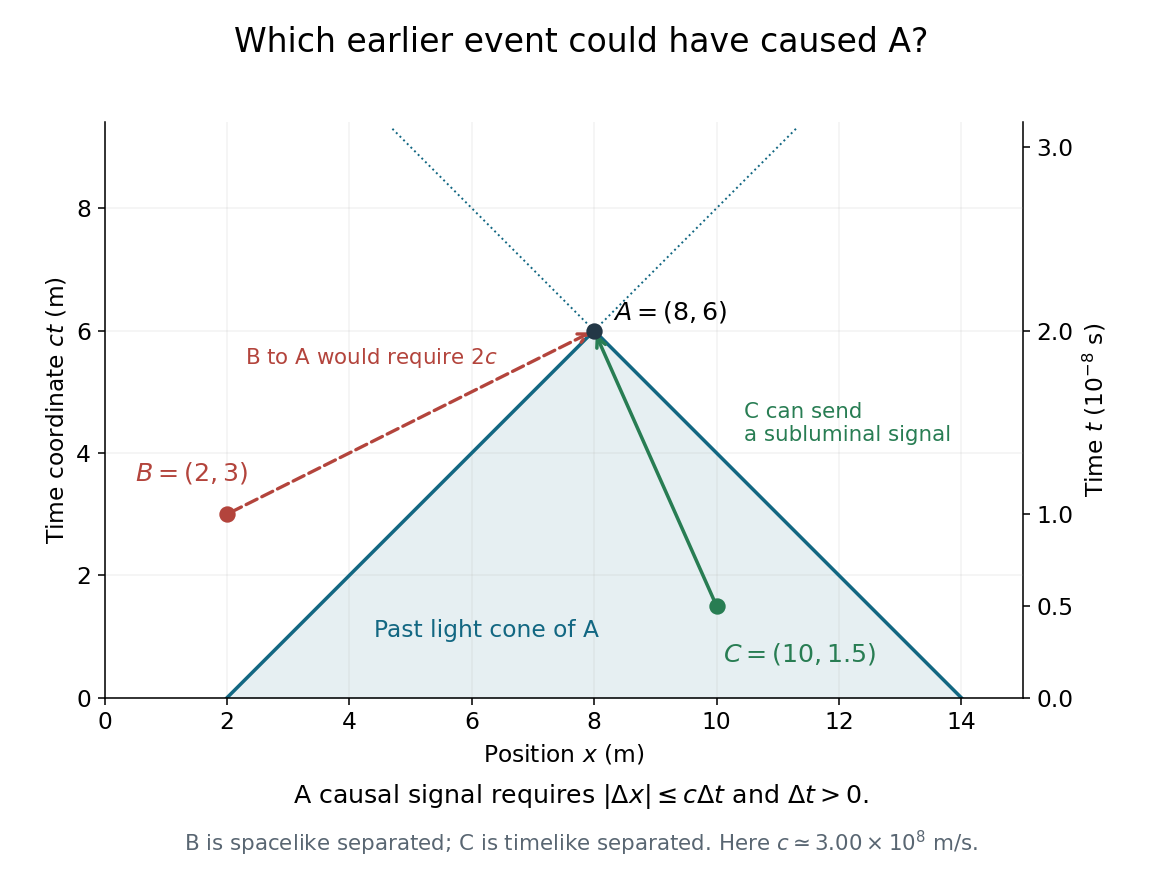
Plot position horizontally and vertically, with equal length scales, so vacuum light rays have slopes . A possible cause of the spacetime event must lie on or inside its past light cone, with . Equivalently, causality requires .
From to , and . Using , the available light-travel distance is only . In the metric signature, the Minkowski interval isThere is spacelike separation, so a signal would need speed :From to , and . Now , givingThis is timelike separation, with a possible signal velocity . Therefore

Descent equation. Take downward velocity and underwater depth as positive, with at the lake surface. For a sphere of radius , the pebble mass is and the frontal area is . Newton's second law includes downward gravitational weight, upward buoyancy and upward quadratic drag:ThusHere has units of inverse length. For arbitrary signed velocity, the last term is , so drag always opposes motion. The displayed downward form suffices for this trajectory.
Limiting speed. At terminal velocity, the net force and vanish. For ,Use , , , and . ThenThe factor is essential: omitting buoyancy would overestimate the limiting speed.
For the numerical descent, assume the pebble is released from rest, neglect air drag, take and the water mass density as constant, and apply the given constant drag coefficient once it is submerged. Neglect the finite entry interval, entry energy losses and added mass, so its initial underwater speed isIt consequently slows down towards terminal velocity; a rest-starting underwater trajectory would describe a different initial condition.
For superterminal descent under quadratic drag, use in . Equivalently,The speed approaches asymptotically from above. There is no finite exact distance at which it first equals the limiting speed. A practical estimate must specify an accuracy. Define “reached” as . ThenFor one-percent accuracy, givesA five-percent criterion gives . The characteristic decay length of the excess squared speed is , but several such lengths are needed because the entry speed is so far above the limiting value. These estimates depend on the stated water-entry idealization; the source gives no finite tolerance or entry-loss model.
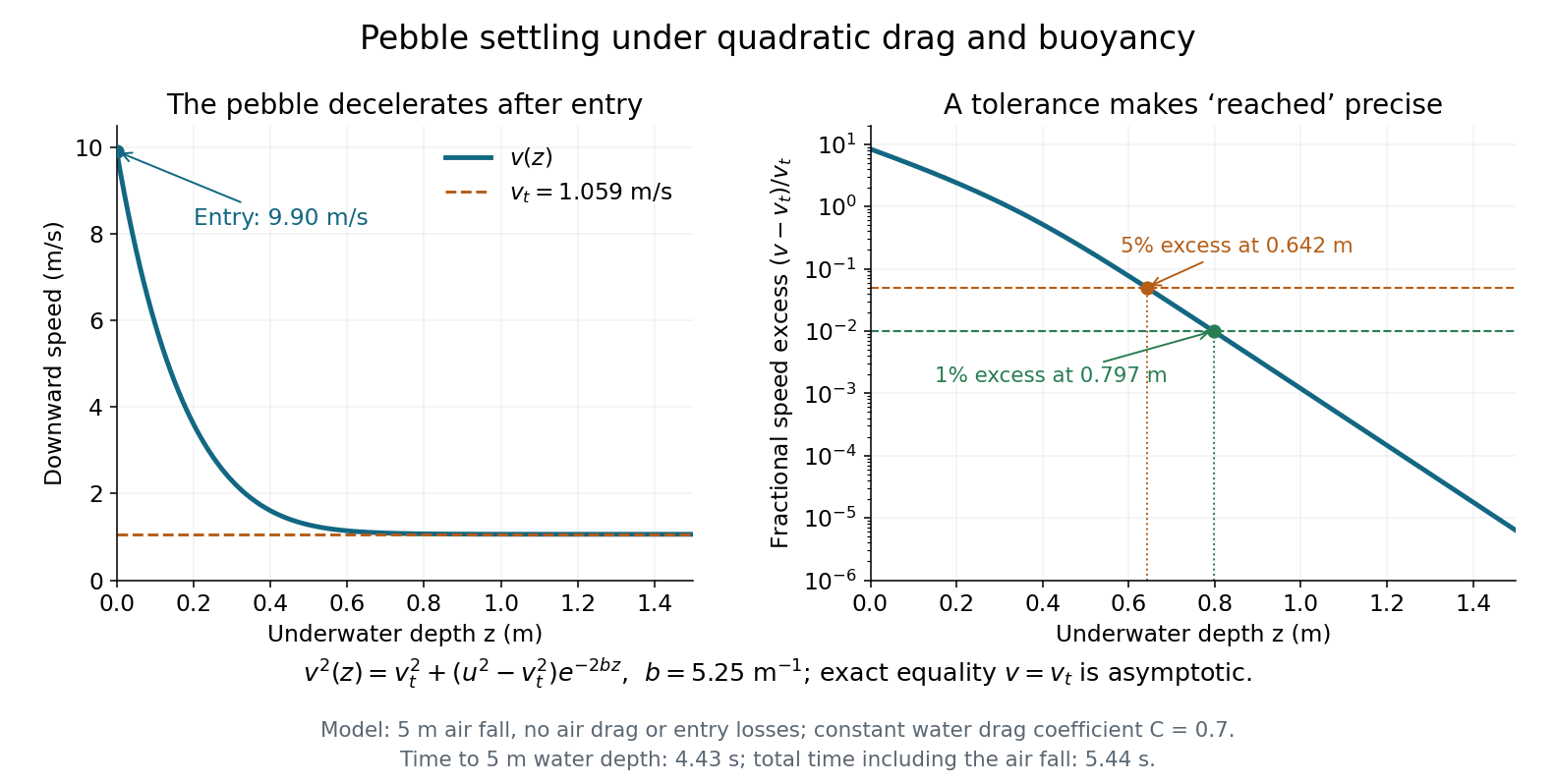

The air fall lastsRetain the underwater deceleration rather than replacing the whole water trajectory with motion at terminal velocity. DefineSeparation of the descent equation gives the hyperbolic cotangent solution and its integrated depth:where now means water entry. The derivative of the logarithm verifies , while . At water depth , inversion using the inverse hyperbolic sine yieldsThe total elapsed time is thereforeFor an estimate without evaluating the exact expression, permits here, givingThis gives the same to the quoted precision. The simpler overestimates the underwater time because the pebble initially moves faster than .
Orbital energy. Treat the star as stationary to leading order in , with Newtonian gravitational parameter . For velocity components in plane polar coordinates, . The kinetic energy is . Integrating Newton's law of universal gravitation with zero gravitational potential energy at infinite separation gives . Thuswhere is the satellite's angular momentum. The first term is radial kinetic energy; the second is transverse kinetic energy, also the centrifugal contribution to the radial effective potential; the last is the attractive gravitational potential energy. These are not three independent sources of energy: the centrifugal term is already part of the ordinary kinetic energy.
For an elliptic Kepler orbit of semi-major axis and orbital eccentricity , the polar equation of a Kepler orbit has semilatus rectum . Substituting into the preceding expression reduces it toFor a circular Kepler orbit, , , , and . Negative total energy describes a bound orbit.
Rapid, symmetric mass loss. Assume the mass is removed on a timescale short compared with the satellite's orbital period, without an impulsive kick or appreciable wind drag on the satellite. The post-loss gravitational parameter is with . At the change, , , and are unchanged. Spherical symmetry keeps the force central, so the specific angular momentum is conserved. Orbital energy is not conserved across the changing gravitational field:The new semi-major axis is consequentlyThe original speed now exceeds the new circular speed at , and the outward radial acceleration is . Thus the release point is the new pericentre, not the apocentre. The impulsive orbital expansion under isotropic mass loss givesFor the stated one-percent loss,An independent angular momentum check is . The impulsive orbit stays bound for ; loss of half the central mass is the zero-orbital energy limit.
What the wind timescale changes. The source specifies a spherically symmetric wind but does not give its duration. The preceding nearest and furthest distances require the rapid-loss assumption. In the opposite, slow limit, adiabatic orbital expansion under isotropic mass loss preserves an initially circular orbit to leading adiabatic order. Conserved specific angular momentum then gives , hence . After the same loss,For a finite intermediate timescale, the orbit depends on the mass-loss history; the percentage alone does not select a unique pair of turning distances. Neglecting wind recoil and wind drag is common to both idealizations.
Use spherical coordinates about the fixed pivot, with fixed rod length , polar angle measured from the downward vertical, and azimuth . The bob's position iswhen the Cartesian axis points upward. Differentiation gives kinetic energy . Taking zero gravitational potential energy at pivot height gives . The spherical pendulum's Lagrangian is thereforeThe rod is light, rigid and of fixed length; pivot friction and air drag are neglected. A rigid rod, unlike a string, may sustain either tensile or compressive constraint force.
The azimuth is a cyclic coordinate, since . Its Euler-Lagrange equation gives conservation of the vertical component of angular momentum:This is the actual angular momentum, not specific angular momentum. The Lagrangian also has no explicit time dependence. The conserved energy isAlong solutions, . These are the conserved quantities associated with rotational symmetry about the vertical and time-translation symmetry, respectively.
The Euler-Lagrange equation readsHenceThe first term reflects the coupling to azimuthal motion; the second is the gravitational restoring contribution for an angle measured from the downward vertical.
Constant azimuth. If is constant, and the motion is a planar simple pendulum:For the small-angle approximation, , giving simple harmonic motion withThe harmonic angular frequency requires small amplitude. At finite libration amplitude , the exact oscillation period is , where is the complete elliptic integral of the first kind; the nonlinear pendulum does not have the same amplitude-independent period.
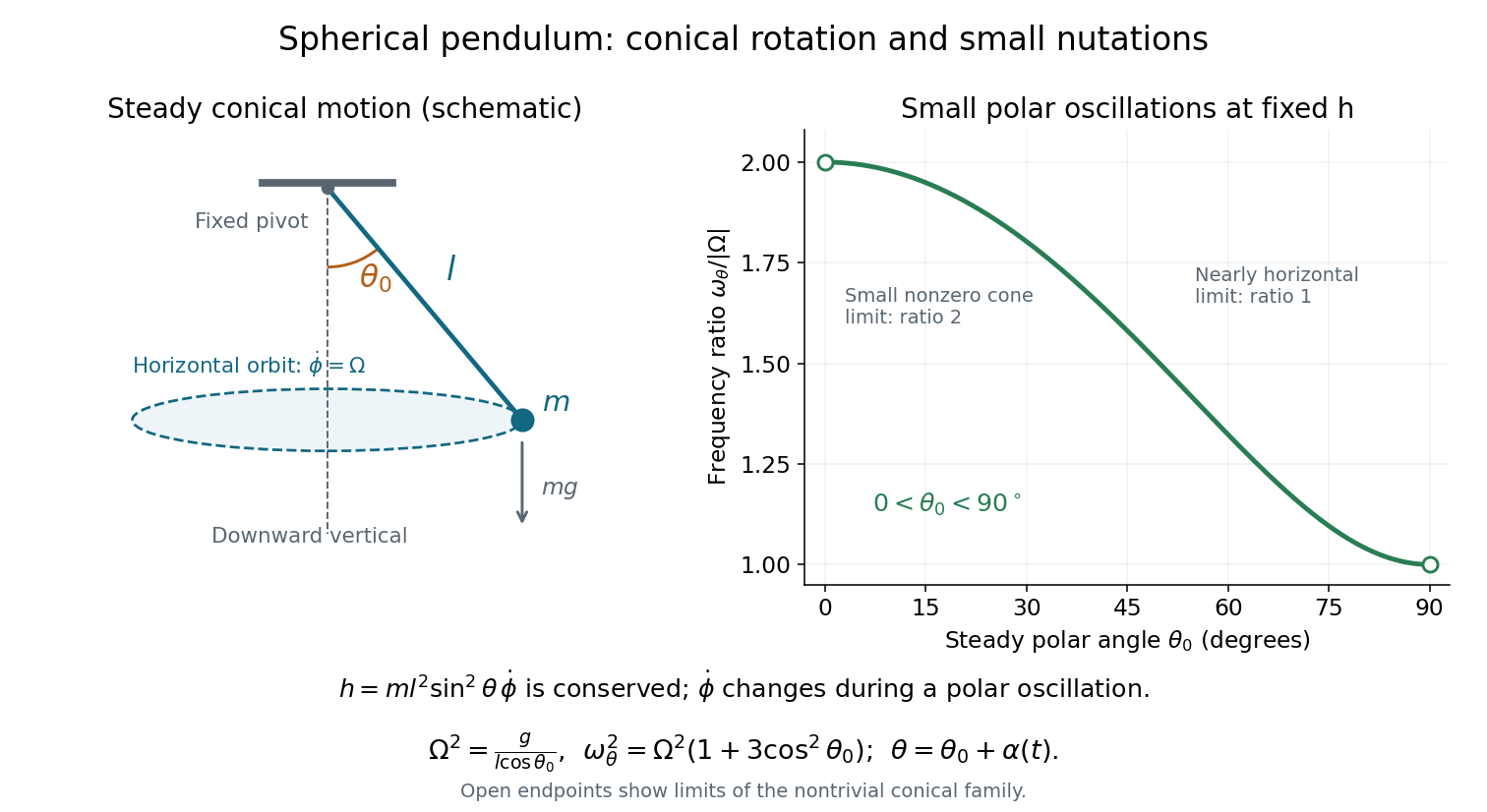
Constant polar angle. If is nonzero and constant, the bob traces a horizontal circle: this is a conical pendulum. Setting and dividing by givesThe sign distinguishes the two senses of rotation. The exactly downward configuration is stationary; its azimuth is undefined and it must not be obtained by dividing by . A nontrivial constant-angle orbit of this gravity-only system needs even though the supporting rod can also push.
Fixed-angular-momentum form. Eliminating using the conserved angular momentum givesEquivalently, the polar motion has effective potentialFor the steady conical pendulum at , , soThe sign of agrees with the sign of ; substituting verifies the constant-angle result in part (d).
Period of small polar oscillations. Put , with and held fixed. This is the appropriate small nutation about a conical pendulum; keeping fixed instead would violate the angular momentum constraint during the oscillation. Ifthen andThe linearization is , givingSince , the coefficient is positive and these small polar oscillations are stable. To first order, , making the compensating change in azimuthal angular velocity explicit. The limit as concerns radial modulation of a small nonzero circular orbit; the exactly planar pendulum is a different, degenerate limit of these polar coordinates.

Energy–momentum transformations and invariant. Let the primed inertial frame move at signed velocity along the unprimed axis. With , a Lorentz transformation of four-momentum givesUse . The longitudinal terms satisfyThe transverse momenta are unchanged, soFor one electron, the relativistic energy-momentum relation identifies this Lorentz invariant as .
Symmetric electron scattering. Assume an isolated elastic collision of the two electrons, with no emitted radiation. The incident electron has total energy and momentum magnitude , so ; the target electron initially contributes rest energy and zero momentum. In the nondegenerate configuration with final track angles and , transverse momentum conservation givesBecause both final particles have the same rest mass, they also have equal total energies. Conservation of energy givesLongitudinal momentum conservation is . Combining these expressions, with , proves the symmetric relativistic equal-mass scattering angle relation:The low-kinetic energy limit has , recovering the familiar right angle between the outgoing tracks in nonrelativistic equal-mass scattering. Relativistic incident energies give , approaching zero at very high energy.
Accelerating potential. For , , so . The acceleration from rest supplies kinetic energy, not total energy. If is the elementary charge, the required accelerating electric potential difference has magnitudeusing electron rest energy . The electric potential difference is oriented to accelerate the negative electron; the result above specifies its magnitude.
Articles by others on the same topic
There are currently no matching articles.