Use the tunnel frame , with the entrance at , the far end at , and at both runner entry and photon emission. The runner has , while the approaching photon has . At detection,For , : the photon meets the runner before the runner reaches the tunnel midpoint.
Let be the runner's inertial frame, with origin at the entry event. The Lorentz transformation isThe emission event has coordinates , . It is earlier than entry in : entry and far-end emission are simultaneous only in the tunnel frame. This is relativity of simultaneity, not an extra delay of the light source.
The entrance clock is at . Let be the event on that clock simultaneous with emission in the runner's frame. Since , its reading isThis is the tunnel clock's reading, not the runner-frame coordinate time . It is also not a calculation of what a photograph of that distant clock would show, which would require an additional light-travel condition.
At that simultaneous entrance-clock event, and . Its runner-frame position isThe runner is at , so the entrance is still ahead by distance at the runner-frame emission time. The simultaneously measured distance between the two tunnel ends is , consistent with length contraction.
The photon starts at and travels left to the runner at the fixed position . ThusThis distance is not the simultaneous contracted tunnel length , because the runner is not at the entrance when the photon is emitted in . Adding the entrance-to-runner gap from part (ii) to indeed gives .
During the photon's runner-frame flight, the tunnel entrance moves left by . It began ahead of the runner by , so at detection it lies behind byDivide this distance into the tunnel by the simultaneously measured tunnel length :The runner is stationary in , but their location relative to the moving tunnel still has this fraction. Omitting the initial entrance gap would incorrectly count the runner's progress from an emission event at which they had not yet entered in this frame. These simultaneous positions give the tunnel photon timing in two inertial frames.
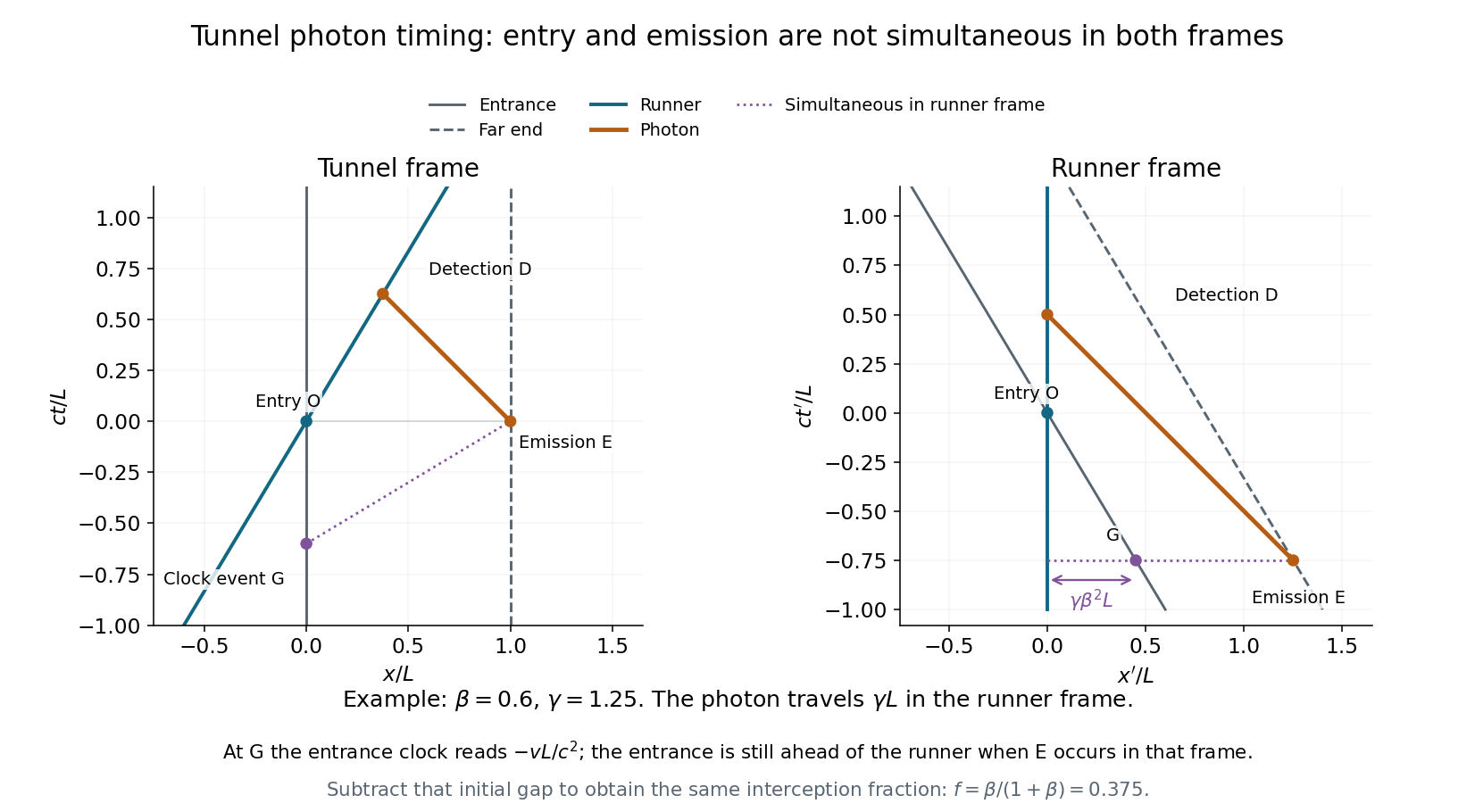
Emission, entry and detection in the tunnel and runner frames
. Original spacetime diagrams for , in units . Event G is on the entrance clock and simultaneous with far-end emission in the runner frame. The runner-frame diagram shows the entrance initially ahead of the runner, and a photon travel distance rather than . Details.
The photon propagates along in the tunnel frame and has energy and momentum . A Lorentz transformation into the approaching runner's frame givesSince , the approaching-source relativistic Doppler effect isIt is a blueshift. With , solving givesThis shift depends on the relative velocity along the light ray, not on the tunnel length or the location of detection.
Articles by others on the same topic
There are currently no matching articles.