Define as the magnitude of the inward central force, so and . The conserved angular momentum is . Eliminating from the mechanical energy yieldsThe added term in the effective potential is the centrifugal barrier. If instead denotes the signed radial force component, the convention becomes .
A circular orbit has constant . Both its initial radial velocity and radial acceleration must vanish, givingEquivalently, the initial tangential speed and angular velocity obeyThe initial polar angle is arbitrary, and the energy is fixed at . Either orientation is possible. These conditions give an exact circular orbit even if it is unstable; stability requires an additional positive second derivative of the effective potential.
For the power law central potential , differentiate the effective potential:The circular orbit condition is . Thus, when , and ,The sign condition expresses attraction. At the force vanishes and there is no nontrivial circular orbit. At , attraction requires and the condition reduces to . In that exceptional case the effective potential is identically zero and every is a possible circular radius for the tuned ; there is no isolated preferred radius. A small radial velocity then gives , rather than an oscillation.
Put , where . The Taylor expansion at a circular orbit isThe constant has no effect on the force. The paper's displayed harmonic potential should be read as this expansion after subtracting that constant and neglecting higher orders; it is not an equality for the absolute effective potential in general. For example, when and , and , whereas the printed quadratic expression is zero at .
Differentiating again and then using givesThe linearized radial equation of motion is , so the radial frequency in a power-law central potential isFor the circular orbit is unstable and radial disturbances grow exponentially, with growth rate . At the linear restoring force vanishes, as described in part (c). Thus an attractive central force alone does not guarantee small oscillations.
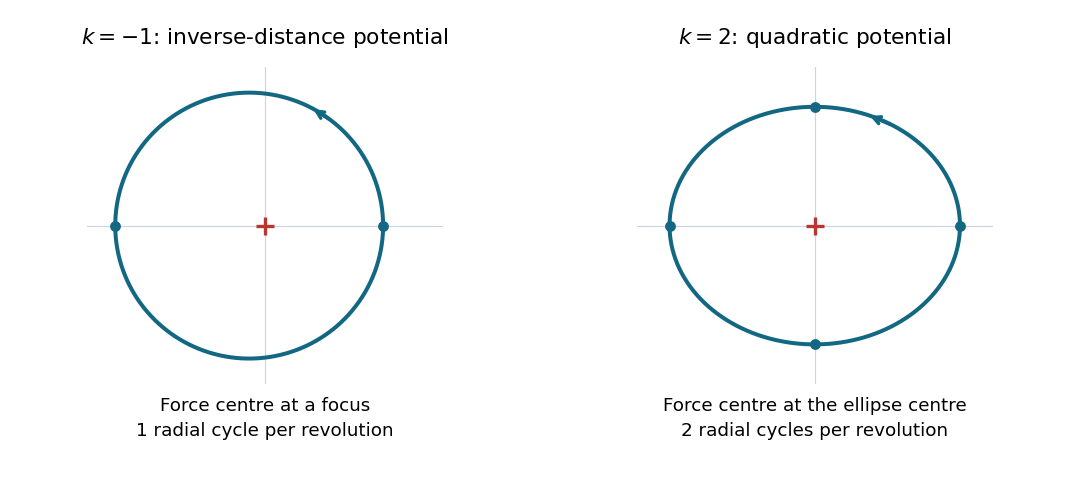
Choose the orientation . To leading order in the radial disturbance, the azimuthal angular frequency is , soFor either orientation the positive frequency ratio is . At , the ratio is : there is one radial oscillation per revolution. The bound Kepler orbit is an ellipse with the force centre at a focus, with one closest and one furthest approach per revolution. Its exact polar coordinates equation isAt , the ratio is : there are two radial oscillations per revolution. The isotropic harmonic oscillator trajectory is an ellipse centred on the force centre. An exact parametrization isHere repeats twice during one full circuit. The two different placements of the force centre distinguish these ellipses. These are the two all-bound-orbit cases of Bertrand's theorem.

Articles by others on the same topic
There are currently no matching articles.