The cover dates this paper to 6 June 2022; the archive member is misleadingly filed under 2021/T. Source gap: printed page 2 is missing from the damaged public PDF. Questions 1–3 cannot be reconstructed; the remaining solutions cover every recoverable part of questions 4–10.
TODO: source missing. Printed page 2, containing question 1, is absent from the supplied damaged PDF. Its statement, subparts and numerical data are unavailable, so no solution can be inferred responsibly.
TODO: source missing. Printed page 2, containing question 2, is absent from the supplied damaged PDF. Its statement, subparts and numerical data are unavailable, so no solution can be inferred responsibly.
TODO: source missing. Printed page 2, containing question 3, is absent from the supplied damaged PDF. Its statement, subparts and numerical data are unavailable, so no solution can be inferred responsibly.
For motion in a central potential, conservation of angular momentum gives . In polar coordinates, the conserved mechanical energy isConsequently, for ,The sign in distinguishes inward and outward motion. Choosing the orientation so , it is also the sign of . The expression under the square root must be nonnegative. If , the motion is radial and is constant, so cannot be parametrized by this way.
Take . At a radial turning point, , and the effective potential givesFor , the smaller positive radial turning point is conveniently written without division by :This includes , where . For there is also an outer radial turning point; the two coincide for the circular orbit at . Smaller energies are inaccessible at that . For there is just one positive radial turning point. If , there is no centrifugal barrier and an inward trajectory can reach the singular centre; its limiting closest distance is zero.
The requested omission of is not possible. For example, at and fixed nonzero , doubling halves . Thus alone cannot determine closest approach.
Use upward generalized coordinates. Let be the displacement of the lower pulley and that of the mass. The two inextensible mechanical strings imposeFor ideal massless pulleys and mechanical strings, only the three masses contribute kinetic energy. HenceUp to a constant, their gravitational potential energy isThe Lagrangian of this compound Atwood machine is therefore
A constant displacement proportional to leaves the velocities unchanged and changes by zero. It is therefore a continuous symmetry of the Lagrangian. The generalized momentum components areNoether's theorem gives the conserved quantityA direct check using the Euler-Lagrange equations isThe normalization of a symmetry generator is arbitrary. One can take the transformation parameter to have length units and dimensionless, giving the units of momentum. Alternatively, for the paper's convention with dimensionless parameter and length-valued , use ; the conserved quantity is then . The conserved content is identical.
The special relativity expression for momentum is , with Lorentz factor . Equal speeds imply equal Lorentz factors, so the pion and proton momenta are in the ratio of their rest masses:The common dimensionless product is , giving and .
By time dilation, the laboratory mean lifetime is , where . The exponential decay law evaluated at travel time gives the surviving pion fractionUse the exact product from part (a), rather than approximating the speed separately. With ,Thus about emerge without decaying, and about decay inside the pipe. This assumes the given common longitudinal speed and neglects losses from other interactions.
Align the spatial axes and make the origins coincide at . For an inertial frame moving at velocity along , the Lorentz transformation isThe inverse Lorentz transformation follows by interchanging primed and unprimed coordinates and replacing by .
Let the object be at rest in , with proper length . Measuring its length in requires two endpoint events simultaneous in , so . The Lorentz transformation then givesThis is length contraction. The simultaneous endpoint events in are not simultaneous in ; that relativity of simultaneity is essential to the measurement.
For the two rockets, take the first rocket's Earth-frame velocity as and the second's as . The velocity-addition formula gives the second rocket's velocity in the first rocket's rest frame:Its Lorentz factor is , and therefore its measured length isHere “appear” is interpreted as a length measured using simultaneous endpoint positions in the observer's inertial frame. A photograph, involving unequal light travel times, is a different measurement.
Write the incident and scattered photon energies as and . Conservation of relativistic energy gives the recoiling electron energy . By momentum conservation, its momentum is the difference of the two photon momenta; henceInsert these into the relativistic energy-momentum relation for the electron:Expanding and cancelling terms givesSince , the Compton scattering formula follows:The scale is the electron Compton wavelength. At , : there is no energy or momentum transfer in this ideal forward limit, so the electron remains at rest. At , the wavelength shift is maximal:The electron gains its largest kinetic energy, , and recoils forward while the photon reverses direction.
Define as the magnitude of the inward central force, so and . The conserved angular momentum is . Eliminating from the mechanical energy yieldsThe added term in the effective potential is the centrifugal barrier. If instead denotes the signed radial force component, the convention becomes .
A circular orbit has constant . Both its initial radial velocity and radial acceleration must vanish, givingEquivalently, the initial tangential speed and angular velocity obeyThe initial polar angle is arbitrary, and the energy is fixed at . Either orientation is possible. These conditions give an exact circular orbit even if it is unstable; stability requires an additional positive second derivative of the effective potential.
For the power law central potential , differentiate the effective potential:The circular orbit condition is . Thus, when , and ,The sign condition expresses attraction. At the force vanishes and there is no nontrivial circular orbit. At , attraction requires and the condition reduces to . In that exceptional case the effective potential is identically zero and every is a possible circular radius for the tuned ; there is no isolated preferred radius. A small radial velocity then gives , rather than an oscillation.
Put , where . The Taylor expansion at a circular orbit isThe constant has no effect on the force. The paper's displayed harmonic potential should be read as this expansion after subtracting that constant and neglecting higher orders; it is not an equality for the absolute effective potential in general. For example, when and , and , whereas the printed quadratic expression is zero at .
Differentiating again and then using givesThe linearized radial equation of motion is , so the radial frequency in a power-law central potential isFor the circular orbit is unstable and radial disturbances grow exponentially, with growth rate . At the linear restoring force vanishes, as described in part (c). Thus an attractive central force alone does not guarantee small oscillations.
Choose the orientation . To leading order in the radial disturbance, the azimuthal angular frequency is , soFor either orientation the positive frequency ratio is . At , the ratio is : there is one radial oscillation per revolution. The bound Kepler orbit is an ellipse with the force centre at a focus, with one closest and one furthest approach per revolution. Its exact polar coordinates equation isAt , the ratio is : there are two radial oscillations per revolution. The isotropic harmonic oscillator trajectory is an ellipse centred on the force centre. An exact parametrization isHere repeats twice during one full circuit. The two different placements of the force centre distinguish these ellipses. These are the two all-bound-orbit cases of Bertrand's theorem.
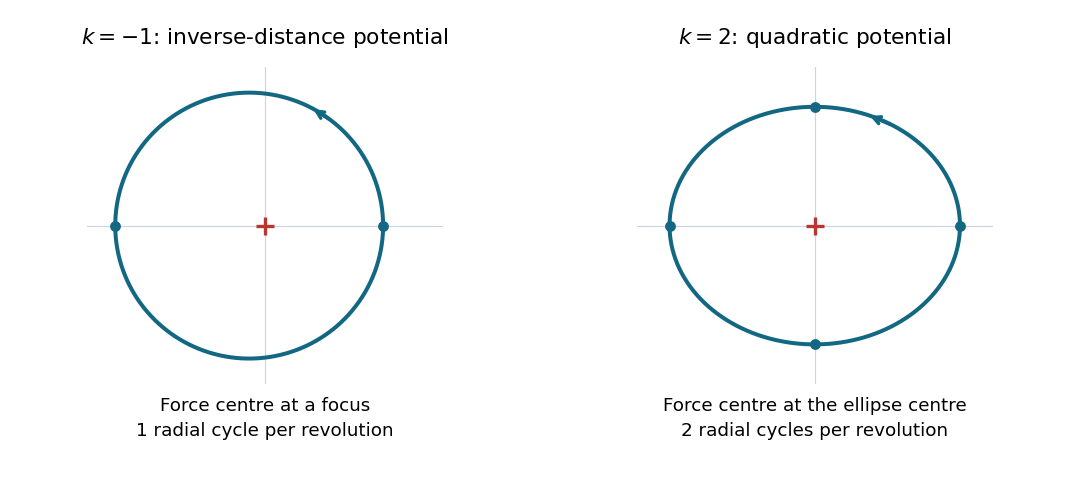
Nearly circular ellipses: one radial cycle about a focus for the inverse-distance potential, and two about the centre for the quadratic potential
. Details. 
The diagram makes the remaining distance to the wall: decreases from to . With the endpoint condition , integrating the supplied mass gradient givesAssume escaping sand has the same horizontal velocity as the bucket at release. There is then no horizontal recoil: the momentum flux of the outgoing sand cancels the contribution to the bucket's momentum derivative. The variable-mass system equation is thereforeSet , the speed towards the wall. Since , the initial condition givesConsequently the remaining sand has kinetic energyIn terms of , . Its derivative is and its second derivative is , givingThe magnitude of the remaining sand's momentum isIt is easier to maximize its square, . Its derivative is , giving the unique interior maximumBoth kinetic energy and momentum tend to zero at , even though the idealized speed diverges. There is no finite-mass bucket left at the endpoint, so that divergence signals the limit of the idealization.
The leaking bucket under constant tension has : the kinetic energy maximum is closer to the wall. As the bucket loses mass, its increasing speed continues to boost after has begun to fall. Equivalently, and , so kinetic energy has the stronger dependence on the growing speed. The work is shared between the remaining sand and the sand already lost; it is not all the bucket's instantaneous kinetic energy.
Take upward velocity as positive, and let be the rearward rocket exhaust speed. During , the ejected parcel has mass and laboratory velocity to first order. The momentum change of the rocket and this parcel equals the gravitational impulse:Discarding the second-order product gives the vertical rocket equationWith and , integration for free flight starting from rest at givesThe logarithmic term is the ideal Tsiolkovsky rocket equation contribution; is the gravity loss. Immediate upward departure requires positive initial acceleration, orAt exact equality the initial acceleration is zero, but further burning reduces the weight and permits departure immediately thereafter. If departure is allowed to be delayed while fuel burns on the pad, the condition is instead at some time before burnout. With final rocket dry mass , any powered departure before burnout requires ; the free-flight formula then starts at the actual departure time with , giving .
For the specified data, the initial mass includes the payload. The rocket fuel fraction givesThe payload is already part of the final mass; it is not the entire rocket dry mass and must not be added a second time. Here , well below the stated rocket exhaust speed, so departure is immediate. The burnout speed isThis is the speed at burnout. Subsequent motion under the assumed uniform gravity has .
For an equal-speed elastic impact on a free rod, let be the signed distance of the impact point from the rod's center of mass, , and the horizontal impulse delivered to the rod. For a smooth impact the impulse is perpendicular to the rod. If the ball's signed final velocity is , the rod's center of mass velocity is and its angular velocity is , momentum balance and angular impulse giveBoth objects have positive final translational velocities for a nonzero impact away from the centre. More explicitly, restitution in an elastic collision gives , and henceEqual final speeds thus require . One can also see that the alternative would violate .
By conservation of kinetic energy in the elastic collision,Thus . Since , elimination of givesEither side of the center of mass works; the nearer end is a distance away. The final angular speed is . These values also satisfy the restitution condition because the struck point's velocity is , reversing the initial relative contact velocity.
The free rod has the same mass and length as in part (a). There is no pivot. Put the rod's initial center of mass at and the impact end at . At impact the combined center of mass isConservation of momentum gives the combined center of mass velocity . Evaluate angular momentum about this combined center of mass; the incident ball's perpendicular lever arm is , so its initial magnitude is .
After the perfectly inelastic collision, the parallel axis theorem gives the combined moment of inertiaWith negligible external angular impulse, conservation of angular momentum therefore givesIts sense is that of the incident ball's angular momentum, clockwise in the source diagram. As a consistency check, the final kinetic energy isThus , or one fifth of the initial kinetic energy, is dissipated in sticking. Treating the rod's original centre as a fixed pivot would give an incorrect angular velocity.
Let be the center of mass acceleration downhill and the uphill static friction. Translation and rotation about the center of mass obeyThe rolling without slipping constraint is . For the coin's moment of inertia , this gives , soThe normal force is . Static friction can enforce rolling without slipping only if , givingThe static friction acts uphill to provide the torque; it is not automatically equal to , attaining that limiting value only at the threshold. For finite the result lies between and .
Articles by others on the same topic
There are currently no matching articles.