Apply the radial momentum operator to a smooth radial test function. More generally , giving the first two labelled identities. Expanding the square gives the third:The kinetic-energy decomposition is . A central potential commutes with and , so choose simultaneous angular eigenfunctions , with and . The radial Hamiltonian consequently has the stated centrifugal term. The radial inner product uses measure ; adjoints below are taken on compatible regular bound-state domains. The formal radial momentum is not thereby asserted to be a self-adjoint observable on a half-line.
Set , and . Since formally and ,The hydrogen radial Hamiltonian factorization follows by matching the Coulomb coefficient, which fixes the Bohr radiusFor the second pair of labelled relations, the opposite product changes the sign of , henceUsing in the factorization then givesThis Coulomb angular-momentum intertwining means applying to an energy eigenstate either gives zero or an eigenstate of with the same energy. For a normalized negative-energy state,At fixed this would become negative if raising continued indefinitely. The bound-state ladder termination by norm positivity occurs at some with , givingThe terminating radial function is proportional to , regular and normalizable; adjoint intertwiners generate lower values at fixed . Positive-energy scattering states are not subject to this terminating negative-energy argument. Here is the mass in the supplied Hamiltonian; including nuclear motion replaces it by the reduced mass.
The remaining cyclic commutators are and . In a spin- irreducible representation,For spin one-half, , appropriate to an electron's spin. Each , so this Hamiltonian is . The orthonormal vectors and are eigenstates with the same energy ; every normalized superposition is also an eigenstate. The term vanishes identically because spin-one-half quadratic anisotropy is constant.
For the supplied three-dimensional basis one consistent choice isThese Hermitian matrices obey the cyclic commutators with the given , and , representing spin one. Their squares giveThus the three normalized Cartesian basis vectors have energies , and , respectively; degeneracies permit arbitrary orthonormal choices in the corresponding eigenspaces.
The parallel and antiparallel states are and . Evolution from the first givesThis spin-one reversal under quadratic anisotropy is complete whenprovided . If , its initial state is stationary up to phase and complete reversal never occurs. Assume real for a Hermitian Hamiltonian.
The stationary equation isThe second derivative represents kinetic energy; the delta term is an attractive point interaction, with having dimensions energy times length. A jump in would produce a delta derivative in , with no matching term in this potential, so is continuous. Integrating through the origin givesFor define . Each side has general solution with independent constants. Square integrability retains on the left and on the right. The jump requires , and wavefunction normalization givesThere is one bound state for every .
For write . General solutions are independent combinations of and on each side. For incidence from the left choose and . Continuity gives and the jump gives . With ,The incident and transmitted velocities are equal, so squared amplitude ratios are current ratios here. At fixed positive energy, gives full transmission and increasing gives increasing reflection, approaching unity. Even an attractive point well reflects quantum waves; energy is conserved, and the static potential does not irreversibly capture the incident particle into its bound state.
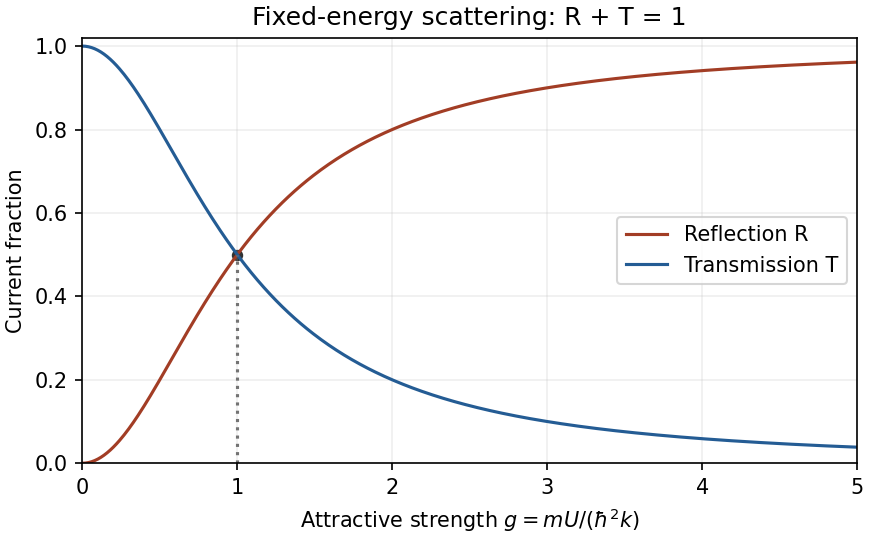
Original reflection and transmission curves versus dimensionless attractive-well strength at fixed incident energy
. Details. 
The anisotropic quantum harmonic oscillator is a sum of three commuting one-coordinate oscillator Hamiltonians. Substituting and dividing by gives a sum of three functions of independent coordinates, so each equals a separation constant. ConsequentlyFor a time-independent operator, conservation for arbitrary states follows from , since . The first labelled operator is ; the second is . The kinetic energy is rotationally invariant. The potential is invariant under rotations about precisely when (i) ; full rotational invariance requires (ii) . For positive oscillator frequencies these are equality of the frequencies themselves. Acting with the commutators on arbitrary test functions excludes anisotropic potentials in case (ii).
In the isotropic case let . ThenThe polynomial is the first excited oscillator factor and the other two factors are ground-state Gaussians. The first excited spatial level has three independent choices, proportional to . Odd parity gives , and Gaussian integration yieldsFor oscillator uncertainty and allocation of classical energy, the mode has energy , whose classical amplitude is , giving . If “same energy” instead means assigning the entire three-dimensional energy to one classical coordinate, its amplitude is and the ratio is . A general three-dimensional classical orbit's amplitude is not fixed by total energy without specifying its allocation among modes.
The capacity of an isotropic oscillator shell, including the two electron spin states, is electrons. Nine non-interacting electrons occupy shells as for . ThusThe least positive excitation promotes an electron by one oscillator quantum. Rearrangements within the partly filled degenerate shell remain ground states and cost no energy.
Articles by others on the same topic
There are currently no matching articles.