time average of harmonic power. Expand the two real parts:The terms proportional to average to zero over complete periods, while is time-independent. For real peak amplitudes this is .
String dynamics. A short element of length experiences transverse force . Newton's second law therefore gives , orThe approximation is a flexible, lossless string with small slope and constant tension; is its linear mass density.
energy transport. Across a cut toward increasing , the transverse force is and the transverse velocity is . For a rightgoing wave these have complex amplitudes and . HenceThis real mechanical impedance is force divided by transverse velocity for a travelling wave, with units .
Matching and power ratios. At an ordinary massless junction without an external transverse force, displacement is continuous and transverse tension is balanced: , . For the same tension, the slope is therefore continuous even if density changes. With real positive impedances,Their sum equals ; the transmitted power includes the impedance ratio and is not simply .
Substituting into the junction formula givesEqual densities give zero reflection; a very large mismatch gives nearly complete reflection. reflection from the higher-impedance side reverses displacement phase.
At the zero-slope boundary, the rightgoing and leftgoing slopes cancel, so . ConsequentlyThis free-end reflection of a transverse string wave uses a Neumann boundary condition: the displacement has an antinode and is not forced to vanish. The instantaneous flux through the boundary is zero, confirming that it transmits no power.
Response and resonance. The terms , and describe inertia, linear viscous resistance and the spring's restoring force; the right side is the applied harmonic force. Substituting the complex trial motion and taking real parts givesThe steady response excludes the decaying homogeneous transient. Its magnitude is . Differentiating the denominator gives , soA nonzero-frequency amplitude maximum exists only for ; otherwise the maximum is at zero frequency. Increasing damping lowers and broadens the peak and shifts it downward. Every curve starts at and tends to at high frequency.
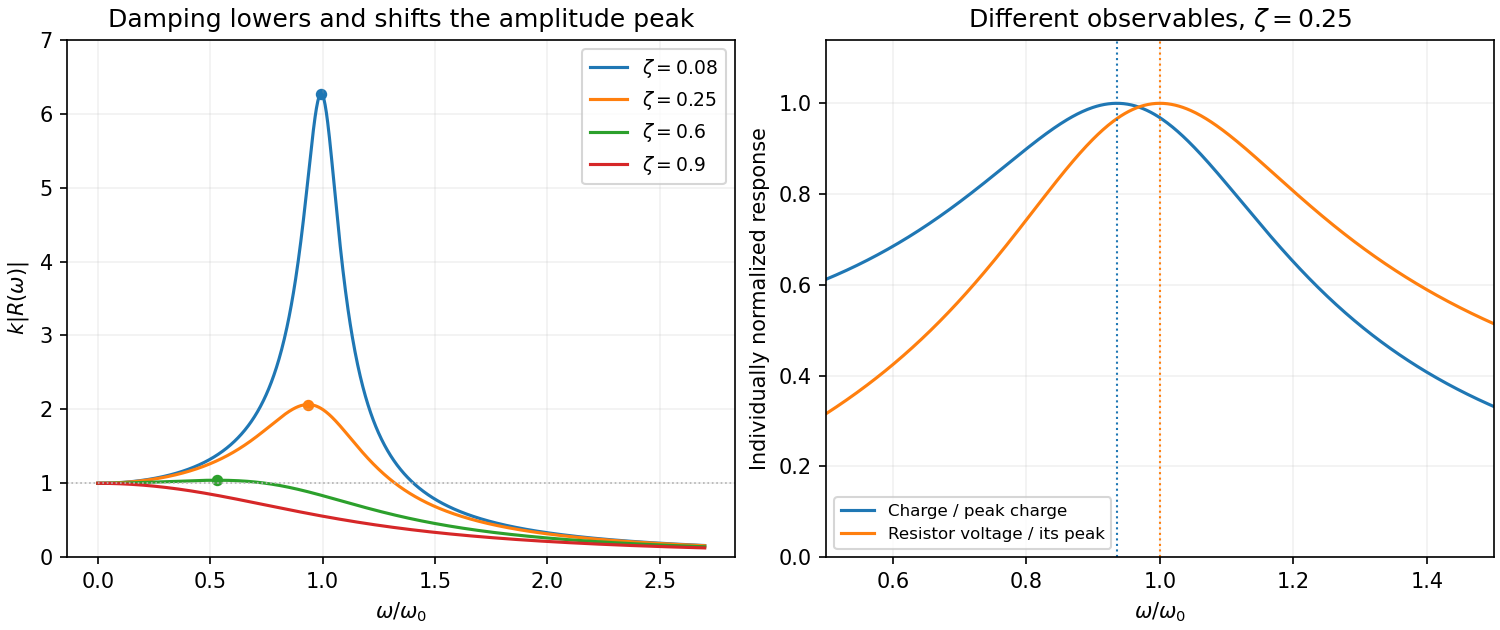
Original normalized oscillator response for several damping ratios, distinguishing amplitude and current resonance
. Details. 
Series circuit. The PDF circuit has the resistor, inductor and capacitor in one loop. With current , Kirchhoff's voltage law gives , henceThus correspond to . The resistor's rms voltage isIt is maximized exactly at for . The charge-amplitude resonance is lower. Expanding its square root for givesThe two maxima refer to different observables: resistor voltage follows current, whereas charge follows displacement.
Packet and group index. A wave packet superposes nearby wavevectors to form a localized envelope. The phase velocity is ; for a narrow packet with weak distortion the envelope velocity is . Since ,For the stipulated linear index, , not simply .
bandwidth and speed spread. A pulse lasting has Fourier bandwidth of order , so ; an exact width coefficient depends on pulse shape and width convention. At the carrier,Across a full bandwidth ,Higher-frequency components have the lower group velocity. For a band symmetric about , the endpoint velocities are approximately .
dispersion-limited digital-fibre link length. Differential group delay accumulates asThe pulse spacing is . Pulse overlap and intersymbol interference become serious when the dispersive spread approaches that spacing, givingA conservative full-width estimate gives about 45 km; this refinement is not a universal sharp boundary because pulse shape, chirp and detection tolerance are unspecified. Attenuation and modal or waveguide dispersion could impose further limits, but are not quantified by the supplied index law.
digital optical pulse regeneration. Each stage must recover and regenerate the data with fresh, short pulses and correct timing, as well as restore signal level. Amplifying the already broadened waveform alone does not remove accumulated dispersion; explicit dispersion compensation is an alternative to full regeneration.
Far-field transform. For transverse aperture scale and screen distance , the quadratic phase across the aperture is negligible when , equivalently a small Fresnel number up to geometrical factors. Expanding the source-to-screen distance at transverse screen coordinate givesDropping the final aperture-dependent term and treating the prefactor as constant givesThus intensity is the modulus squared of the aperture Fourier transform. A lens focal plane supplies the same angular transform without a very distant screen. The infinitely extended vertical dimension is treated per unit vertical extent.
half-slit phase-reversal diffraction. Put on the left half and on the right half. With and ,ThereforeThe apparent singularity at zero angle is removable: , so the centre is dark. Normalizing by the uncoated slit's on-axis intensity gives . Noncentral zeros have , or . The two largest lobes are symmetric, at the first nonzero root of , , giving when those directions propagate. Smaller lobes lie farther out under a decaying envelope.
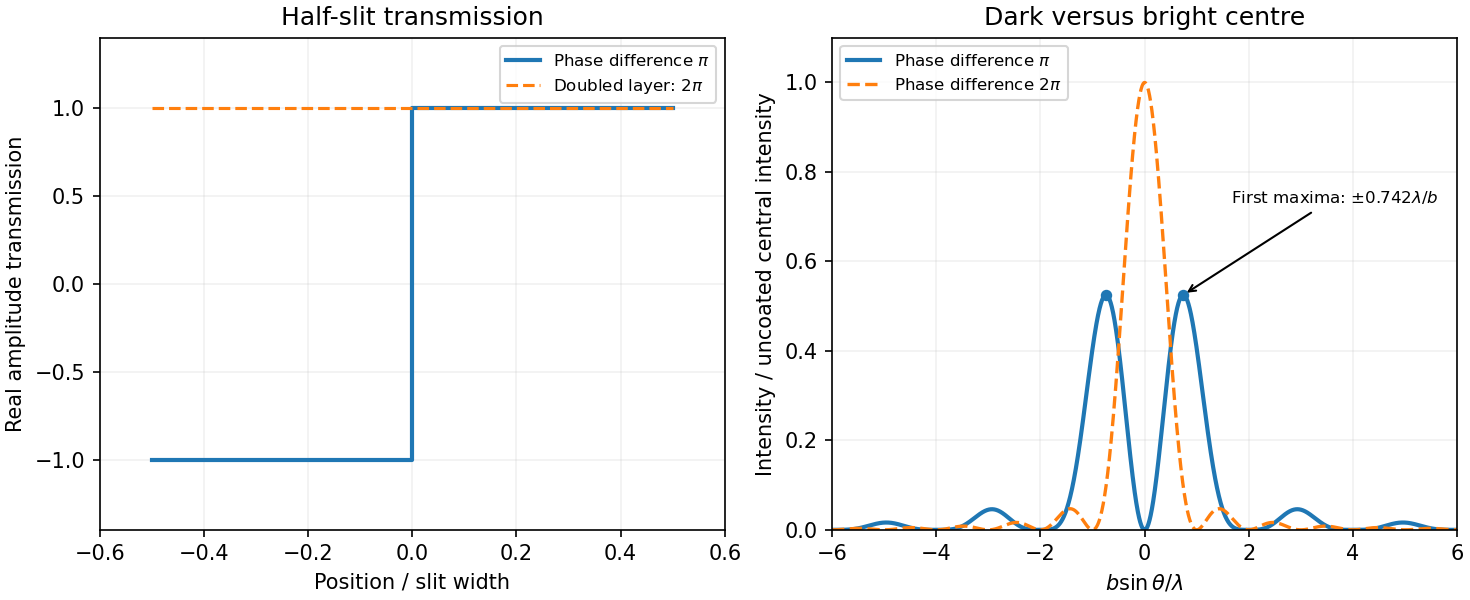
Original calculated half-slit phase-reversal pattern and its change when the phase-layer thickness is doubled
. Details. 
Doubled thickness. Neglecting absorption and interface reflection, the phase delay doubles from to . Both halves then transmit with the same phase, recovering the ordinary single-slit patternIt has a bright centre and first zeros at . The phase layer redistributes transmitted power rather than absorbing it in this idealization.
Articles by others on the same topic
There are currently no matching articles.