Write the one-electron Coulomb energies as , . The Pauli exclusion principle allows electrons in shell , including spin. The ground configuration therefore has two electrons in and seven in , giving . The least energy-increasing promotion is from to :Rearranging the partly occupied degenerate shell does not produce a higher energy. Both total energies are negative, so this ratio is below one even though .
Choose the centre of the finite square well as the origin and its edges as . The first three bound wavefunctions have even, odd, even parity, with respectively zero, one and two interior nodes. They oscillate inside and decay exponentially outside, with . Both the wavefunction and its first derivative are continuous at each finite potential step. The higher bound states have longer external decay lengths because they lie closer to the barrier height. Overall sign is arbitrary.
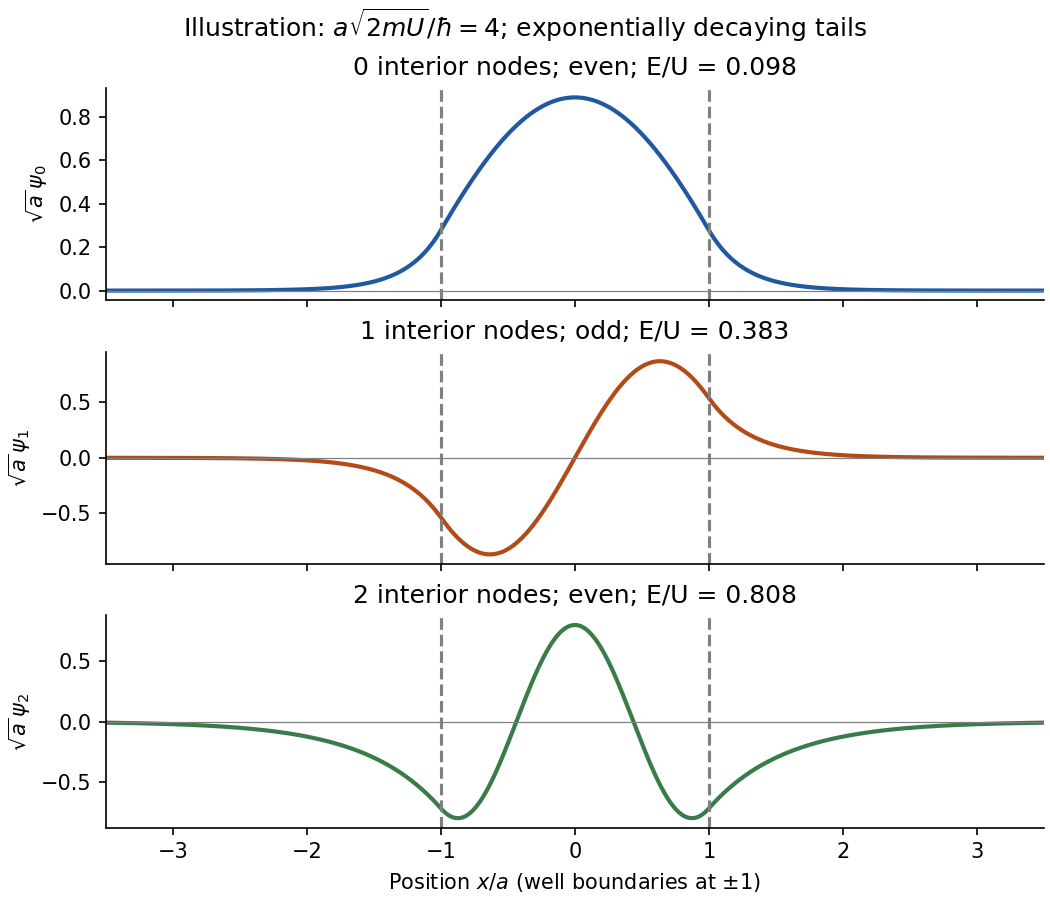
Original normalized finite-well eigenfunctions with parity, nodes and exponential tails; illustrative dimensionless depth, not supplied numerical data
. Details. 
Confinement to length gives a momentum scale by the Heisenberg uncertainty principle. Using the alpha-particle mass , its speed scale is . Counting encounters with either wall,This is an order-of-magnitude collision-rate estimate, not a classical trajectory of a stationary quantum state. Taking , a different geometric interpretation of the well size, or successive returns to the same wall changes the coefficient by factors of order unity; the robust scale is .
Let denote detection. Weight each incident fraction by its detection efficiency, not by its loss probability. Bayes' theorem givesThus about 2.83% of detected particles are in the high-energy group. Energy-dependent detector dead time changes the composition of the observed sample.
Interpret the quoted r.m.s. as the root-mean-square fluctuation about the mean, namely the standard deviation . Standardization gives . The supplied cumulative Gaussian curve gives , henceThe exact Gaussian value is . A raw r.m.s. temperature of could not coexist with a mean of ; the spread interpretation is required.
Articles by others on the same topic
There are currently no matching articles.