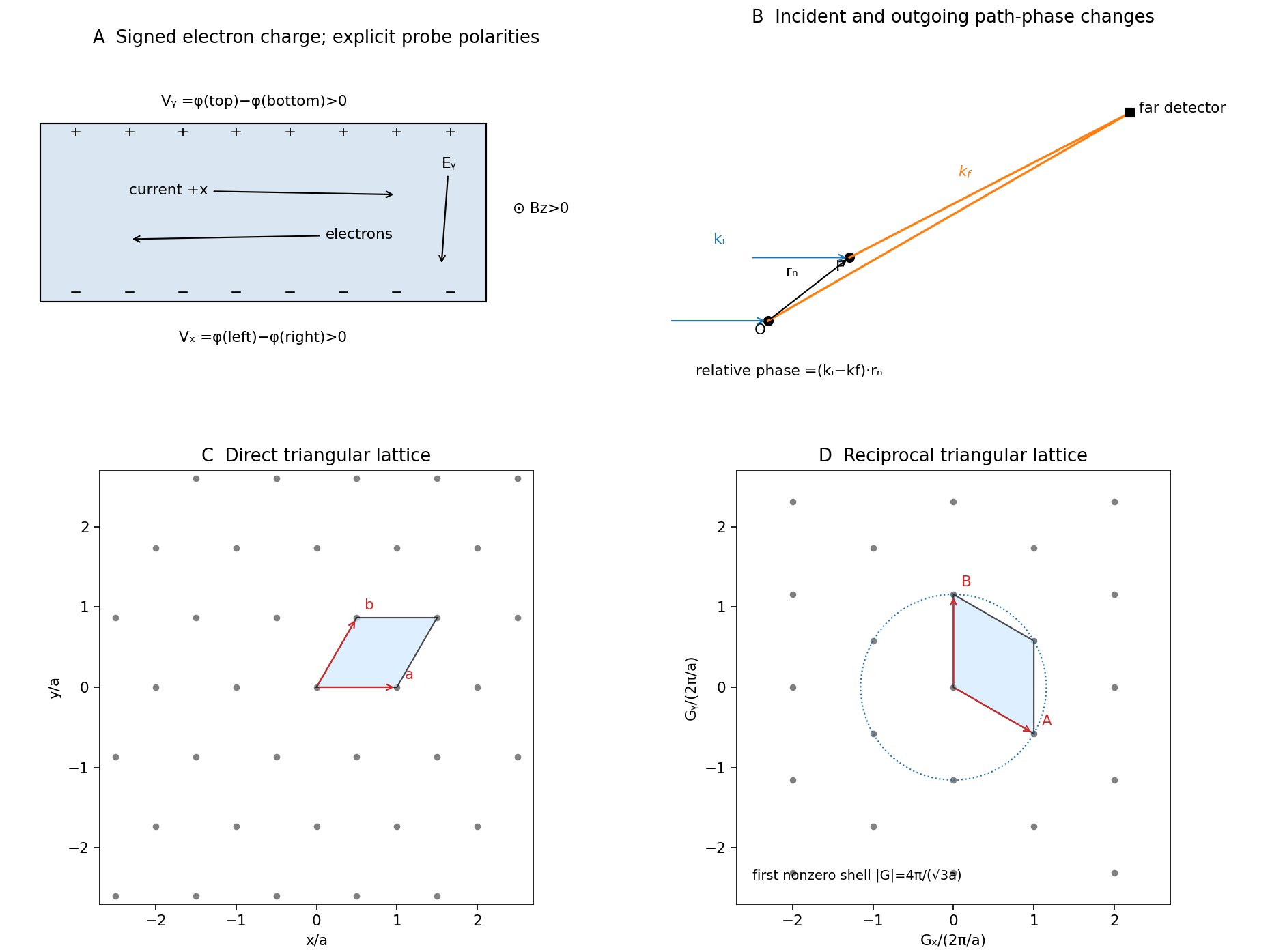
Take the electron's signed charge to be , where is the elementary-charge magnitude. Conventional electric current flows along , while the mean electron drift velocity is negative. With , the magnetic Lorentz force separates charge across the width until a transverse electric field balances it. The accumulated edge charge then sustains a Hall voltage without a transverse steady current. In a one-carrier model, the Hall coefficient identifies the sign and number density of carriers; real multiband materials require a more careful interpretation.
The acceleration term contains the effective mass describing the local band response. The relaxation term removes drift momentum on the mean momentum-relaxation time . The remaining two terms are the electric and magnetic Lorentz force on signed charge ; the magnetic force is perpendicular to velocity and does no instantaneous work. The relaxation-time approximation replaces individual scattering events by an averaged drift equation.
Let be the electron number density, distinct from the negative charge . In transverse open circuit and . The steady component equations givehenceConsequentlyThere is no sign ambiguity in this field-defined once axes and carrier charge are fixed.
A measured voltage ratio additionally needs probe polarities, which the geometric bar diagram does not label. To reproduce the positive ratio specified for electrons, define the longitudinal voltage drop and the transverse rise . ThenReversing either voltage's probes reverses the measured ratio, without changing the physical carrier density. With both voltages instead defined as drops along their positive axes, the algebraic ratio would have the opposite sign. The figure records the convention used here.
A monovalent copper model assigns roughly one delocalized conduction electron per atom to a broad, approximately free-electron-like band. Using is therefore a sensible first estimate for its transport scale. Monovalence alone does not prove that every band curvature or orbit has exactly the free mass: periodic-potential mixing, the nonspherical Fermi surface and direction-dependent scattering limit the model. The calculated is conditional on the stipulated effective-mass approximation.
Experimentally, reverse both current and magnetic field and extract the part of the transverse voltage odd in each. This rejects fixed contact offsets and much longitudinal pickup; use four-terminal longitudinal sensing, measure dimensions independently and check heating before assigning material parameters. These controls are implemented in a reusable Hall/conductivity teaching experiment, although that experiment uses germanium rather than the copper sample here.[ref]
The Hall Effect and Conductivity in Germanium by Rex Tayloe. pp.1–3, equipment, contact geometry, room-temperature conductivity and four current/field polarity combinations

The reciprocal lattice consists of all wavevectors whose plane-wave phase is unchanged under every direct-lattice translation :It expresses periodicity in wavevector space, with dimensions of inverse length.
Choose incident field convention . The wave at the second atom acquires incident phase relative to the atom at the origin. Its path to a distant detector is shorter by approximately , contributing outgoing phase . ThereforeNeglecting variation of detector distance across the specimen, identical atoms have a common scattering amplitude factor andThe original geometry diagram shows the incident direction, outgoing direction and direct-space displacement separately; is a wavevector difference, not an extra ray path.
The primitive reciprocal vectors obeywith cyclic versions for . If , every lattice term has phase times an integer, so all terms add constructively. Conversely, full translational reinforcement requires , and to be integer multiples of , hence is reciprocal. These are the Laue equations. A finite crystal gives finite-width maxima rather than ideal reciprocal-space delta peaks; elastic scattering must also satisfy .
For the two-dimensional Bravais lattice interpretation, with one atom per primitive cell, takeSolving the duality conditions givessoThe reciprocal primitive vectors have equal length and angle ; the array itself is triangular. A different primitive basis can use a angle without changing the lattice. The direct primitive-cell area is and its reciprocal-cell area is divided by that area.
For nonzero integer pairs, has minimum one, attained for six shortest vectors. Therefore the first nonforward maximum has . If the forward transmitted maximum is included literally, the smallest value is ; the nonzero value is the first diffraction shell. Reaching that shell in elastic scattering additionally requires .
Articles by others on the same topic
There are currently no matching articles.