Use the quantum free electron model: conduction Electrons move as independent particles in a three-dimensional box of volume , with a uniform positive background replacing the ionic lattice potential. Neglect the detailed periodic potential and explicit electron-electron interactions; the interior one-electron dispersion relation is . The boundary confines the particles, and its detailed shape does not affect the bulk state count in a sufficiently large sample.
The Electrons are spin- fermions: each spatial quantum state accommodates two opposite spin states, with occupations given by the Fermi-Dirac distribution and the Pauli exclusion principle. A fixed number of conduction Electrons and thermal equilibrium are assumed. Collisions can be represented by a phenomenological momentum relaxation time for transport, but are unnecessary for the equilibrium state counting here. These assumptions distinguish the quantum model from a classical Maxwell-Boltzmann Electron gas.
Impose periodic boundary conditions on a large cubic box. The allowed wavevectors occupy a lattice of cell volume in wavevector space. Including the two spin states, the number of states with magnitude at most isUsing and differentiating gives the total, spin-summed three-dimensional free-electron density of states,It counts states per unit energy; divide by for states per unit volume per unit energy. At zero temperature, the Fermi-Dirac distribution fills all states up to the Fermi energy, givingWriting givesThe energy zero is the bottom of the free-electron band. The electron Fermi temperature is .
The occupation probability of an individual one-electron state is the Fermi-Dirac distribution,At , it is a step: one below and zero above it. Heating rounds the step over an energy range of order a few , creating empty states below and occupied states above the chemical potential. At every positive temperature, .
For fixed in the three-dimensional free electron model, the chemical potential is determined by ; it is not exactly constant. In the degenerate regime , the Sommerfeld expansion givesIt is therefore reasonable in a simple low-temperature sketch to set , provided this approximation is stated. The figure includes the leading small shift. At much higher temperature the fixed- approximation fails and the distribution approaches the classical dilute limit. The plotted occupation is , rather than the energy distribution .
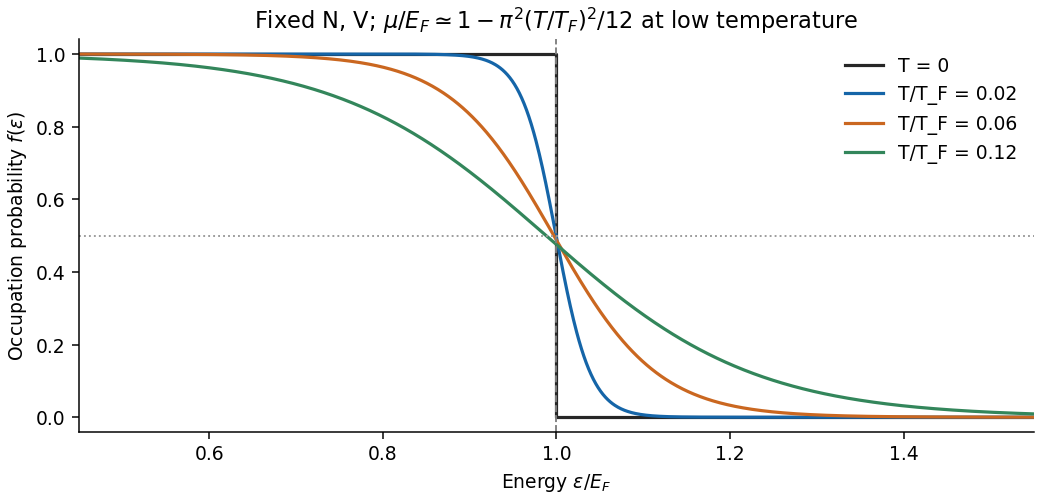
Thermal rounding of Fermi-Dirac occupations at fixed particle number, with the leading chemical-potential shift
. Details. 
Only a shell of energy width of order near the Fermi energy can change occupation: much lower states are blocked by the Pauli exclusion principle. The thermal-shell estimate of electronic heat capacity countsTo recover the rough coefficient requested in the paper, assign each of these active particles an excitation energy of order . ThenThe differentiation matters: the active shell itself widens as temperature rises. This argument explains the small linear-in- electronic heat capacity; its shell width and average excitation energy are heuristic, so it does not establish a precise numerical prefactor.
A controlled calculation from the Fermi-Dirac distribution gives a nearby but different result. At fixed particle number, the Sommerfeld expansion yieldsThus is a rough estimate of the exact free-electron coefficient , not an exact consequence of the stated density of states. Both require .
Assume sodium supplies one conduction Electron per atom. The supplied Fermi energy givesThe gas is strongly degenerate at room temperature. For one mole, and . Using the requested estimate,The supplied mass density determines the answer per unit volume: . ThereforeThe density is not needed for the molar heat capacity once is supplied. Using the precise Sommerfeld expansion coefficient instead gives .
Either electronic estimate is only about of the stated measured total. Most of the total heat capacity comes from lattice phonons, whose high-temperature Dulong-Petit law limit is . The remaining difference from need not be electronic: anharmonic lattice effects and the difference between heat capacity at constant pressure and heat capacity at constant volume also contribute. The paper does not specify the measurement constraint, so the two totals should not be equated exactly.
Articles by others on the same topic
There are currently no matching articles.