Locally, zero curl permits ; for a global single-valued potential the circulation around every noncontractible loop must also vanish. incompressibility gives . The exterior of a cylinder is multiply connected, so local irrotationality alone does not exclude a circulating solution.
For inviscid constant-density flow under conservative gravity, Euler's equation is . The identity gives, for irrotational flow,For steady flow, absorb the potential's time-only gauge term and obtain throughout the connected fluid region. Without irrotationality the steady constant need only be common along each streamline.
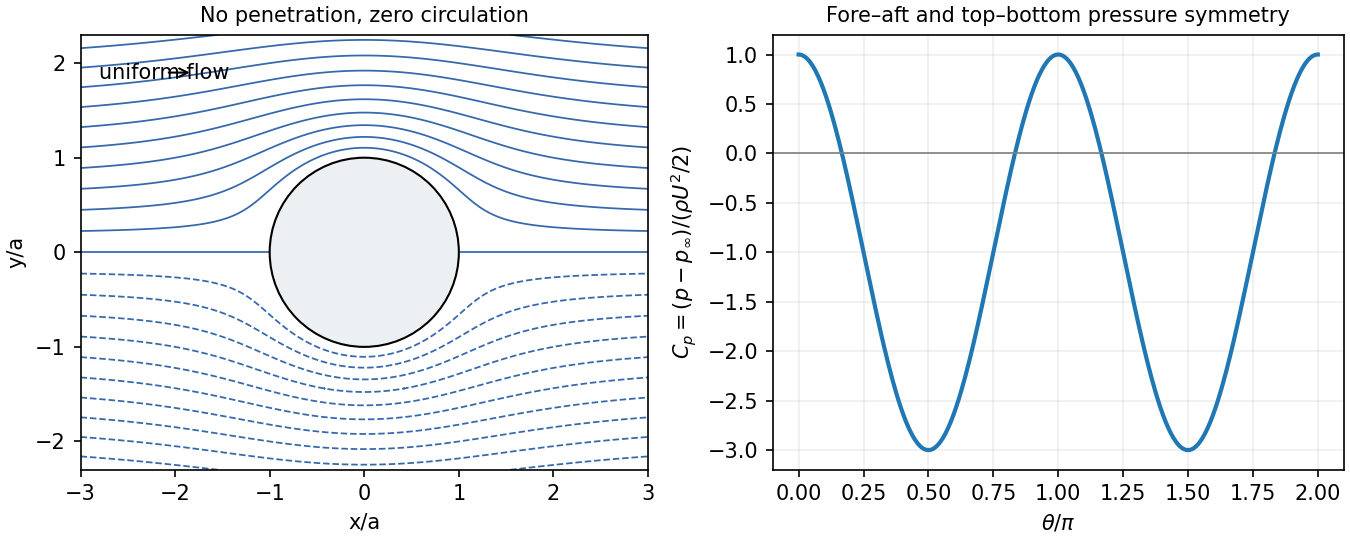
Use for the uniform upstream speed and take the flow along . The boundary conditions are and at infinity. A perfect inviscid model imposes no penetration, not no slip. For the intended no-circulation solution, require a globally single-valued potential, so the coefficient of is zero. The logarithmic term would be a net source and violates no penetration, so its coefficient is also zero. Growing terms with violate the uniform far field. For each remaining , the surface normal condition then forces its decaying coefficient to vanish. The terms satisfy and :An irrelevant additive potential constant is understood. At the same elevation, Bernoulli balance with the upstream stream givesThe force per unit height ispressure symmetry gives zero drag and zero lift in this zero-circulation idealization. D'Alembert's paradox is the failure of this inviscid model to represent real separated viscous wakes and their drag, not a claim that a real pole feels no force.
The zero-circulation assumption matters: leaves the stated velocity boundary conditions intact but adds to the surface tangential speed. It produces for positive counterclockwise circulation. Thus the boundary conditions alone do not justify excluding the angular term; an initially noncirculating inviscid start, or an explicitly single-valued potential, supplies the missing condition.[ref]
Flow Past a Cylindrical Obstacle by Richard Fitzpatrick. equations 5.73–5.81 and discussion after 5.83: circulation, force and the zero-circulation initial condition

Articles by others on the same topic
There are currently no matching articles.