Phase equilibrium minimizes Gibbs free energy at specified temperature, pressure and composition. Coexisting phases have equal temperature, pressure and chemical potential. For a pure substance, a first-order transition has continuous equilibrium Gibbs free energy but a jump in its first derivatives, such as entropy or volume; the latent heat is . Continuous transitions lack that latent heat and can instead have singular or discontinuous higher responses.
The van der Waals molar equationcombines an excluded-volume correction with attractive interactions. Its inflection conditions giveBelow , the oscillatory isotherm contains a mechanically unstable segment with . Equilibrium instead replaces the loop by a constant-pressure coexistence line. Equality of chemical potentials gives the Maxwell construction,On isothermal compression the gas reaches saturation, then converts progressively into liquid at fixed pressure. The mean molar volume obeys , where is the gas fraction. Metastable superheated or supercooled states can persist when nucleation is delayed; they are not the global equilibrium selected by this construction.
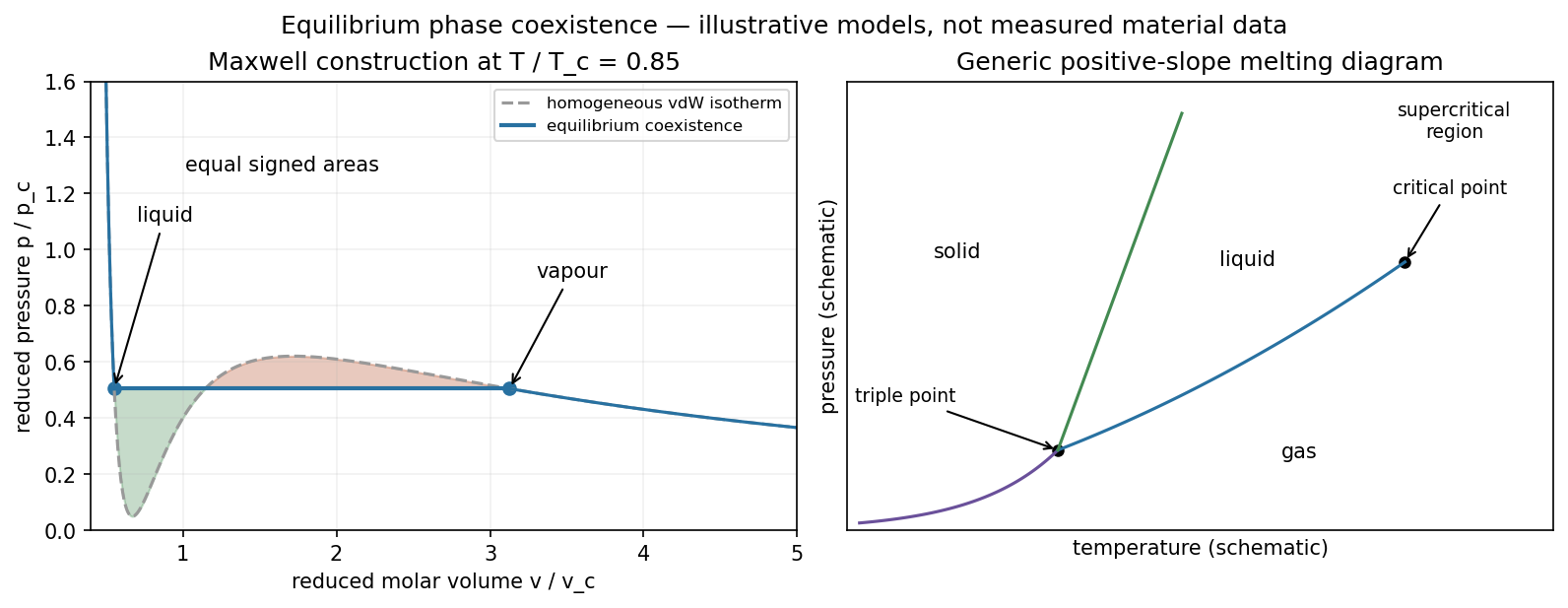
Illustrative reduced van der Waals coexistence and a generic pure-substance phase diagram
. Details. 
A pressure–temperature phase diagram contains coexistence curves separating solid, liquid and gas. Three phases meet at a triple point; the liquid–gas coexistence curve ends at a thermodynamic critical point, above which liquid and gas can be connected without crossing a first-order phase boundary. A generic solid–liquid line continues beyond the liquid–gas critical temperature. For one component the Gibbs phase rule is , so a three-phase equilibrium fixes both temperature and pressure.
Along a two-phase coexistence curve, for each phase givesThis is the Clapeyron equation, valid with consistent molar or specific quantities. For vaporization, neglecting the liquid volume and treating the vapour as ideal gives , hence . With approximately constant molar latent heat,This Clausius–Clapeyron approximation explains the rapid rise of vapour pressure with temperature. It fails close to the thermodynamic critical point, where phase volumes converge, and is not a universal expression for melting. The sign of a melting-line slope depends on its volume change; water's denser liquid gives a familiar negative slope.
Articles by others on the same topic
There are currently no matching articles.