For speed distribution normalized to one and isotropic directions, the incident number flux isThe positive normal velocity weights the population reaching the wall. Consequently its mean translational energy isThe bulk value would omit the arrival weighting.
For the two vessels, let , with subscripts h and c for hot and cold. Equal opposing effusion rates give . Number conservation in equal, fixed volumes adds . HenceBoth final pressures must be determined; holding the cold temperature fixed does not hold its particle number fixed.
For aperture area , the common one-way flux is . The translational heat transfer from hot to cold is thereforeThis is the total heat transfer for a monatomic gas with no active internal modes, neglecting radiation and conduction through vessel walls. For a molecular gas, add for its internal energy per molecule. The maintained unequal temperatures describe a stationary nonequilibrium state even though the net particle current is zero.
A thermodynamic potential packages the equilibrium state in variables suited to the imposed constraints. For a simple fluid, has differential . Legendre transforms give , and , with natural variables of a thermodynamic potential , and respectively. At fixed particle number, Helmholtz free energy is minimized at fixed ; Gibbs free energy at fixed .
A flow vessel is an open control volume, even if its walls are enclosed. For each inlet, pressure forces carry flow work in addition to internal energy. The steady first-law balance isWith no heat exchange, shaft work, or significant kinetic and gravitational energy differences, the enthalpy fluxes are equal. Mass flow must also balance. This equality concerns mass-flow-weighted specific enthalpies, not an unweighted sum over pipes.
Using for the printed specific enthalpy, the formal outlet mass balance givesFor fixed outlet enthalpies the greatest yield occurs at the smallest inlet enthalpy. Among the tabulated pressures this is 30 atm. Approximating the atmospheric-pressure gas enthalpy by the tabulated zero-pressure limiting value givesThis uses a low-pressure approximation: atm is not literally the zero-pressure table entry. Linear interpolation to 1 atm would instead give and . The sparse table does not determine an exact continuous optimum between entries.
TODO: a physically consistent liquid fraction requires corrected outlet conditions and their corresponding gas and liquid enthalpies. The printed claim that the outlet contains liquid at 14 K and atmospheric pressure is inconsistent with helium's critical temperature near 5.2 K and normal boiling point near 4.224 K. The formal calculation above therefore is not a physically realizable 14 K liquefaction yield; the supplied states must not be silently replaced.[ref]
A heat pump delivers : electrical work moves heat from a source as well as contributing energy itself. Its heating coefficient of performance can therefore exceed one, whereas direct resistance heating supplies at most its electrical input as useful room heat. For an ideal reversible pump,with absolute temperatures and . This is an ideal limit; actual costs also depend on compressor performance and tariffs.
For the annual ground-temperature wave, model the soil as a homogeneous semi-infinite conductor, with depth positive downward and a prescribed surface temperature. Here is thermal conductivity and is heat capacity per unit volume, so the thermal diffusivity is . Conservation of energy gives . After transients decay, put . Substitution gives ; the solution bounded at depth uses . Matching the surface then givesThis approximation identifies the ground surface with air temperature and neglects the pump's perturbation of the ground, as required by the model. The attenuation and phase delay arise from heat diffusion, not propagation at one fixed wave speed.
The graph below covers a full annual cycle. At , the amplitude is K and the minimum lags January by a quarter-year. At , the amplitude is only K and the minimum lags by half a year: the ground is slightly warmer than its annual mean in January.
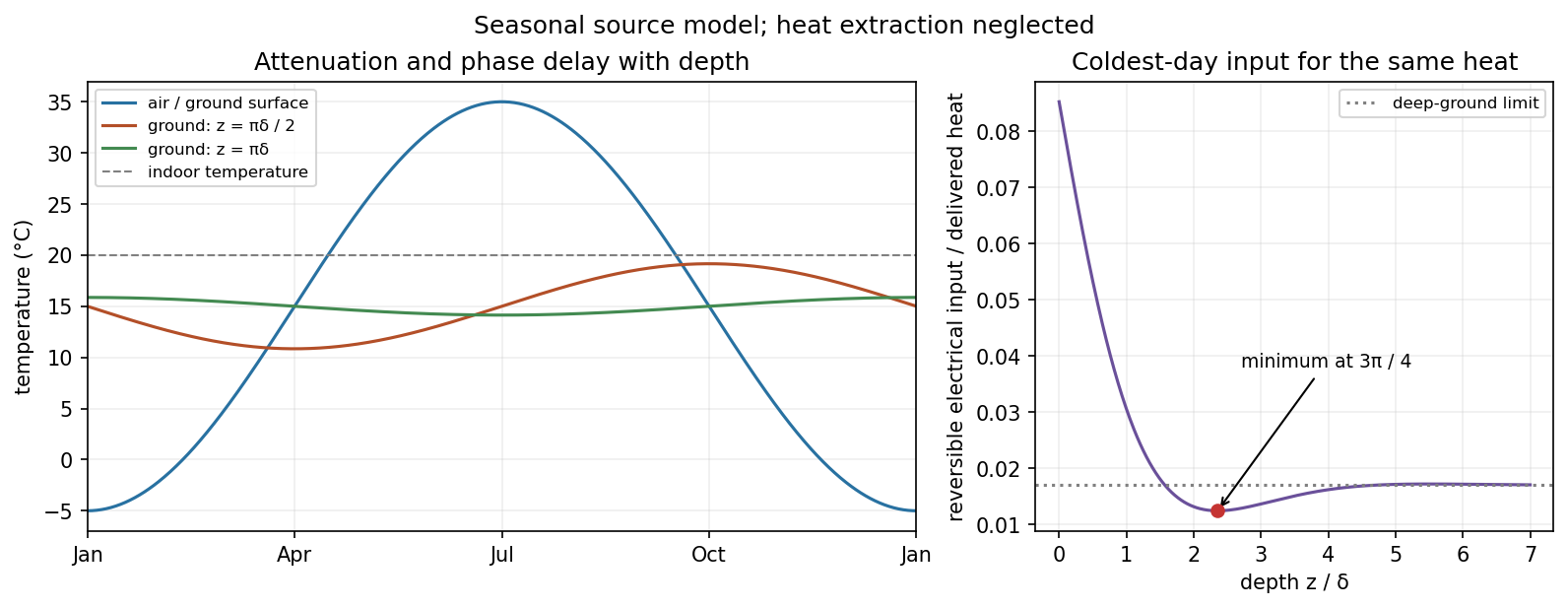
Annual air and ground temperatures, with attenuation and depth-dependent phase delay
. Details. 
The seasonal source depth for a reversible heat pump has a subtle limit: a deep source approaches and avoids severe winter cooling, but infinite depth is not the thermal optimum of this single-frequency model. In January, with , maximize . The first and largest maximum is at , where , giving and . It is also the optimum of the ideal annually integrated heating work: the heating load is even about January, so its weighted sine term integrates to zero and the depth dependence is again proportional to . Installation cost, finite tube spacing, heat extraction, weather and real pump performance alter this result. The supplied model therefore supports a finite seasonal thermal optimum, while not fixing a practical burial depth in metres.
The coldest day has outside temperature , so the indoor–outdoor temperature difference is 25 K. If is the building's heat-loss coefficient, the required heating rate is . For direct electrical heating,This sets the reference electrical cost for the same delivered heat and tariff.
For the ideal reversible comparison, K and the coldest air source is K. ThusA real air-source pump uses more work than this reversible lower bound, and its low-temperature performance is not specified.
A source much deeper than the annual penetration depth has K. ThereforeThe ideal coldest-day electrical-input ratios are direct : air-source : deep-ground = 1 : 0.0853 : 0.0171. The deep source needs one fifth of the ideal air-source work. These ratios compare equal useful heating, and do not include excavation, circulation losses or an assumed real compressor efficiency.
Phase equilibrium minimizes Gibbs free energy at specified temperature, pressure and composition. Coexisting phases have equal temperature, pressure and chemical potential. For a pure substance, a first-order transition has continuous equilibrium Gibbs free energy but a jump in its first derivatives, such as entropy or volume; the latent heat is . Continuous transitions lack that latent heat and can instead have singular or discontinuous higher responses.
The van der Waals molar equationcombines an excluded-volume correction with attractive interactions. Its inflection conditions giveBelow , the oscillatory isotherm contains a mechanically unstable segment with . Equilibrium instead replaces the loop by a constant-pressure coexistence line. Equality of chemical potentials gives the Maxwell construction,On isothermal compression the gas reaches saturation, then converts progressively into liquid at fixed pressure. The mean molar volume obeys , where is the gas fraction. Metastable superheated or supercooled states can persist when nucleation is delayed; they are not the global equilibrium selected by this construction.
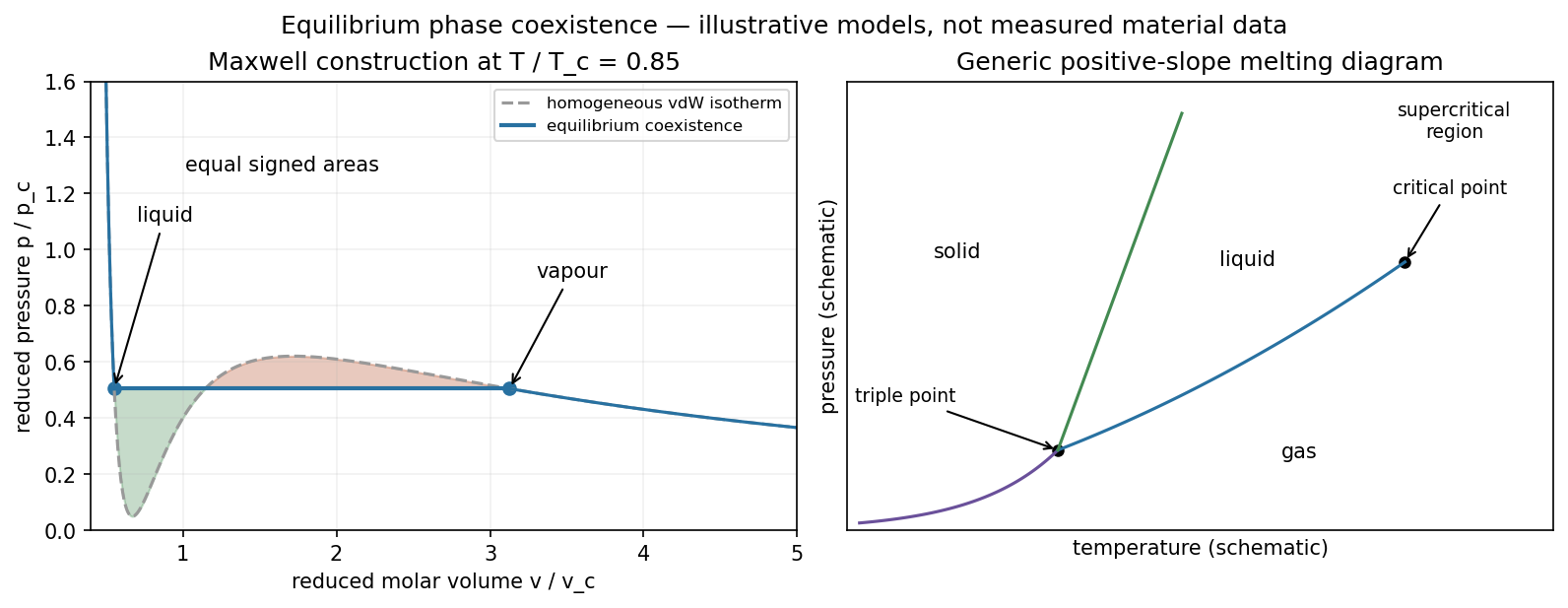
Illustrative reduced van der Waals coexistence and a generic pure-substance phase diagram
. Details. 
A pressure–temperature phase diagram contains coexistence curves separating solid, liquid and gas. Three phases meet at a triple point; the liquid–gas coexistence curve ends at a thermodynamic critical point, above which liquid and gas can be connected without crossing a first-order phase boundary. A generic solid–liquid line continues beyond the liquid–gas critical temperature. For one component the Gibbs phase rule is , so a three-phase equilibrium fixes both temperature and pressure.
Along a two-phase coexistence curve, for each phase givesThis is the Clapeyron equation, valid with consistent molar or specific quantities. For vaporization, neglecting the liquid volume and treating the vapour as ideal gives , hence . With approximately constant molar latent heat,This Clausius–Clapeyron approximation explains the rapid rise of vapour pressure with temperature. It fails close to the thermodynamic critical point, where phase volumes converge, and is not a universal expression for melting. The sign of a melting-line slope depends on its volume change; water's denser liquid gives a familiar negative slope.
Articles by others on the same topic
There are currently no matching articles.