Let L be the vessel initially containing argon and R the vessel initially containing helium. Both have volume and fixed temperature , and the aperture has area . The incoming and outgoing rates of each species must be considered separately. For species ,Thus its density difference relaxes exponentially with time constantThe two-vessel effusive mixing solution for the four densities isUsing atomic masses of approximately and atomic mass units gives . Helium therefore transfers faster. Each species eventually reaches in each vessel, but its transient is different. In particular, the total density temporarily rises in the initially argon vessel and falls in the initially helium vessel, before both return to .
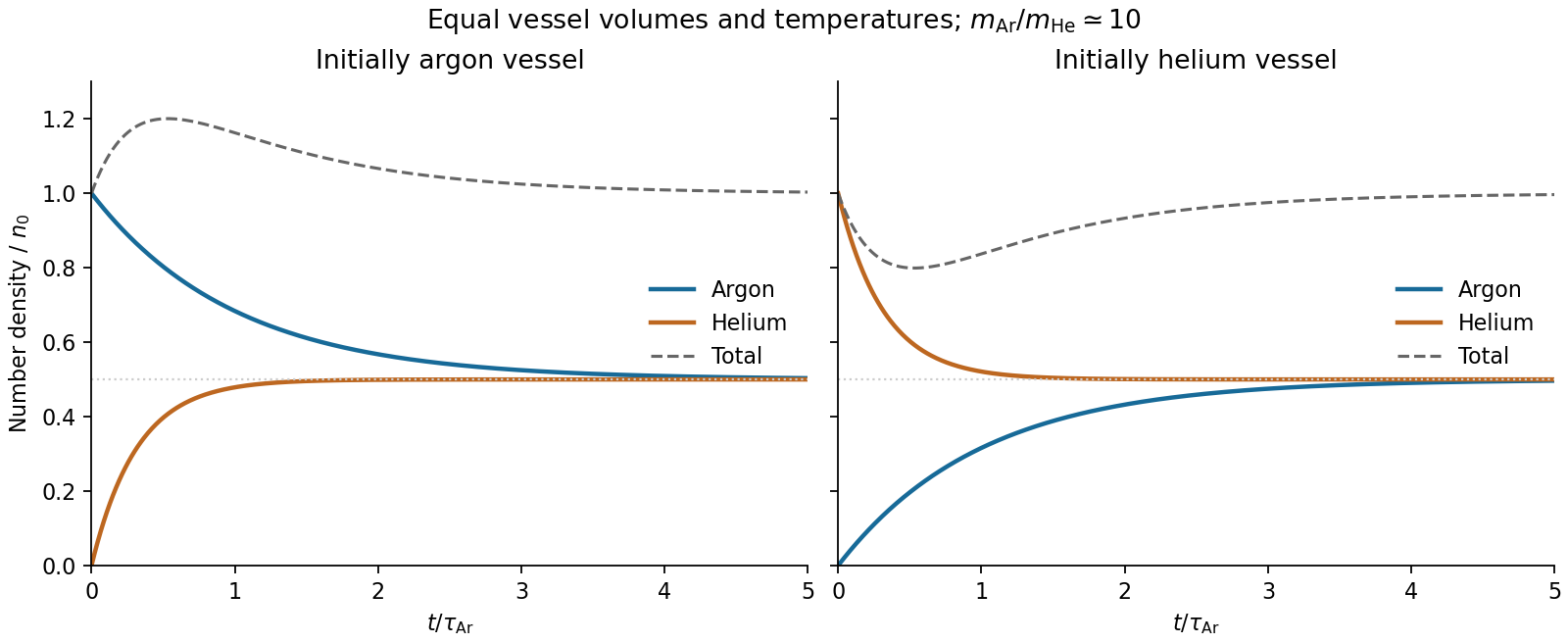

For unequal maintained temperatures , replace the rate equation byWith each species' total density sum still , its final densities and relaxation time areEvery species has the same final density ratio and partial-pressure ratio . Thus there is no permanent composition separation in this ideal steady state, although the rates remain mass dependent. A maintained hot side has lower density and higher pressure. Equal particle rates do not imply thermal equilibrium: atoms arriving from the hotter side carry more energy, so external heating and cooling are required to hold different temperatures. The model assumes thin-hole effusion, local equilibrium within each vessel and negligible aperture volume.
Articles by others on the same topic
There are currently no matching articles.