For a classical dilute ideal gas in thermal equilibrium, the probability of a single-particle velocity is proportional to the Boltzmann factor for kinetic energy, . Velocities with speed between and fill a spherical shell of velocity-space volume . The normalized Maxwell speed distribution is thereforeThe factor counts states, rather than representing an extra Boltzmann energy factor.
Set and use . Normalization cancels in ratios, so the given recurrence givesConsequentlyThe root mean square speed is larger than the mean speed, consistent with the positive variance of the speed distribution.
Choose a flat wall and let measure the angle from the direction towards it. Particles of speed in solid angle occupy fraction of an isotropic gas. In time , those within normal distance reach the wall. Their number per area per time is therefore .
Only the incoming hemisphere contributes. Integrating gives the one-way collision rate per unit area,Its units are . This is not : selecting the incoming half of the particles must also account for their mean normal velocity. For effusion through a thin hole whose diameter is much less than the mean free path, the same one-way rate applies because collisions within the opening can be neglected.
Wall arrivals are not an unbiased sample of the gas: faster atoms arrive more frequently. The normalized speed distribution among incident atoms isThe angular factor in the arrival rate cancels when calculating the mean kinetic energy. ThusUsing givesBy contrast, an atom chosen randomly from the bulk has mean kinetic energy . The arrival weighting raises the normal-direction contribution to while each tangential direction still contributes . This is also the mean energy carried by atoms effusing through a thin aperture from an equilibrated reservoir.
Denote the heated and cold vessels by subscripts . For argon, the opposing effusive particle rates are equal in the steady state:Because and ,This is thermal transpiration in the free-molecular limit. It fixes a ratio; the initial conditions determine the absolute pressures.
For the stated two identical vessels, take their fixed volume to be and the combined system sealed. Initially it contains atoms. HenceLet . Combining this inventory with gives the closed-vessel thermal transpiration resultHeating makes the hot side less dense but at higher pressure. Both expressions reduce to when . For a small imposed temperature rise , the pressure difference starts as .
If instead the cold vessel is interpreted as an externally maintained pressure reservoir with , the answer becomes . That alternative requires the fixed-pressure reservoir assumption; it does not conserve the initial particle inventory of two sealed equal-volume vessels. Merely describing the vessels as large does not keep their pressures fixed through the redistribution. The pressures in the boxed answer assume the natural closed-vessel interpretation.
Let L be the vessel initially containing argon and R the vessel initially containing helium. Both have volume and fixed temperature , and the aperture has area . The incoming and outgoing rates of each species must be considered separately. For species ,Thus its density difference relaxes exponentially with time constantThe two-vessel effusive mixing solution for the four densities isUsing atomic masses of approximately and atomic mass units gives . Helium therefore transfers faster. Each species eventually reaches in each vessel, but its transient is different. In particular, the total density temporarily rises in the initially argon vessel and falls in the initially helium vessel, before both return to .
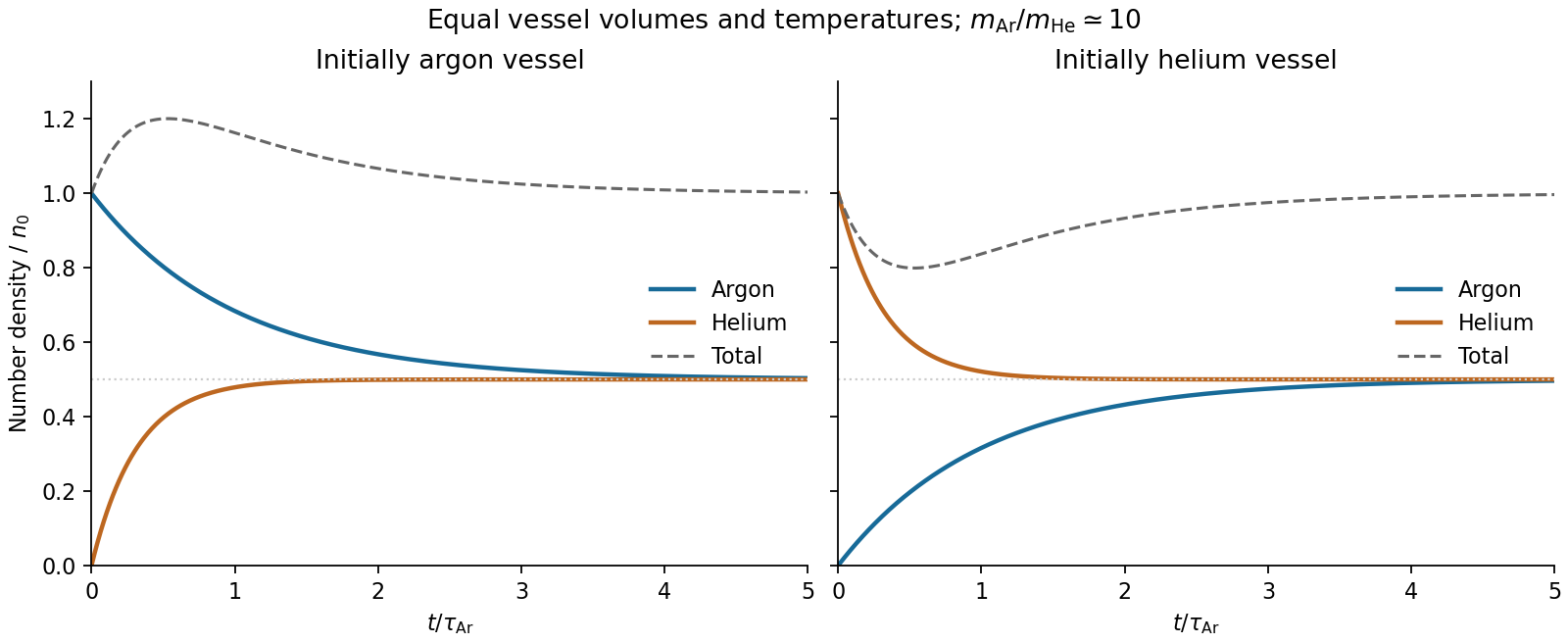

For unequal maintained temperatures , replace the rate equation byWith each species' total density sum still , its final densities and relaxation time areEvery species has the same final density ratio and partial-pressure ratio . Thus there is no permanent composition separation in this ideal steady state, although the rates remain mass dependent. A maintained hot side has lower density and higher pressure. Equal particle rates do not imply thermal equilibrium: atoms arriving from the hotter side carry more energy, so external heating and cooling are required to hold different temperatures. The model assumes thin-hole effusion, local equilibrium within each vessel and negligible aperture volume.
Articles by others on the same topic
There are currently no matching articles.