A Carnot cycle consists of four reversible stages: isothermal expansion at the hot-reservoir temperature , adiabatic expansion to , isothermal compression at , and adiabatic compression back to the starting state. The adiabatic stages exchange no heat. For one mole of an ideal gas, the two isothermal stages have heats and in magnitude. The reversible adiabatic relations ensure .
More generally, the total entropy change over any reversible cycle is zero. The two heat exchanges therefore satisfyWith work output , its thermal efficiency isThe temperatures must be absolute. The second law makes this the maximum efficiency for an engine exchanging heat only with those two reservoirs; irreversible entropy production lowers the efficiency.
Label the initial state 1, the end of compression 2, the end of constant-pressure heating 3, and the end of adiabatic expansion 4. The volume sequence is , with . The Diesel cycle has a compression adiabat , a horizontal constant-pressure heat-input segment , an expansion adiabat , and a vertical constant-volume cooling segment .
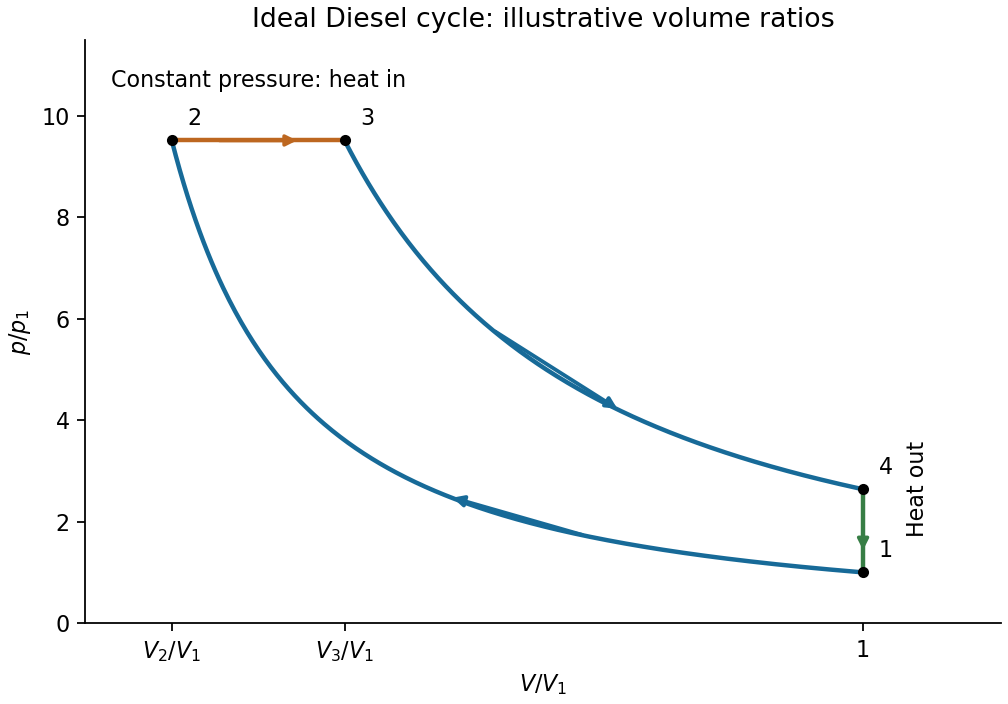

For an ideal gas, a reversible adiabat obeys , so it falls more steeply than an isotherm. The expansion adiabat lies above the compression adiabat at equal volume between and , giving a clockwise cycle with positive work output.
For one mole, , and constant heat capacities satisfy . The specified diatomic-gas model hasA reversible adiabatic process satisfies . Constant-pressure expansion satisfies . Applying these in order givesEvery volume ratio is dimensionless, so the expressions have units of temperature. For the intended volume ordering, the minimum temperature is and the maximum is .
Use heat into the gas as positive. The two adiabatic stages have . During constant-pressure heating and constant-volume cooling,The first law over a complete cycle gives , since the internal energy returns to its initial value. ThereforeSubstitute the temperatures:HenceEquivalently, define compression ratio and cutoff ratio :These formulas use the ideal constant-heat-capacity model and reversible adiabatic strokes. The heat-addition and heat-rejection strokes occur over changing gas temperatures, unlike the isothermal heat exchanges of a Carnot engine.
For , Taylor expansion gives . The vanishing-cutoff limit of the Diesel cycle isThe maximum temperature tends to , while the minimum stays at . A Carnot engine between those limiting extrema hasso the limiting efficiencies coincide. At exactly , however, both heat input and net work vanish, and the cycle retraces its compression adiabat. The efficiency there is an undefined ; the boxed value is the continuous limit for neighbouring nonzero cycles, not finite work at zero heat input.
For a finite cutoff ratio , the Carnot comparison uses , giving . The Diesel cycle has smaller efficiency. For example,which makes its rejected/input heat ratio larger than the Carnot ratio.
An equation of state relates equilibrium state variables such as pressure, volume, temperature and material amount. At fixed composition, it reduces the number of independent thermodynamic variables. It does not by itself specify all caloric properties: information such as heat capacity or internal energy is also needed.
At a liquid-gas first-order transition, an equilibrium isotherm can contain a constant-pressure interval in which changing total volume changes the phase fractions. A metastable single-phase extrapolation can instead show a region with ; that region has negative isothermal compressibility and is mechanically unstable. Thermodynamic phase coexistence requires equal temperature, pressure and chemical potential, and a consistent free-energy description replaces the unstable region by coexistence. For an appropriate analytic fluid equation of state, a liquid-gas critical point occurs where .
These tests diagnose the phase behaviour represented by that equation of state. They do not guarantee detection of every possible transition involving an additional order parameter which the mechanical equation omits.
For the given one-mole model,At fixed positive temperature its isotherm is an ideal-gas hyperbola shifted right by : pressure diverges as and tends to zero as . Higher temperatures give higher pressure at any fixed allowed volume.
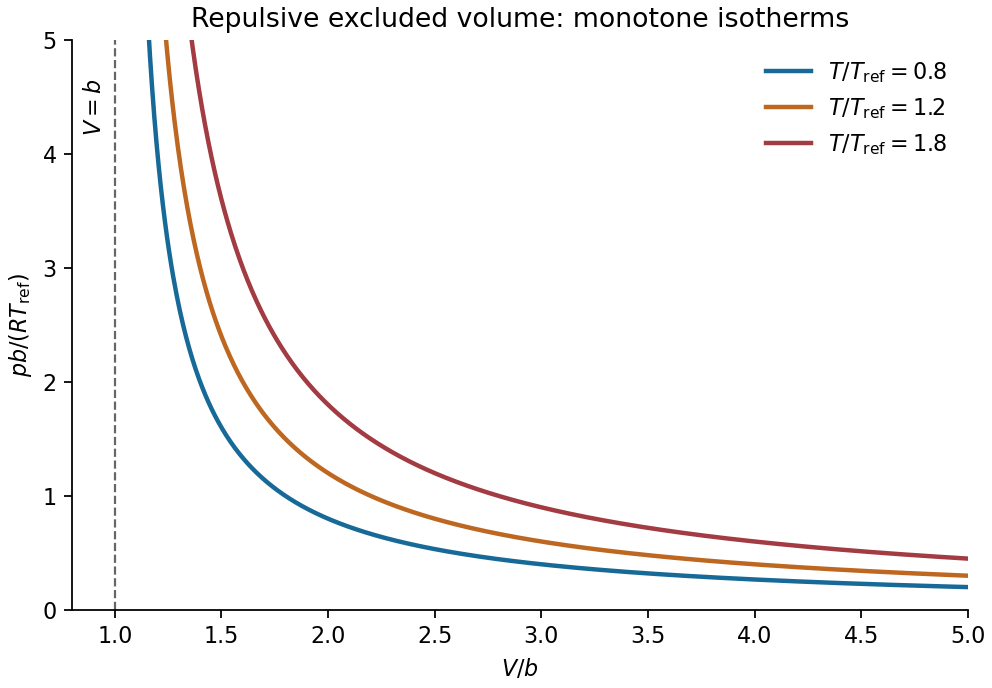

For positive , the volume is the effective volume available to molecular motion. Thus describes excluded-volume repulsion or an effective incompressible molecular core. It is a molar volume in this one-mole equation, not necessarily the literal sum of molecular geometric volume. Setting recovers the ideal gas law. No attractive-energy term is included.
Start with the fundamental relation at fixed material amount, , and expand entropy in independent variables :The last equality uses the supplied Maxwell relation. ConsequentlyFor the excluded-volume ideal gas, , so the bracket vanishes:Once depends only on temperature, cannot depend on volume either. Its stipulated temperature independence therefore makes it a constant, giving with arbitrary energy reference . Excluded volume changes the pressure without adding the volume-dependent attractive internal energy that a more general interacting-gas model might have.
Use the enthalpy . The equation of state gives , soAt fixed pressure, is constant. ThereforeSince and are constants, this ratio is independent of both temperature and pressure. Although the gas is not mechanically ideal when , its constant-pressure/constant-volume heat-capacity difference remains in this model.
For a reversible adiabatic change, , equivalently . Substitute :Integration, with fixed positive reference values , givesSince and ,The relation applies to the quasistatic reversible adiabat. Adiabatic heat isolation alone does not enforce it for an irreversible process which generates entropy. The shifted volume , rather than itself, is the appropriate coordinate in this model.
At every , ,There is no constant-pressure coexistence interval, unstable loop or finite-temperature critical inflection. The isothermal compressibility is positive:Thus this equation of state predicts no liquid-gas phase transition in its physical domain. Its divergence at the excluded-volume boundary is a repulsive constraint, not a liquid-gas coexistence mechanism. This conclusion concerns the stated model and cannot rule out an ordering transition requiring additional physics or an additional thermodynamic variable. Extrapolation to absolute zero is also outside the classical gas model's reliable regime.
For a classical dilute ideal gas in thermal equilibrium, the probability of a single-particle velocity is proportional to the Boltzmann factor for kinetic energy, . Velocities with speed between and fill a spherical shell of velocity-space volume . The normalized Maxwell speed distribution is thereforeThe factor counts states, rather than representing an extra Boltzmann energy factor.
Set and use . Normalization cancels in ratios, so the given recurrence givesConsequentlyThe root mean square speed is larger than the mean speed, consistent with the positive variance of the speed distribution.
Choose a flat wall and let measure the angle from the direction towards it. Particles of speed in solid angle occupy fraction of an isotropic gas. In time , those within normal distance reach the wall. Their number per area per time is therefore .
Only the incoming hemisphere contributes. Integrating gives the one-way collision rate per unit area,Its units are . This is not : selecting the incoming half of the particles must also account for their mean normal velocity. For effusion through a thin hole whose diameter is much less than the mean free path, the same one-way rate applies because collisions within the opening can be neglected.
Wall arrivals are not an unbiased sample of the gas: faster atoms arrive more frequently. The normalized speed distribution among incident atoms isThe angular factor in the arrival rate cancels when calculating the mean kinetic energy. ThusUsing givesBy contrast, an atom chosen randomly from the bulk has mean kinetic energy . The arrival weighting raises the normal-direction contribution to while each tangential direction still contributes . This is also the mean energy carried by atoms effusing through a thin aperture from an equilibrated reservoir.
Denote the heated and cold vessels by subscripts . For argon, the opposing effusive particle rates are equal in the steady state:Because and ,This is thermal transpiration in the free-molecular limit. It fixes a ratio; the initial conditions determine the absolute pressures.
For the stated two identical vessels, take their fixed volume to be and the combined system sealed. Initially it contains atoms. HenceLet . Combining this inventory with gives the closed-vessel thermal transpiration resultHeating makes the hot side less dense but at higher pressure. Both expressions reduce to when . For a small imposed temperature rise , the pressure difference starts as .
If instead the cold vessel is interpreted as an externally maintained pressure reservoir with , the answer becomes . That alternative requires the fixed-pressure reservoir assumption; it does not conserve the initial particle inventory of two sealed equal-volume vessels. Merely describing the vessels as large does not keep their pressures fixed through the redistribution. The pressures in the boxed answer assume the natural closed-vessel interpretation.
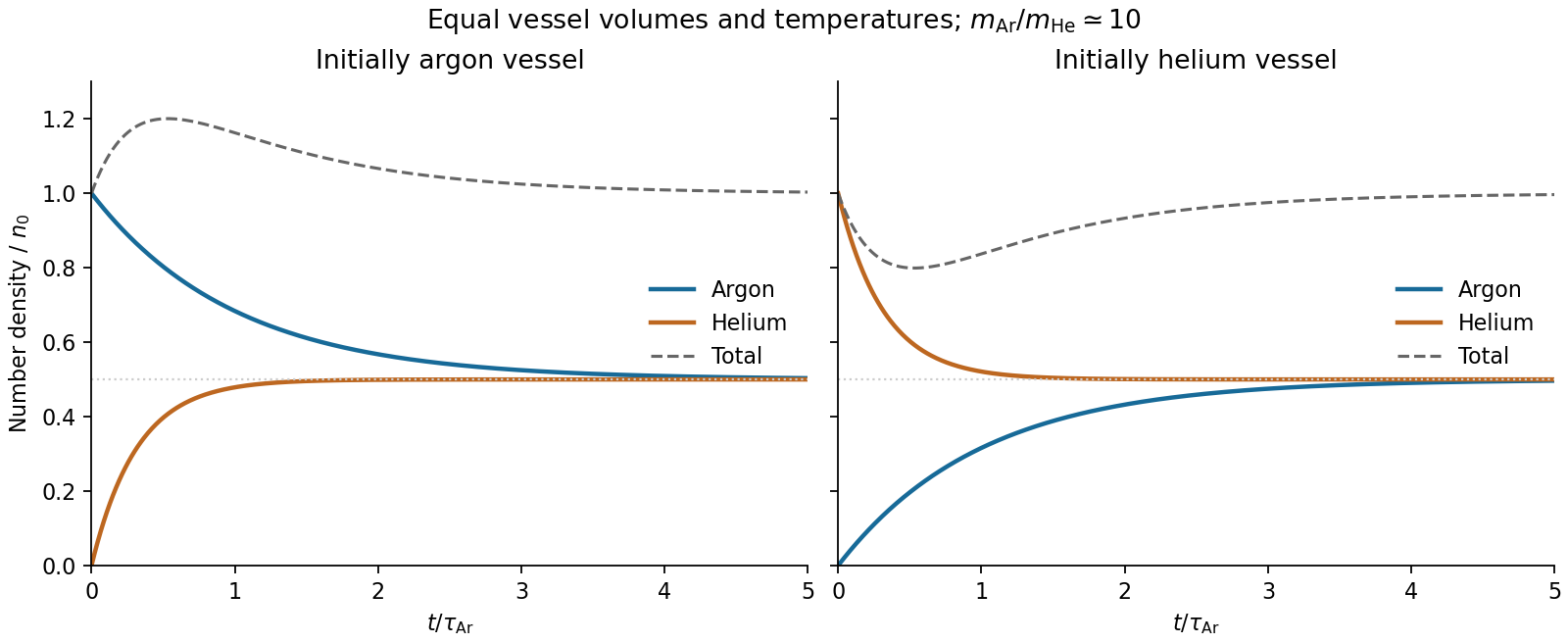
Let L be the vessel initially containing argon and R the vessel initially containing helium. Both have volume and fixed temperature , and the aperture has area . The incoming and outgoing rates of each species must be considered separately. For species ,Thus its density difference relaxes exponentially with time constantThe two-vessel effusive mixing solution for the four densities isUsing atomic masses of approximately and atomic mass units gives . Helium therefore transfers faster. Each species eventually reaches in each vessel, but its transient is different. In particular, the total density temporarily rises in the initially argon vessel and falls in the initially helium vessel, before both return to .

For unequal maintained temperatures , replace the rate equation byWith each species' total density sum still , its final densities and relaxation time areEvery species has the same final density ratio and partial-pressure ratio . Thus there is no permanent composition separation in this ideal steady state, although the rates remain mass dependent. A maintained hot side has lower density and higher pressure. Equal particle rates do not imply thermal equilibrium: atoms arriving from the hotter side carry more energy, so external heating and cooling are required to hold different temperatures. The model assumes thin-hole effusion, local equilibrium within each vessel and negligible aperture volume.
Molecular transport across gradients. A gas can transport momentum, thermal energy and species abundance even when its average bulk velocity is zero. Molecules arriving at a point carry properties acquired near their preceding collisions. A small gradient makes the populations arriving from opposite sides slightly different, producing transport from larger to smaller values of the carried property. A continuum transport law requires a mean free path small compared with the gradient length, and relaxation times short compared with the observation time.
For a dilute hard-sphere gas,where is molecular collision diameter. Both speed and collision distance matter: high speed alone does not determine a transport coefficient.
A simple kinetic estimate makes the common structure explicit. For a quantity carried per particle, a molecule moving at angle to brings approximately . Expanding to first order and averaging an isotropic velocity distribution givessince and . This mean-free-path argument estimates the coefficients; a detailed collision calculation changes their numerical prefactors and distinguishes different relaxation rates.
Momentum transport and viscosity. For a shear flow with mean velocity , the transported directed momentum per molecule is . The net flux of momentum in the direction isHere is dynamic viscosity in . The associated shear stress on a material surface has the corresponding traction sign convention; the flux carries momentum from the faster-moving layer towards the slower-moving one. The kinematic viscosity is , with units . Viscosity smooths velocity gradients, and the lost ordered mechanical energy becomes heat.
Heat transport. Let be the thermal heat capacity per molecule, in . Substituting gives Fourier's law,Thermal conductivity has units . For a monatomic gas, translational equipartition gives . Rotational or vibrational excitations in other gases can increase the energy carried per molecule, while collisions govern how those modes exchange energy. A temperature gradient can therefore be transported differently from directed momentum even when the dimensional estimates look similar.
Species transport. For a dilute tracer or a mixture with prescribed total density and negligible bulk flow, molecules diffuse down concentration gradients. The first-gradient number flux is Fick's first law,The diffusivity has units ; multiplying number flux by the species mass gives mass flux. More generally one uses diffusion flux relative to the mixture's bulk velocity and specifies mass or mole fractions. The approximation is not a claim that an arbitrary pure-gas pressure gradient can remain at rest while only a Fick flux acts. In a mixture, collision cross-sections and relative molecular speeds, including the reduced mass, determine the species diffusivities.
Dependence on density and temperature. The kinetic estimates of gas transport coefficients predict, for fixed collision diameter and molecular heat capacity,Thus dynamic viscosity and thermal conductivity are approximately density independent in the dilute continuum regime. Reducing density reduces the number of carriers but increases their mean free path in the same proportion. At fixed density all three estimates grow as ; at fixed pressure, andKinematic viscosity and thermal diffusivity also grow roughly as at fixed pressure in this model. Real interaction potentials make effective collision cross-sections temperature dependent, and internal excitations change . Dense-gas correlations and boundaries invalidate the simple cancellation. In particular, when the mean free path approaches the apparatus scale, transport becomes free molecular; it cannot be described by extending the same local, pressure-independent Fourier and viscosity coefficients indefinitely.
Heat diffusion equation. For a stationary gas with constant volumetric heat capacity , constant thermal conductivity and negligible compression work, the energy balance in any fixed volume isHere is a possible heat generation rate per volume. The divergence theorem and Fourier's law yieldThermal diffusivity has units and is of order . In a moving or compressing gas, the material derivative, pressure-volume work and viscous heating must also enter the internal-energy equation. The displayed pure diffusion equation describes the approximation in which those effects are absent or negligible.
Representative solutions. With no source, a steady one-dimensional slab between temperatures at has and uniform heat flux . Thus a constant spatial gradient transports heat without changing local temperature in time when the boundaries continually supply and remove it.
For an infinite medium and an initial sinusoidal temperature perturbation,Short spatial wavelengths decay faster, and the characteristic smoothing length after time is . A finite slab with both ends held at has a sine expansion with factors ; its slowest relaxation time is .
An instantaneous heat input per unit transverse area at in an otherwise uniform infinite medium gives the Gaussian solutionIts integral conserves the deposited heat. The peak falls as while its width grows as ; diffusion redistributes energy instead of transporting a sharp front at a single velocity.
Finally, a semi-infinite body initially at and held at surface temperature from hasIt has and approaches far from the boundary at finite time. These solutions demonstrate steady conduction, mode decay, spreading of localized heat and boundary-driven diffusion. Their idealized behaviour at extremely short times or arbitrarily long distances must be interpreted within the continuum regime rather than as an assertion of instantaneous microscopic communication.
Articles by others on the same topic
There are currently no matching articles.