A normal mode of a linearized mechanical system is a motion in which every generalized displacement oscillates at a single common angular frequency, with fixed relative amplitudes and phases. In coordinates , an undamped oscillatory mode may be writtenwhere the amplitude vector is fixed; negative components describe relative phase . An arbitrary small motion is a linear combination of the normal modes when the mode vectors form a complete basis.
Let be each sphere's moment of inertia about the fibre, and let be the common fibre filament torsional stiffness, so a length exerts restoring torque . The single-sphere torsion pendulum obeysFor the two coupled torsional pendulums, the upper fibre has twist and the joining fibre has relative twist . The joining fibre exerts equal and opposite torques on the two spheres:Using the measured givesThe fibre's own rotational inertia and damping are neglected, so its twists supply elastic torques without additional dynamic coordinates.
Set and use normal mode amplitudes , with real physical displacements obtained at the end. In units of , the stiffness matrix isWriting , the eigenvalue condition isThereforeFor finite positive fibre lengths both eigenvalues are positive. The corresponding amplitude ratio isThe lower normal mode has the spheres twisting in the same sense, and the higher one has opposite signs of angular displacement.
In terms of ,Both curves decrease monotonically: with , , while . The limits, including their leading approach, areThus the limiting squared angular frequencies are and infinity for short joining fibre, and zero and for very long joining fibre. For orientation, at the values are . The high-frequency curve stays above and the low-frequency curve below .
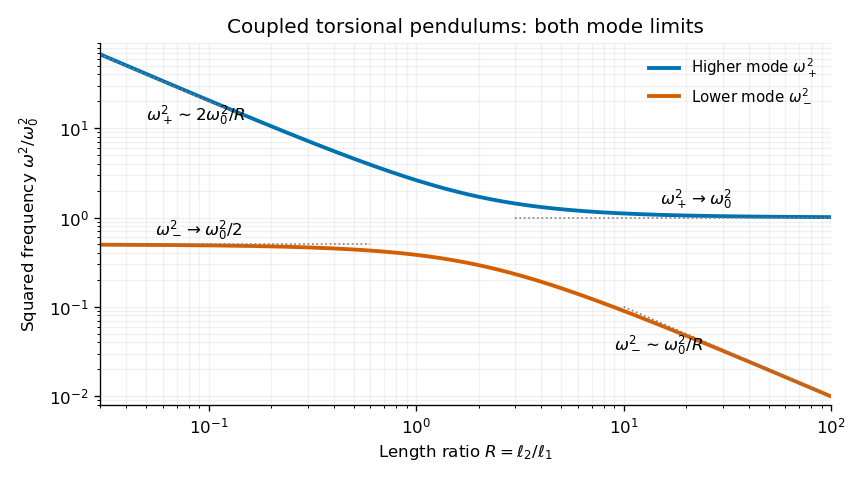
Calculated squared normal-mode frequencies versus fibre-length ratio; both axes are logarithmic to show all four asymptotic limits
. Details. 
As , the short joining fibre is very stiff and the lower normal mode has . The spheres therefore behave as one torsional load with combined moment of inertia , suspended by the upper fibre of torsion constant . Its angular frequency satisfiesThe high-frequency opposite-twist mode costs increasingly large elastic energy and moves to arbitrarily high frequency in the massless-fibre model.
As , the joining fibre is very compliant. In the higher normal mode the lower sphere scarcely moves: the amplitude ratio tends to . The upper sphere approaches the original single torsion pendulum, givingThe other mode is then a slow twist of the almost freely suspended lower sphere. These interpretations assume the formal limits do not invalidate the thin massless-fibre approximation.
Articles by others on the same topic
There are currently no matching articles.