- Kepler's first law: a bound planetary orbit is an ellipse with the central attracting body at one focus.
- Kepler's second law: the line from that focus to the planet sweeps equal areas in equal times, equivalent to constant areal velocity.
- Kepler's third law: the squared orbital period is proportional to the cube of the semi-major axis, when the orbiting mass is negligible.
The first law includes a circular Kepler orbit as a special case. The third-law constant is the same for bodies orbiting the same dominant mass.
Choose zero gravitational potential energy at infinite separation. The spacecraft's conserved total orbital energy isAt periapsis and apoapsis, the radial velocity vanishes, so the velocity is perpendicular to the radius. The conserved angular momentum magnitude is thereforeThe angular momentum vector is normal to the fixed orbital plane. The respective units are joules and . These expressions use Newtonian gravity and the approximation .
Eliminate using the angular momentum expressions from part (b):HenceFor distinct turning radii, factor the difference of squares and cancel the common factor to obtainThe circular Kepler orbit case is recovered continuously by setting , giving . Combining this with the energy expression also gives for the transfer ellipse.
Use a Hohmann transfer orbit. At the initial radius , make a short prograde burn parallel to the existing velocity. The increased speed changes the circular Kepler orbit into an elliptic orbit whose periapsis is the burn point and whose apoapsis lies on the desired larger circle. Coast for half the transfer orbital period to apoapsis.
At that point the transfer velocity is again tangent to the target circle, but its magnitude is smaller than the circular speed there. A second short prograde burn raises it to the required circular speed. Thus both burns increase the instantaneous speed and preserve its direction at the burn, even though the final circular speed is lower than the original one. During the coast the spacecraft loses kinetic energy while gaining gravitational potential energy.
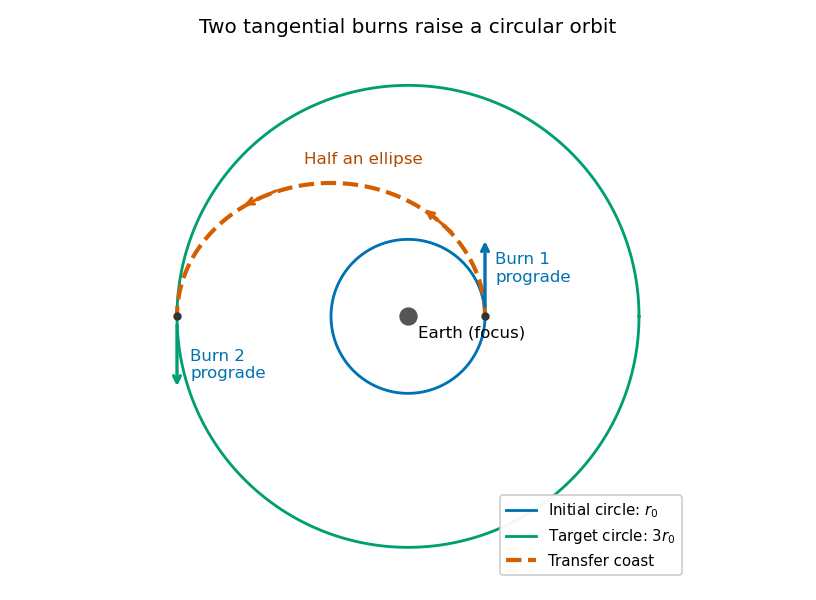
Original transfer-orbit construction for the later example with outer radius three times the inner radius; arrows show the two prograde burns
. Details. 
The figure illustrates for the subsequent parts, but the same construction works for any larger target radius. The impulsive approximation neglects the distance travelled during each burn and keeps both circles and the transfer ellipse coplanar.
The original circular Kepler orbit has . For the transfer ellipse, set , in part (c):The first required speed increase is . Under the question's negligible-mass-change fuel model, fuel use is proportional to the magnitude of the impulse. Since the full fuel supply corresponds to ,This is the stated “about a quarter” of the original fuel supply. It is an instance of the Hohmann transfer impulse fractions; no variable-mass rocket model is required under the stipulated assumptions.
At transfer apoapsis, angular momentum conservation givesThe desired circular Kepler orbit has speed . Thusof the original fuel supply is used in the second burn. This is about of the fuel remaining after the first burn. The total transfer consumes of the original supply, leaving about . The two positive impulse magnitudes are added for the fuel budget, even though their directions at opposite ends of the orbit differ.
A normal mode of a linearized mechanical system is a motion in which every generalized displacement oscillates at a single common angular frequency, with fixed relative amplitudes and phases. In coordinates , an undamped oscillatory mode may be writtenwhere the amplitude vector is fixed; negative components describe relative phase . An arbitrary small motion is a linear combination of the normal modes when the mode vectors form a complete basis.
Let be each sphere's moment of inertia about the fibre, and let be the common fibre filament torsional stiffness, so a length exerts restoring torque . The single-sphere torsion pendulum obeysFor the two coupled torsional pendulums, the upper fibre has twist and the joining fibre has relative twist . The joining fibre exerts equal and opposite torques on the two spheres:Using the measured givesThe fibre's own rotational inertia and damping are neglected, so its twists supply elastic torques without additional dynamic coordinates.
Set and use normal mode amplitudes , with real physical displacements obtained at the end. In units of , the stiffness matrix isWriting , the eigenvalue condition isThereforeFor finite positive fibre lengths both eigenvalues are positive. The corresponding amplitude ratio isThe lower normal mode has the spheres twisting in the same sense, and the higher one has opposite signs of angular displacement.
In terms of ,Both curves decrease monotonically: with , , while . The limits, including their leading approach, areThus the limiting squared angular frequencies are and infinity for short joining fibre, and zero and for very long joining fibre. For orientation, at the values are . The high-frequency curve stays above and the low-frequency curve below .
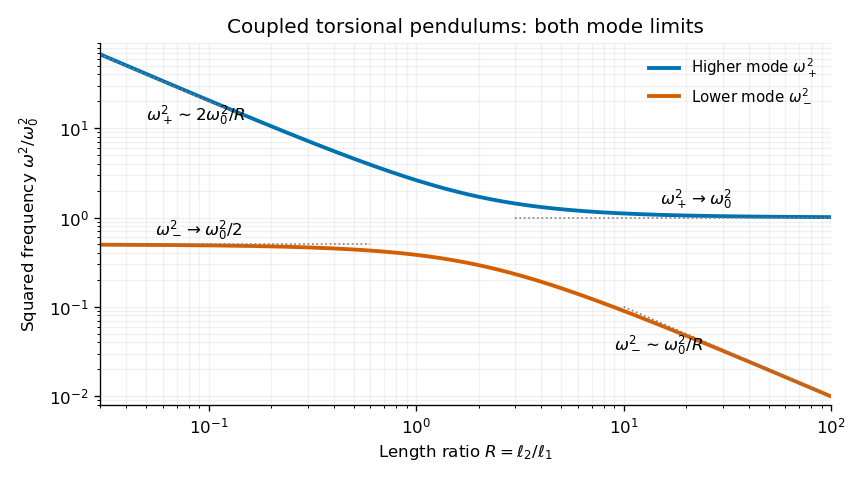
Calculated squared normal-mode frequencies versus fibre-length ratio; both axes are logarithmic to show all four asymptotic limits
. Details. 
As , the short joining fibre is very stiff and the lower normal mode has . The spheres therefore behave as one torsional load with combined moment of inertia , suspended by the upper fibre of torsion constant . Its angular frequency satisfiesThe high-frequency opposite-twist mode costs increasingly large elastic energy and moves to arbitrarily high frequency in the massless-fibre model.
As , the joining fibre is very compliant. In the higher normal mode the lower sphere scarcely moves: the amplitude ratio tends to . The upper sphere approaches the original single torsion pendulum, givingThe other mode is then a slow twist of the almost freely suspended lower sphere. These interpretations assume the formal limits do not invalidate the thin massless-fibre approximation.
Articles by others on the same topic
There are currently no matching articles.