Here is the potential energy and is the stationary energy eigenvalue. The Schrödinger equation is the eigenvalue equation for kinetic plus potential energy. Its boundary conditions select the allowed energies. For a normalized wavefunction, the Born rule assigns probability to a small area, and . A stationary state's full time dependence is ; its probability density is time-independent.
The infinite walls impose on all four boundaries. For a separated solution in the zero-potential interior,The first term depends only on and the second only on , so each is constant, and . Vanishing at and removes the cosine terms. Vanishing at the other boundaries givesThe normalized two-dimensional infinite square well eigenbasis and energies areNormalization follows from the two sine-squared integrals and . Zero quantum numbers would give an identically zero function. These separated products form a basis, not every possible wavefunction: a general state is their superposition, and a degenerate energy eigenspace can have nonseparable stationary combinations of products with that same energy.
For and , the ground state is and the nearest excitation is , along the longer side. The next quantum along the shorter side costs more energy. ThusThis transition has nonzero dipole matrix element for an electric-field component along . Light polarized strictly along would not drive it, so the minimum assumes an allowed polarization rather than an arbitrary fixed one.
For the requested degeneracy, keep . The first two states are necessarily and , since . The third level is the smaller of and : states with both indices at least two lie above , and higher states on the sequence lie above . Make these two candidates equal:The third-level degeneracy in a rectangular quantum box then has lowest distinct energies , and in units , with multiplicities one, one and two. The third-level pair is exactly and .
At the first two specified times, the displacement profiles areThe second curve is the first shifted right by . More generally a point of fixed wave phase satisfies , so it moves along . Hence the wave travels in the positive direction withThis phase velocity is distinct from the local transverse velocity of a string element.
For the force derivation take a short segment between and . Let the tangent angles to the positive axis be and . The left tension pulls along the negative tangent and the right tension along the positive tangent. With small slopes and approximately constant tension magnitude , the horizontal components cancel to leading order andThe segment mass is , where is mass per unit length, not volume density. Newton's second law therefore givesThe approximation neglects bending stiffness, damping and changes in tension caused by finite-amplitude stretching.
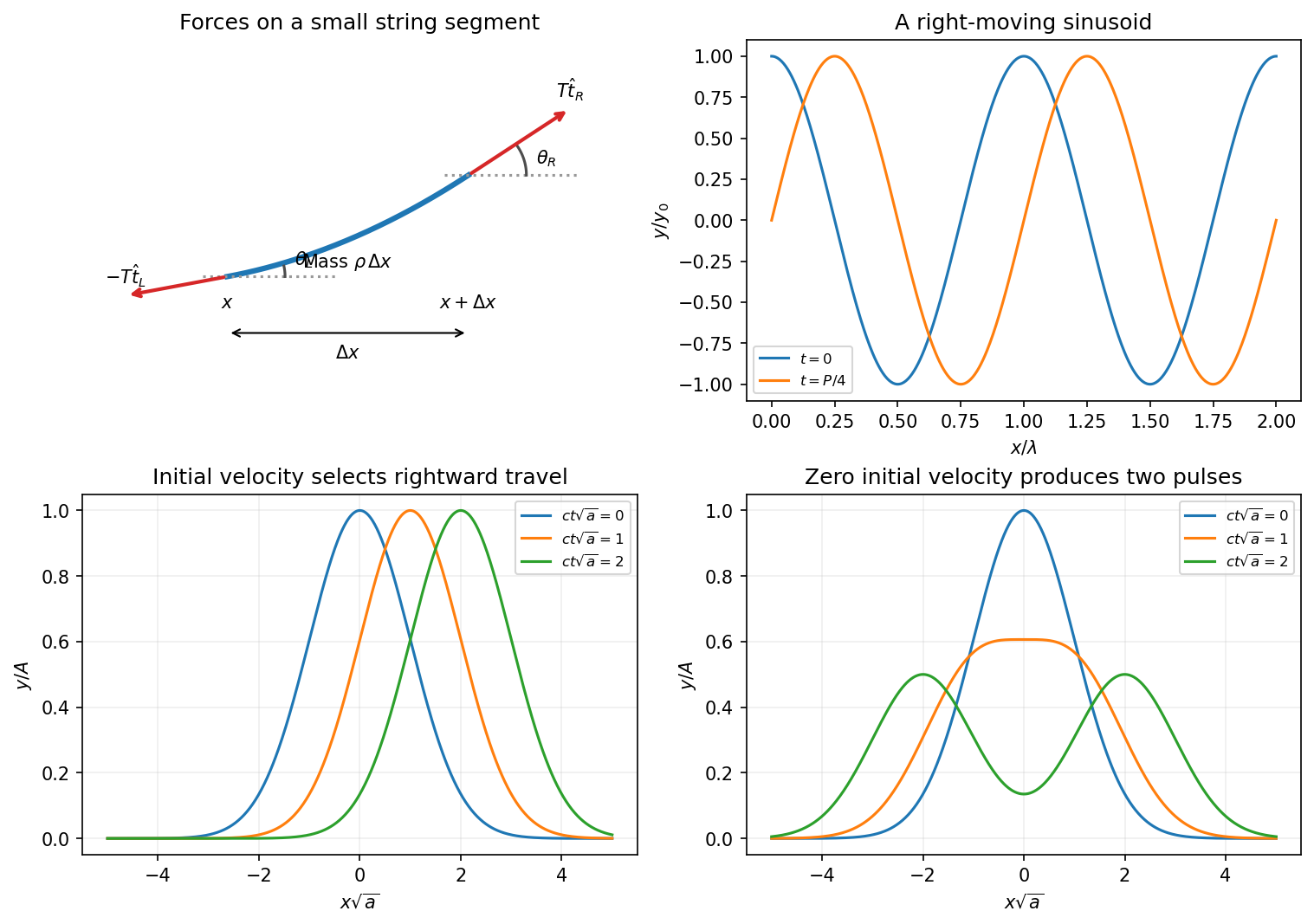

Converting the supplied density gives , soFor the pulse, define with . The given initial velocity is , exactly the velocity associated with a right-moving displacement . ThereforeIt moves right without changing shape in this nondispersive model. With the same initial displacement but zero initial transverse velocity, D'Alembert's formula instead gives the Gaussian pulse splitting from zero initial velocityThe two half-amplitude pulses travel in opposite directions. Their initial velocities cancel, while their initial displacements add to the prescribed Gaussian. The two initial-value problems have different kinetic energies; splitting into half-height pulses does not contradict energy conservation. These forms assume a string long enough that reflections from its ends have not returned.
Articles by others on the same topic
There are currently no matching articles.