For an ideal gas of fixed molecular composition, translational energy is supplemented by rotational, vibrational and eventually electronic excitations as their level spacings become thermally accessible. Activating more internal degrees of freedom generally increases the heat capacity. In a harmonic vibrational mode the contribution rises from nearly zero when to its classical limit when ; summing modes with different frequencies gives a smooth increase over an intermediate temperature range.
A monatomic gas has no molecular rotations or vibrations, so its mass-specific is nearly constant until electronic excitation or ionization becomes important: is then small. A simple diatomic gas can also have a small slope when its rotations are already active but its vibrational modes remain frozen. Large flexible polyatomic molecules have many internal modes, often with relatively low excitation energies, and can give a larger slope over their activation range.
The linear law is a local approximation, not an asymptotic result. A finite set of modes approaches finite classical heat-capacity contributions, whereas grows without bound. At still higher temperatures dissociation and ionization change the composition and gas constant, invalidating the fixed-molecule ideal-gas model as well. The constants have units and .
Take the convection to maintain a dry, nearly reversible adiabat, with specific gas constant . Hydrostatic equilibrium and an ideal-gas equation of state will be used separately to convert pressure to height. For an adiabatic displacement, the first law of thermodynamics in enthalpy form givesThe adiabat with linear heat capacity follows by integrating from the surface: this gives the monotone implicit temperature–pressure relationAn explicit form, using the positive real Lambert W branch, isAs , . At fixed ,Larger heat capacity therefore keeps the upper atmosphere warmer at the same pressure. Equivalently becomes smaller. The original normalized sketch below shows the resulting family of profiles; no particular gas constants or surface temperature are assumed there.
The height equations areIntegrating the latter givesThe physically selected root starts at and decreases. Its formal upper boundary isAt that height and . The limit is . This finite-height zero is a property of the assumed polytropic-like model, not a claim that a real atmosphere reaches absolute zero: molecular heat capacities, composition, transport and the continuum ideal-gas description cease to support that extrapolation.
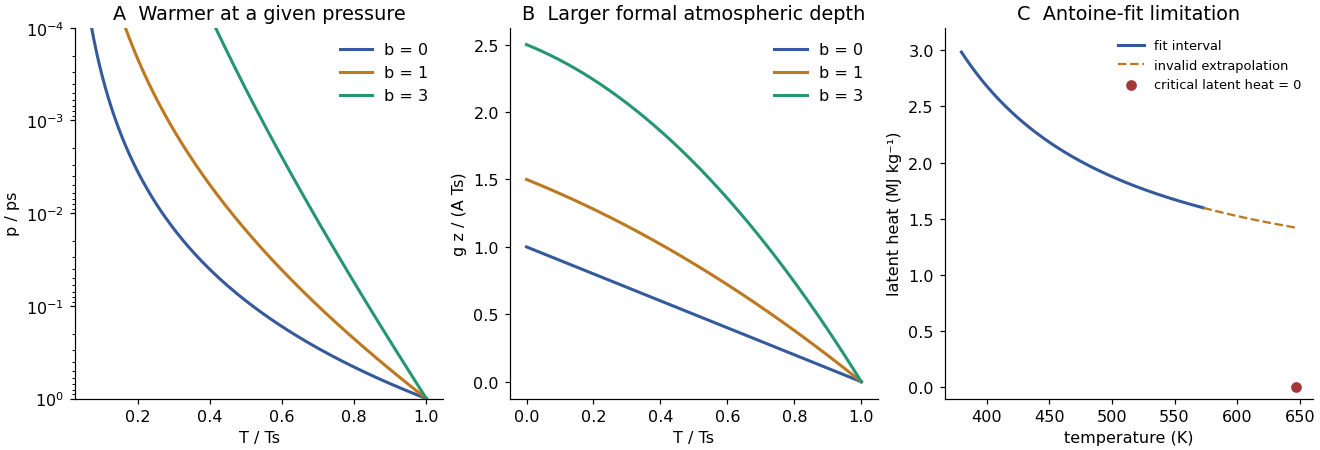
Adiabats with increasing heat capacity and the limited-temperature latent heat inferred from an Antoine fit
. Original calculations. Adiabats use dimensionless parameters and ; the latent-heat plot distinguishes the stated fit range from an invalid extrapolation toward the known critical point. Details.
Rename the Antoine equation coefficients to distinguish them from the heat-capacity constants. The logarithmic slope is independent of the pressure unit:Using an ideal vapour and neglecting liquid specific volume, Clausius–Clapeyron gives . Therefore the positive magnitude of the latent heat released on condensation isFor , over the quoted range. With , this fit implies approximately at and at . The required ratio does not depend on :The decreasing trend is qualitatively consistent with the liquid and vapour phases becoming less distinct towards the liquid-gas critical point. However, the full Clapeyron relation is : at criticality the two specific volumes merge and the latent heat vanishes. Neglecting and treating the vapour as ideal then fail. The Antoine coefficients are not licensed for extrapolation beyond , and derivatives of an approximate pressure fit can be less accurate than the fitted pressures themselves.
A concrete check exposes the extrapolation failure: at the supplied critical temperature the formula would still give , rather than zero, and rather than . Above the true liquid-gas critical point there is no liquid–vapour coexistence curve or condensation latent heat in the same sense. The last panel of the original figure in solution makes this limitation visible.
Articles by others on the same topic
There are currently no matching articles.