For the variable-latent-heat saturation curve of a pure saturated water atmosphere, the total pressure equals the saturation pressure. The exact Clausius-Clapeyron relation along the phase coexistence curve iswhere are the specific volumes of the vapor and condensed thermodynamic phase. Neglecting and using the ideal gas law, , givesThe triple point provides the integration constant. Below it, the prescribed latent heat is constant, soAbove it, write . Integrating givesThese are the requested implicit temperature profiles . Both branches meet at , and each is monotone before the limiting liquid-gas critical point. The lower branch describes equilibrium with ice, rather than a stable liquid surface. A stable liquid ocean surface belongs to the upper branch; the colder upper atmosphere may use the lower branch. Hydrostatic balance is needed to convert this relation into a height profile, but not to obtain .
Let . For the temperature-dependent latent heat,Keeping the latent heat of vaporization fixed changes only the upper branch toBoth curves fall from as , pass through at the triple point, and are convex. At the triple point there is a corner because the latent heat changes from to . Their right-hand slopes there agree. Above the triple point,The variable-latent heat curve lies above the fixed-latent heat curve: its downward slope has smaller magnitude at every . It reaches a horizontal tangent at , whereas the fixed-latent heat curve is still descending. Both limiting ordinates are finite; this model gives and . These are extrapolations of the stipulated model, not accurate water liquid-gas critical point data. Extending the variable branch beyond would give negative latent heat and is physically inadmissible.
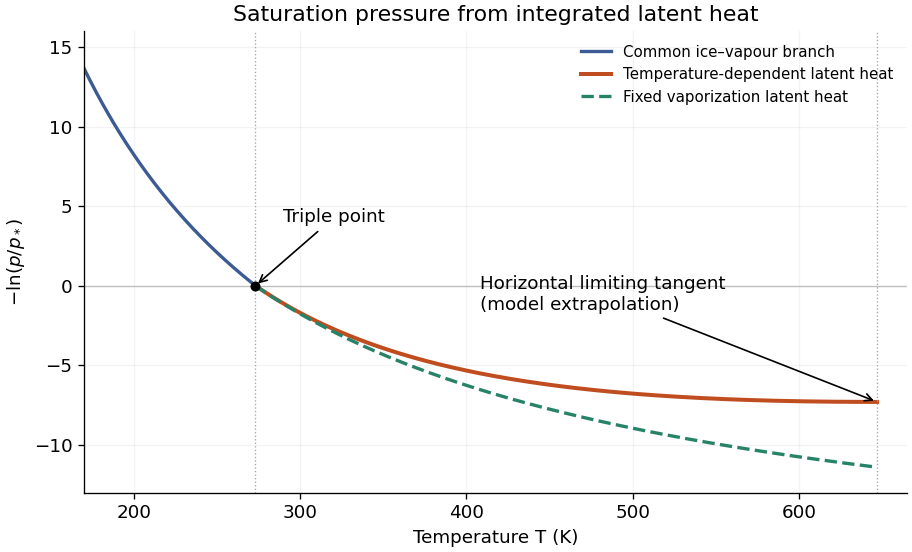

For constant gravitational acceleration, hydrostatic balance gives the atmospheric column mass , with negligible pressure at the top. For the same surface temperature , the variable latent heat gives a smaller integrated , and henceMultiplying by the same planetary surface area gives the same comparison for total mass. The models agree for a surface at or below the triple point, where they use the same sublimation branch. The comparison assumes the same surface temperature, rather than the same surface pressure.
No. Near the liquid-gas critical point, the mass densities of liquid and vapor approach each other, so the neglected condensed-phase specific volume becomes comparable with the vapor specific volume. The vapor also ceases to obey the dilute ideal gas law. Although the latent heat tends to zero, the specific-volume difference tends to zero too: the exact Clausius-Clapeyron relation contains their ratio. Setting only the numerator to zero therefore does not justify a vanishing physical saturation pressure slope. A realistic equation of state and coexistence data are required near the surface; the dilute colder upper atmosphere can still be described approximately by the earlier expression.
Articles by others on the same topic
There are currently no matching articles.