A magnetic field quantizes the transverse cyclotron motion into Landau levels. For a parabolic band, this is a harmonic oscillator with , , where and the half arises from its zero-point energy. Equivalently, semiclassical orbit quantization gives the stated flux sequence in increments of .
To relate real and momentum space, take and electron charge . The semiclassical Lorentz force isConsequently and . The real-space orbit is a rotated copy of the transverse wavevector orbit, scaled by . Their areas satisfy . Since ,This is Onsager quantization for the ordinary half-integer phase. For a circular parabolic orbit, reproduces the Landau energy spacing. The flux increment here concerns a single electron; it is distinct from the superconducting pair flux unit.
As changes, each quantized orbit area grows linearly with field while the Fermi surface cross-section stays approximately fixed. Landau energies repeatedly cross the Fermi energy, making the density of states there oscillate. If the relevant extremal orbit has area , its crossings satisfyThus the oscillations are periodic in inverse field rather than field. In three dimensions integration over longitudinal momentum makes extremal cross-sections dominate.
One observable is the de Haas-van Alphen effect: the field-dependent occupation changes the electronic free energy, so its field derivative, the magnetization, oscillates. The corresponding oscillations of longitudinal electrical resistance are the Shubnikov-de Haas effect. Both probe Fermi-surface geometry.
The two voltage contacts in the inset lie along the current direction. The measured signal is therefore longitudinal resistance in a Hall bar, not the transverse Hall voltage.
The peaks are Shubnikov-de Haas oscillations: a broadened Landau level passes through the Fermi level, increasing the density of accessible extended states and longitudinal dissipation. Between levels the longitudinal resistance falls. At smaller , hence larger , some orbital peaks resolve into separate spin branches because of Zeeman splitting, . The splitting becomes visible when it exceeds the disorder broadening and thermal smearing. Its ratio to the orbital spacing can remain roughly constant while both become larger relative to these smearing scales.
Without material or spin information one cannot exclude other internal degeneracies in every conceivable 2D system, but the conventional interpretation requested here is unresolved spin degeneracy at low field and resolved spin peaks at high field.
For interface area , each resolved spin branch has one state per flux increment , so its degeneracy of a Landau level isIf such branches are occupied, including fractional occupation of the highest, the filling factor givesThe filling counts spin and any other internal branches separately; it is an integer when a whole number of resolved levels are full.
From the visible PDF axes, approximately ten unsplit periods lie between and , giving . Consecutive unsplit orbital peaks differ by two occupied spin branches, so carrier density from spin-degenerate quantum oscillations givesThe precision is limited by reading the plotted trace, roughly a few percent. The factor two assumes only spin remains unresolved in that part of the graph; counting individual spin-split peaks would instead use a one-branch filling increment.
At large inverse field, and the cyclotron frequency are small, so the orbital spacing becomes comparable with both disorder broadening and the Fermi occupation's thermal width. Scattering of quantum lifetime gives a typical half-width ; overlapping levels lose their density-of-states contrast. The fundamental Dingle factor and thermal damping of quantum oscillations areBoth shrink rapidly as falls. Well-resolved oscillations require a sufficiently large and a temperature small compared with the orbital spacing. The scattering time in this broadening argument is not automatically the transport time inferred from mobility; small-angle events affect the two differently.
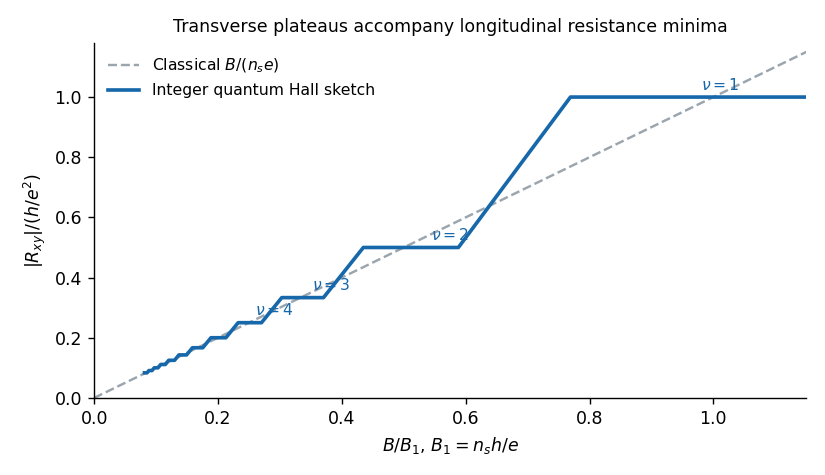
The transverse Hall resistance is approximately in the classical weak-field regime. At stronger fields the integer quantum Hall effect produces plateausaccompanied by nearly vanishing longitudinal resistance. Localized bulk states between extended Landau states allow plateau intervals, while current can be carried by quantum Hall edge states. At still larger fields and sufficiently low temperature, the cleanest samples show the fractional quantum Hall effect, with interaction-generated incompressible states at fractional fillings such as . The sign of depends on the contact and magnetic-field orientation; the sketch shows its magnitude.

Articles by others on the same topic
There are currently no matching articles.