Use the shock frame, with upstream and downstream fluid velocities and pointing in the same direction. These are the Strong-shock Rankine-Hugoniot conditions for a nonrelativistic monatomic gas with adiabatic index . The two scattering media approach one another at relative speed , to first order in . An energetic electron repeatedly crosses the shock wave, scatters from magnetic turbulence carried by the local plasma, and returns. Each scattering approximately conserves its energy in the local fluid rest frame while changing its direction; comparing successive fluid frames produces a systematic energy and momentum gain. The energy comes from the converging bulk flow, through the moving magnetic field irregularities and their associated electric fields. This is diffusive shock acceleration, a first-order Fermi acceleration process.
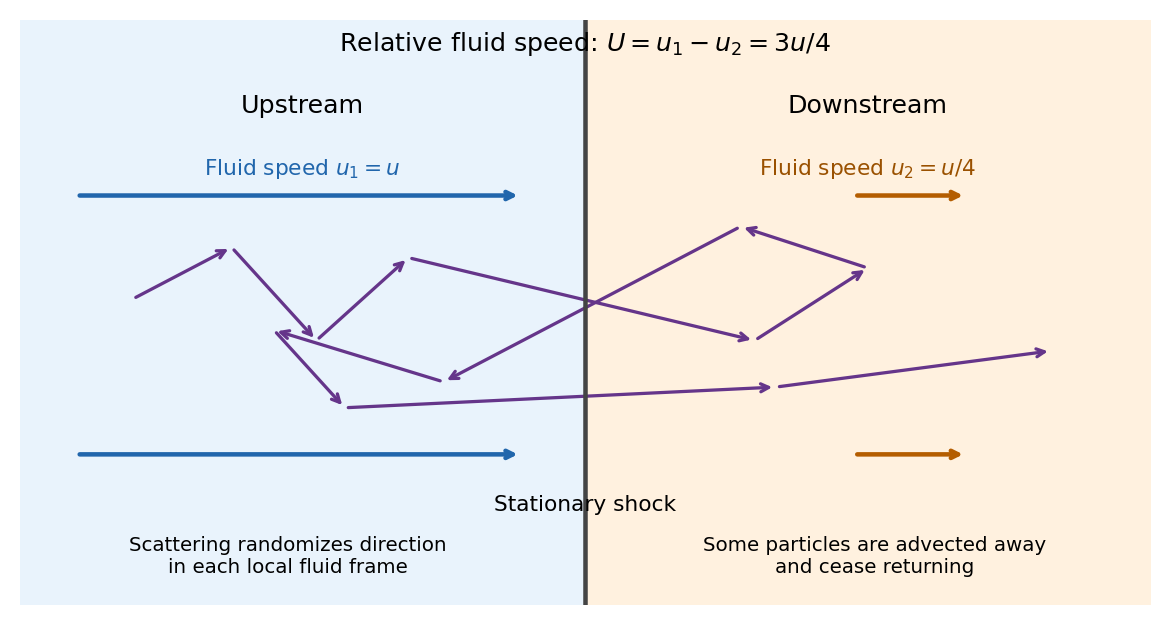

Let be the positive cosine of the crossing angle with the shock wave's normal. The Lorentz transformation between fluid frames gives, for either crossing direction with the corresponding sign of the normal reversed,For an almost isotropic population, the number crossing a unit area is weighted by its normal velocity. Thus the normalized crossing distribution is , rather than a uniform distribution in , andFor an ultrarelativistic electron, and its speed , soMore generally gives , while a nonrelativistic kinetic energy has . A complete upstream–downstream–upstream cycle contains two crossings and has ultrarelativistic fractional energy gain .
The initially cold electrons need an injection stage: shock wave heating and small-scale plasma processes must first produce particles with speed much larger than that can return across the front. The result is a description of that accelerated population; a cold electron cannot simply be assigned at its first encounter.
In the ultrarelativistic regime of a, retaining a constant mean fractional energy gain and ignoring losses gives, after individual crossings,After complete return cycles, and , to the same first-order accuracy. These products approximate the mean amplification; individual electron crossing angles give a distribution around it.
The downstream electron distribution is nearly isotropic. Its crossing particle flux per unit area is , where is the accelerated-particle number density. The downstream flow permanently advects particles away at particle flux . Their ratio estimates the escape probability after a downstream visit:Upstream particles are swept back towards the shock wave in this idealized infinite-upstream model. Consequently this return probability applies once per complete cycle, not once per individual crossing or local scattering event.
Let be the amplification per complete cycle and . A steady injection of particles leaves surviving to reach . Eliminating gives the cumulative power law and differential energy distributionThe escape distribution has the same differential exponent when is independent of energy. Thus the standard Strong-shock Rankine-Hugoniot conditions giveEquivalently the phase-space one-particle distribution function is for ultrarelativistic particles. Equal logarithmic intervals then contain equal particle energy. A finite source age, upstream escape, and radiative losses eventually introduce cutoffs or breaks.
A particle exponent is not automatically the radiation spectral index. For optically thin uncooled synchrotron radiation from , the characteristic frequency scales as and the emitted power as . Hence . With the convention , this gives and . Strong synchrotron cooling steepens a continuously injected particle distribution by one exponent, giving above its cooling break. A photon number distribution has , or in the uncooled case.
Convention qualification. If the printed is instead imposed independently at every individual crossing, its combination with gives and uncooled . For example gives , whereas the consistent cycle model gives . The standard estimate requires matching the probability and amplification to the same complete cycle.
In a sufficiently tight binary star, the main sequence companion can fill its Roche lobe. Roche-lobe overflow then transfers gas through the inner Lagrange point towards the neutron star. The gas carries angular momentum, so it generally forms an accretion disk rather than falling radially onto the surface. Internal stresses carry angular momentum outwards and permit accretion inwards. Capture of a stellar wind is another possible supply mechanism if the companion does not fill its Roche lobe.
Near the neutron star, the rapidly increasing magnetic dipole field, with , becomes dynamically important when its magnetic pressure is comparable to the inflow stresses. The accretion disk is truncated around a magnetospheric radius. Ionized material attaches to magnetic field lines and streams along them in magnetically channelled accretion, forming an accretion column above one or both magnetic poles. The Lorentz force impedes motion across the magnetic field, but does not forbid motion parallel to it. Gas can therefore reach the polar surface, with its gravitational potential energy released in a hot shock wave and radiation.
This description presumes the neutron star rotates slowly enough for material to reach it: sufficiently rapid rotation can centrifugally expel the inflow instead. A strong magnetic field by itself does not guarantee surface accretion.
Work in the locally planar shock frame, taking towards the surface. For a stationary normal shock wave with negligible radiative loss inside the discontinuity, the Rankine-Hugoniot conditions for a perfect gas express conservation of mass, conservation of momentum, and conservation of energy per unit area asHere is specific enthalpy, including the pressure work; using only internal energy would omit that work. The gravitational potential is continuous across an infinitesimally thin front. For cold upstream gas, and are negligible, while a monatomic gas has and .
The hydrodynamic equations apply to flow parallel to the guiding magnetic field when its stress contributions cancel across the front. An oblique magnetohydrodynamic shock requires magnetic stresses and Poynting flux; a radiation-mediated front or appreciable escaping radiation requires the corresponding radiative momentum and energy flux terms. These are additional physics, not terms hidden in here.
For the stipulated Strong-shock Rankine-Hugoniot conditions, and . The ideal gas law is , with a dimensional mean particle mass. The specific enthalpy of a nonrelativistic monatomic gas is . Dividing the energy flux equation in d by the common mass flux givesThereforeAs an independent check, conservation of momentum gives , and division by gives exactly the same temperature. The numerical coefficient relies on and the absence of dynamically important radiative or magnetic stresses.
Interpret the terminal infall speed as the free-fall speed from a radius much larger than the neutron star radius . In the Newtonian estimate,For fully ionized hydrogen with electrons and protons at a common temperature, there are two particles per atom and . The result of e then yieldsThis is the thermal energy scale per particle. In the same classical monatomic gas approximation, the mean random kinetic energy per particle is . Before the shock wave, the bulk kinetic energy per proton is . Distinguishing these quantities avoids an ambiguity in “particle energy”. If only the ions support the downstream pressure because electrons have not equilibrated, instead gives ; that is a different, two-temperature assumption.
These are estimates within the question's Newtonian, model. Its self-consistency is poor here: , and is much larger than the electron rest energy . Relativistic electrons, electron–positron pair production, radiation, unequal species temperatures, and general relativity can alter the equation of state and shock wave structure. In particular, the numerical must not be presented as a precision surface temperature prediction.
Articles by others on the same topic
There are currently no matching articles.