Write the one-dimensional random walk endpoint as xm=∑j=1mξj, starting at the origin. Assume unbiased, independent increments, each with ⟨ξj⟩=0 and ⟨ξj2⟩=Δ. Expanding the square givesIndependence makes each cross expectation ⟨ξi⟩⟨ξj⟩=0. ConsequentlyUncorrelated increments with the same second moments would suffice. Unbiasedness alone does not remove correlations: persistent or anticorrelated steps need not satisfy this result. The symbol Δ is already the mean-square step size, with units of length squared.
⟨xm2⟩=∑j⟨ξj2⟩+2∑i<j⟨ξiξj⟩.
⟨xm⟩=0,⟨xm2⟩=mΔ.
Let C(x) be the particle number density, U(x) the conservative potential energy and F=−dU/dx the applied force. In the overdamped regime a viscous drag coefficient ζ gives drift velocity vd=F/ζ. Combining this drift with Fick's first law gives the number fluxAt thermal equilibrium, the Boltzmann distribution is Ceq∝e−U/(kBT), so dCeq/dx=FCeq/(kBT). Setting its net flux to zero yieldsThis is the Einstein diffusion relation. The derivation assumes a dilute equilibrium suspension, uniform temperature, linear drift response and a well-defined long-time diffusion coefficient. With a nonzero conservative force, the full transport equation includes drift; the force-free equation in the next section describes spreading without that drift.
J=−DdxdC+ζFC.
0=FCeq(ζ1−kBTD),D=ζkBT=μkBT,μ=ζ−1.
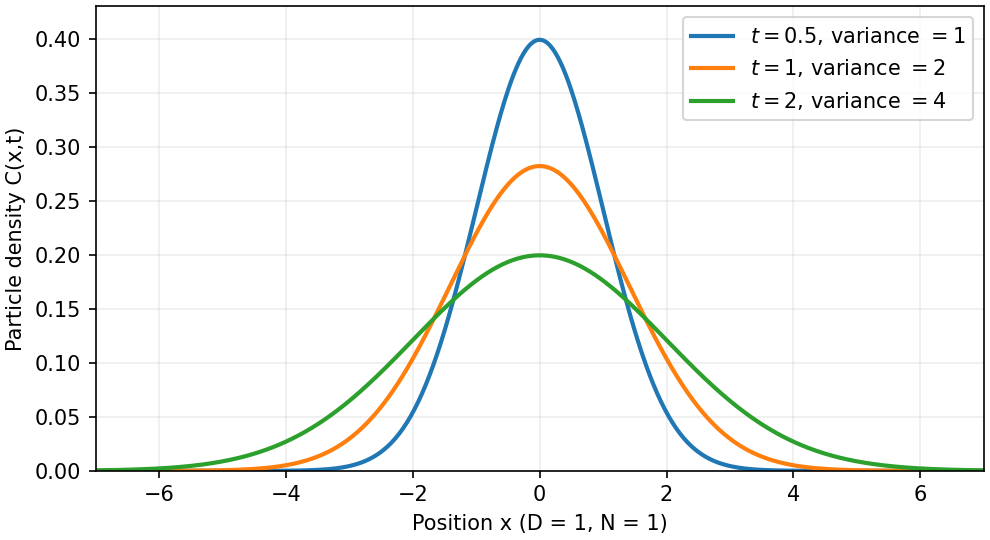
For constant D and no drift, particle conservation and Fick's first law give the one-dimensional diffusion equation ∂tC=D∂x2C. For C=At−1/2e−x2/(4Dt),so direct substitution verifies the equation for t>0. The Gaussian integral fixes the normalization:This is the heat kernel for a point release, with C(x,0)=Nδ(x) in the distributional limit. It remains centered at zero while its width grows as t1/2 and its peak falls as t−1/2. To compute the second moment, set y=x/4Dt:using ∫y2e−y2dy=π/2 over the whole real line, obtained by integration by parts.
∂tC=C(−2t1+4Dt2x2),∂x2C=C(−2Dt1+4D2t2x2),
∫−∞∞Cdx=A4πD=N,C(x,t)=4πDtNexp(−4Dtx2).
⟨x2⟩=N1∫x2Cdx=π4Dt∫−∞∞y2e−y2dy=2Dt,
If the mean number of independent unbiased jumps in time t is ⟨m⟩=ft, conditioning on m gives ⟨x2(t)⟩=Δ⟨m⟩=fΔt. Matching it to the continuum diffusion result yieldsFor fixed-magnitude steps a, Δ=a2. The equality of second moments also holds for Poisson jump times independent of the increments; a Gaussian continuum approximation additionally requires many steps and finite step variance.
D=2fΔ.

Ancestors (10)
- S12
- 2012
- Past exam of the short options paper shared by Prelims and Parts A and B of the physics course of the University of Oxford
- Short options paper shared by Prelims and Parts A and B of the physics course of the University of Oxford
- Physics course of the University of Oxford
- Undergraduate course of the University of Oxford
- Course of the University of Oxford
- University of Oxford
- List of universities
- Home
Discussion (0)
New discussionThere are no discussions about this article yet.
Articles by others on the same topic (0)
There are currently no matching articles.