A hydrophobic surface is poorly wetted by water: on a smooth surface its equilibrium contact angle, measured through the liquid, exceeds . A drop therefore tends to bead up, limiting its contact area. Hydrophobicity does not mean that the surface exerts a mysterious repulsive force on every water molecule.
The waxy coating has a largely nonpolar exterior. Water molecules form favorable hydrogen bonds with one another, whereas a hydrocarbon-rich wax surface offers few suitable hydrogen bond donors or hydrogen bond acceptors. Water–surface adhesion is weak relative to water's cohesion. The drop shape minimizes the combined solid–air, solid–water and water–air interfacial free energies, not merely the liquid's exposed area.
In terms of Young's equation, . A contact angle greater than corresponds to : replacing dry surface by wetted surface has an interfacial cost. The balancing liquid interface then favors a small wetted patch. Microscopic leaf texture can amplify the apparent hydrophobicity, especially when it traps air under the drop as a Cassie–Baxter state; the chemistry of a smooth wax layer alone does not guarantee an extremely large apparent angle.
On Teflon, the water drop has an obtuse contact angle and beads up, whereas the oil drop has an acute contact angle and spreads into a shallower patch. For small drops with negligible Bond number, both can be drawn as spherical caps.
To compare shape at equal volume , let denote the generating sphere radius. The cap height and footprint radius areFor a fixed , these relations give a taller, narrower drop for the larger contact angle. The angles are measured inside the liquid, including the obtuse angle of the water drop.
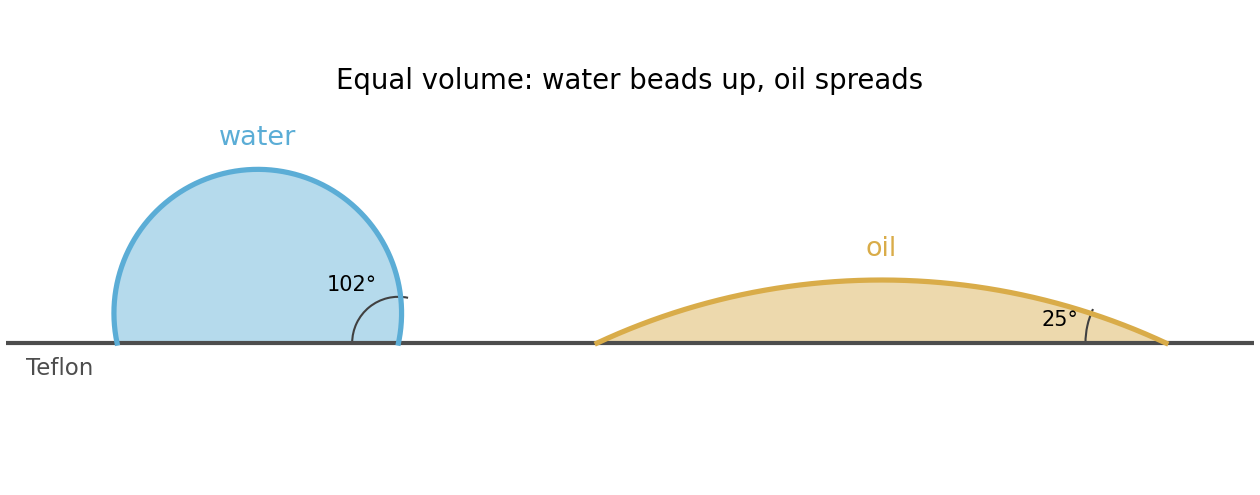

For an ideal smooth homogeneous substrate in thermodynamic equilibrium, Young's equation iswhere denotes air, the solid, and the chosen liquid. It follows either by balancing tangential interfacial forces at the contact line or by varying the wetted area at fixed drop volume.
The dry Teflon–air surface energy is the same in the two measurements, so subtracting the two equations eliminates it:ThereforeThe water–Teflon interface has the higher interfacial free energy per unit area. Neither individual solid–liquid surface energy is determined without the solid–air value; the difference is determined.
Colloidal particles experience attractive Van der Waals forces, arising from correlated molecular charge fluctuations and other dipolar interactions. Integrating many weak molecular attractions over two particles can give a deep near-contact well. For identical spheres of radius and surface gap , a positive Hamaker constant gives approximatelyBrownian motion brings particles into encounters. Without a repulsive barrier, they can reach the attractive primary minimum; if the binding energy is much larger than , thermal motion rarely separates them again. Repeated sticking produces aggregates. This is a kinetic stability statement: thermal agitation causes encounters but does not itself supply a stabilizing interparticle repulsion. The molecular cutoff and hard sphere exclusion prevent the unphysical divergence of the continuum attraction.
One method is to give every particle a sufficiently large surface charge density of the same sign. For example, attach ionizable sulfonate groups covalently to the surface. Dissociation leaves negatively charged surface groups and releases mobile positive counterions into the water. A surfactant with a strongly bound head group can provide another charging route, provided it does not desorb during the experiment.
Each charged particle is surrounded by an electric double layer. As two such particles approach, overlap of these ionic clouds raises the electrostatic and ionic free energy, producing repulsion. In a dilute electrolyte, the range is set by the Debye–Hückel screening length,For identical weakly charged spheres a representative screened Coulomb pair potential isIts sum with the Van der Waals force attraction is the DLVO theory pair potential. Choose the charging level so that the repulsive barrier is many high; particles then rarely reach the primary attractive well during the observation time. This is kinetic stabilization rather than removal of all attraction.
Deionized water is useful because low added ionic strength gives a long-ranged repulsion. It does not mean that the charged dispersion contains no ions: the surface's own counterions are unavoidable and contribute to screening. Surface dissociation, contamination and particle concentration therefore matter even without added salt. An alternative valid route is a dense, firmly attached layer of water-soluble polyethylene glycol, producing steric stabilization without relying on a large electrostatic barrier.
Without stabilization, the potential energy is predominantly attractive outside the molecular core and drops into a deep primary minimum. With the charging treatment, the DLVO theory sum develops a positive barrier between distant particles and that primary minimum. The barrier must be large compared with to inhibit aggregation on the experimental timescale. A shallow secondary minimum can remain at larger separation, depending on parameters.
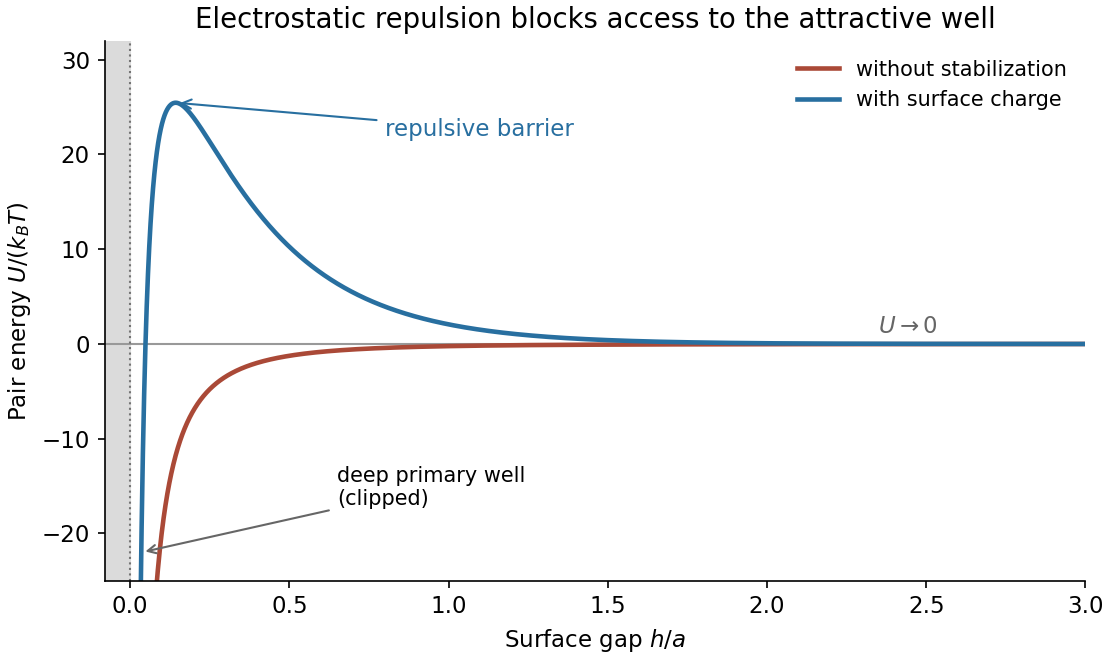
Attractive and electrostatically stabilized colloidal pair potentials
. Original illustrative curves for two equal spheres. The unstabilized curve uses the nonretarded sphere–sphere attraction; the stabilized curve adds screened electrostatic repulsion. The molecular core is excluded and the deep near-contact well is clipped by the plotting range. Potential depths and screening parameters are illustrative, not data supplied by the paper. Details.
The horizontal axis is the surface gap, so the molecular exclusion boundary is at its origin. Both interactions tend to zero at large separation. Raising salt concentration shortens the Debye–Hückel screening length and can reduce the barrier, allowing particles to stick again.
Articles by others on the same topic
There are currently no matching articles.