For one Cartesian velocity component of a free Brownian particle, the inertial Langevin equation isThe random force and viscous drag obey the fluctuation-dissipation relation. With a thermal equilibrium velocity distribution, the relaxation time is andIntegrating velocity twice givesFor , this is Einstein's diffusion law, , with . In three dimensions . At the motion is ballistic, . A sphere in the Stokes-drag regime has , giving .
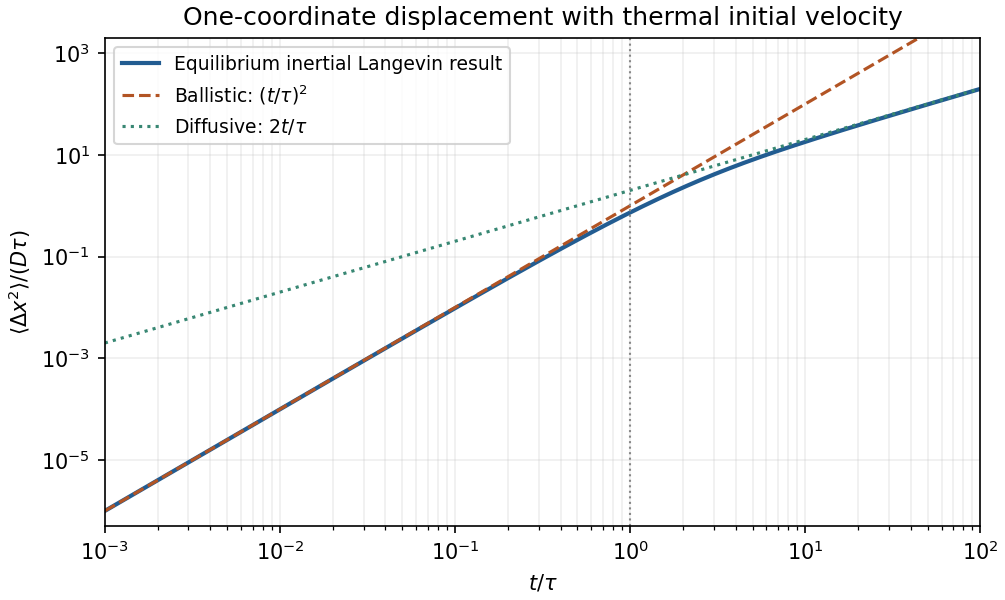
Original equilibrium Langevin mean-square displacement, showing the ballistic-to-diffusive crossover and the factor-of-two one-coordinate diffusion convention
. Details. 
Landau theory expands the free energy in an order parameter. For a scalar with sign-reversal symmetry and zero conjugate field, a useful sextic even Landau potential isEquilibrium selects the global minimum; other local minima can be metastable.
For , the minimum changes continuously from to as passes below zero. This is a second-order transition at : the order parameter is continuous, there is no latent heat, and thermodynamic derivatives such as heat capacity can be discontinuous.
For , the sixth-order term stabilizes the free energy. Equality of the ordered and disordered minima, together with , givesThe order parameter jumps at . The entropy generally jumps too, giving latent heat; metastable branches and barriers permit hysteresis, though equilibrium coexistence itself does not require hysteresis. The special case is tricritical. Mean-field exponents can fail where fluctuations dominate.
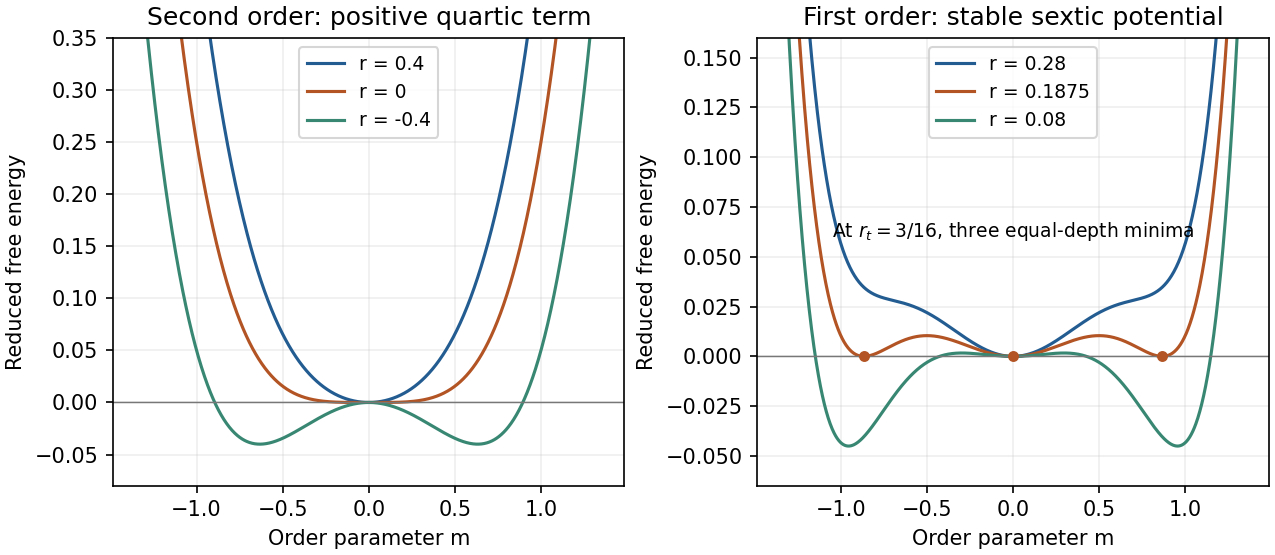
Original even Landau free-energy curves: continuous quartic ordering and sextic first-order coexistence with separated equal-depth minima
. Details. 
At , Pauli exclusion restricts thermally changed occupations to an energy interval of order about the Fermi energy. The affected fraction is of order ; their typical excitation energy is of order , so the thermal energy correction is proportional to and the heat capacity is linear in .
More precisely, with the total density of one-particle states per unit energy, including spin,For a three-dimensional ideal gas with quadratic dispersion, , henceThe fixed-particle-number Sommerfeld expansion gives . The temperature dependence of the chemical potential must be included when obtaining this expression; holding it artificially fixed changes the intermediate energy correction.
Articles by others on the same topic
There are currently no matching articles.