The unit circle is Hausdorff and second countable, since both properties pass to topological subspaces of the Euclidean plane. To exhibit its local coordinate charts, consider the four open semicirclesThey cover . On , the projection map is a homeomorphism onto the open interval , with continuous inverse functionOn , use , with inverse function . These coordinate charts show that is a one-dimensional topological manifold with empty manifold boundary.
Let be the common point of the two circles. For sufficiently small , the open neighbourhoodhas the following local structure: consists of four disjoint open arcs, an upper and a lower branch from each circle. These are its four connected components, each open and closed relative to .
Suppose a coordinate chart of some dimension of a manifold existed at . The case would make an isolated point, which it is not. For , shrink the chart inside so that its image is an open ball centred at the image of . Its domain of a function is an open neighbourhood of , so it meets all four arms of . Intersecting those arms with gives four disjoint nonempty clopen sets partitioning ; hence there are at least four connected components.
But a punctured ball in has exactly two connected components, and a punctured ball in for is path-connected. A homeomorphism preserves connected components, giving a contradiction in every dimension of a manifold. Thus is not a topological manifold. The argument uses arbitrarily small coordinate charts; the fact that the whole has two pieces alone would not be a local obstruction.
Label the hexagon polygon vertices in the direction in which its boundary word is , with the first side running from to . Matching the endpoints according to the arrows givesThus the two vertex equivalence classes are and .
The polygonal schema gives a compact connected surface with empty manifold boundary. Interior points have disc neighbourhoods; a paired polygon edge glues two half-disc neighbourhoods into a disc. At each of the two vertex equivalence classes, its three corner sectors join cyclically, so the vertex link in a polygonal schema is a circle, again giving a disc neighbourhood. Pairing every label once positively and once negatively makes these gluings consistent with an orientation, so the resulting surface is orientable.
The resulting CW complex has CW cells comprising two vertices, three edges and one face. Its Euler characteristic isBy the classification of compact surfaces, a connected closed orientable surface with has genus satisfying , hence . The quotient space is a torus.
True. Label the pentagon polygon vertices clockwise from the upper left asUse for the upward single arrows and for the rightward double arrows in the original diagram. Their endpoint identifications areAll five polygon vertices are therefore identified. The remaining diagonal polygon edge, from to , has its endpoints identified and is the only boundary component of a surface.
The paired polygon edges join half-disc neighbourhoods into disc neighbourhoods. At the common vertex, the five corner sectors join in one chain whose two free ends lie on the unpaired polygon edge: its vertex link in a polygonal schema is a closed interval. Hence that point has a half-disc neighbourhood. This verifies that the quotient space is a surface with boundary, rather than merely counting its CW cells. The paired polygon edges are oppositely traversed around the polygon, so this surface is orientable.
Its CW cells comprise one vertex, three edges (the pair, the pair, and the free polygon edge), and one face. ThereforeThe classification of compact surfaces identifies it as a torus with an open disc removed.
False: the result is again a torus with one open disc removed. Label the hexagon polygon vertices clockwise from the upper left asWith the same arrow labels as in part (ii),There are two vertex equivalence classes, and . The free diagonal polygon edges are and . Each joins to , so together they form one boundary component of a surface, not two. At each vertex equivalence class the three corner sectors join in a single chain between these two free polygon edges. Thus each vertex link in a polygonal schema is a closed interval, and the quotient space is an orientable surface with boundary.
Its CW complex has CW cells comprising two vertices, four edges and one face, givingIn contrast, a torus with two disjoint open discs removed has two boundary components of a surface and Euler characteristic . Either topological invariant rules out the proposed homeomorphism.
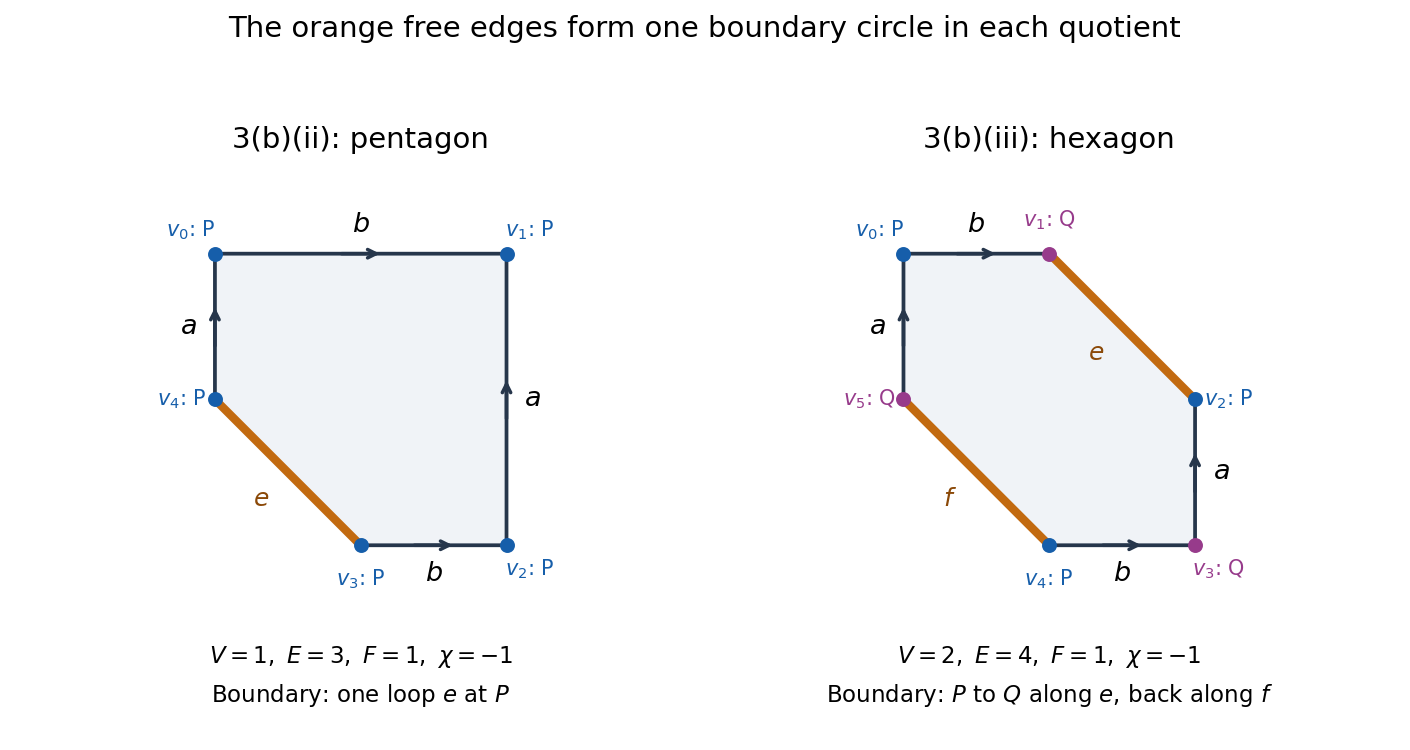
After identifying equally labelled arrows, both polygons have one boundary circle; in the hexagon the two free edges join the two vertex classes
. Details. 
A complete pairing of the six polygon edges leaves three edges and one face as CW cells, together with the vertex equivalence classes. If denotes their number, then and the polygonal-schema Euler count givesA closed orientable surface of genus two has Euler characteristic . Since the Euler characteristic is a topological invariant, no complete pairing of a hexagon can give that surface. Equivalently, the polygonal-schema Euler count bounds the genus of an orientable result by , so .
Every complete polygon edge pairing gives a compact connected surface with empty manifold boundary. Here is the local reason at the vertices. Replace each polygon corner by a small link interval. The polygon edge pairings identify all endpoints of these link intervals in pairs. In a given vertex equivalence class, the resulting graph is connected: the endpoint identifications generating that vertex equivalence class also connect its corner intervals. Every link graph vertex has degree of a vertex two, so the graph is a circle. Its topological cone is a disc, giving the required local surface model. Edge and face CW cell interiors have the usual disc neighbourhoods as well. A finite triangulation compatible with the polygon edge pairings realizes the result as a finite simplicial complex, giving a Hausdorff, second-countable space.
For every such surface, . If it is orientable, the classification of compact surfaces gives , so or . If it is a nonorientable surface, write for its nonorientable genus; then gives . The exhaustive list is therefore
- the sphere ;
- the torus ;
- the real projective plane ;
- the Klein bottle ;
- the connected sum of surfaces , a nonorientable surface of nonorientable genus three.
To prove that every listed possibility actually occurs, the following six-letter boundary words specify complete pairings of a hexagon:The vertex counts follow by matching starts and ends of equally directed arrows, just as in part (b). The first and third words pair every letter with its inverse, giving orientable surfaces. Each other word contains a letter twice with the same sign, giving a nonorientable surface: an orientation on the face would induce equal, rather than opposite, boundary directions along that glued pair. With the displayed Euler characteristics, the classification of compact surfaces identifies the examples exactly as listed. All five types occur, and no others occur.
Articles by others on the same topic
There are currently no matching articles.