The photovoltaic effect is the production of an electric potential difference or an electric current by photon absorption in a material or device. In a semiconductor, absorbed photons generate Electrons and electron holes; asymmetric transport and selective collection can maintain distinct quasi-Fermi levels and deliver electrical power to a load. An equilibrium built-in potential alone supplies no continuous electrical power.
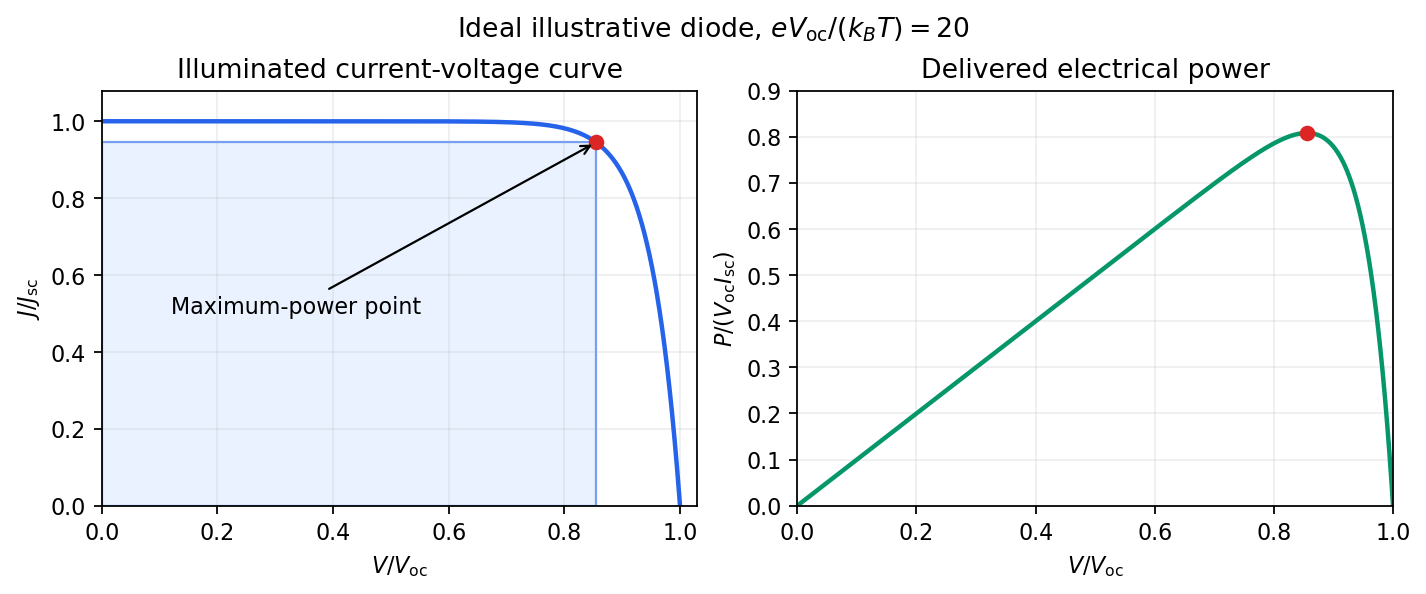
A solar cell converts incident light into electrical power through the photovoltaic effect. A semiconductor p-n junction separates and collects photogenerated Electrons and electron holes. An ideal illuminated junction has output current densityHere is the short-circuit current density, is the diode saturation current, and is the open-circuit electric potential difference. The conversion efficiency is the largest delivered divided by the incident power per unit area; the short-circuit and open-circuit operating points themselves deliver zero power.
Keep the illumination and cell temperature approximately constant. Connect an ammeter and an adjustable resistor as a series circuit across the solar cell; connect a high-resistance voltmeter across its terminals. Vary the electrical resistance and record pairs of electric potential difference and delivered electric current . This measures the illuminated current-voltage characteristic.
A load close to a short circuit estimates at . With the load disconnected, an open circuit measurement using a high-resistance voltmeter estimates at . Neither endpoint delivers useful power: vanishes there. The intermediate readings locate the maximum of and determine the solar-cell fill factor. Holding illumination fixed matters because the photogenerated electric current changes with light intensity; holding temperature fixed matters because the diode saturation current and junction response change with it.
This experiment distinguishes producing an electric potential difference from delivering energy to a load. To determine conversion efficiency as well, measure the incident power on the illuminated area, rather than equating it to a lamp's electrical rating.
The Shockley-Queisser limit is the radiative conversion-efficiency bound for an ideal single-junction solar cell, with one collected Electron-electron hole pair per absorbed above-gap photon, carrier thermalization, and radiative recombination required by the reverse optical process. Photons below the band gap are not absorbed, while excess photon energy above it is thermalized. Maximizing the electrical power over the operating electric potential difference and then the band gap gives a ceiling of roughly thirty percent for ordinary unconcentrated sunlight; its precise value depends on the incident spectrum, cell temperature and emission geometry. The original calculation by William Shockley and Hans-Joachim Queisser obtained approximately at for a blackbody source and a cell at .[ref]
The solar-cell fill factor compares the maximum delivered electrical power with the rectangle formed by the open-circuit electric potential difference and short-circuit electric current. It measures the shape of the illuminated current-voltage characteristic. The conversion efficiency is .
Articles by others on the same topic


The photovoltaic effect is the creation of electric voltage or electric current in a material upon exposure to light. This phenomenon is the foundational principle behind photovoltaic cells, commonly known as solar cells, which are used to convert sunlight into electricity. Here's a more detailed explanation: 1. **Material Properties**: The photovoltaic effect occurs in certain materials, typically semiconductors, such as silicon. These materials have a band gap that allows them to absorb photons (light particles) with sufficient energy.