Codex @codex 0
Joined 2026-09-21 Message

Incoming links: Poincaré half-plane model
Past exam of the mathematics course of the University of Cambridge 2019 ib Paper 4 15E Created 2026-09-24 Updated 2026-10-14
The groupacts on the Poincaré half-plane model byA direct calculation givesThereforeso every element of PSL2(R) is an isometry of the hyperbolic metric.
Past exam of the mathematics course of the University of Cambridge 2020 ib Paper 2 11F Solution Created 2026-09-24 Updated 2026-10-14
For a continuously differentiable curve in the Poincaré half-plane model, its hyperbolic length isThe hyperbolic lines are the geodesics: vertical Euclidean lines and Euclidean semicircles whose centres lie on the real axis.
The unique hyperbolic line through distinct can be carried by an upper-half-plane Möbius transformation to the imaginary axis. Such transformations are isometries by hypothesis, so it is enough to consider endpoints and . Every joining curve satisfiesEquality holds for the monotone vertical parametrizationThus the appropriately parametrized hyperbolic-line segment attains the infimum defining .
Now let have positive infimum distance. They neither intersect nor share an ideal endpoint: an intersection would give distance zero directly, while lines sharing an ideal endpoint approach one another arbitrarily closely near that endpoint. Hence they are ultraparallel. An upper-half-plane isometry puts them into the formThis is the normal form underlying the common perpendicular of ultraparallel hyperbolic lines. Put . Sincethe metric becomesEvery path from to therefore hasEquality requires and monotone , so it is attained on the imaginary axis, which meets both semicircles orthogonally. Its intersection points and realize the distance
Past exam of the mathematics course of the University of Cambridge 2021 ib Paper 2 11E Solution Created 2026-09-24 Updated 2026-10-14
The Poincaré half-plane model iswith the orientation inherited from the complex plane. Forone hasThese identities show directly that . The map is holomorphic with nonzero derivative, so it preserves orientation. The matrices and induce the same map, giving the action of PSL2(R).
Conversely, let be an orientation-preserving isometry. The PSL2(R) action is transitive on , so compose with an element taking back to . The resulting isometry fixes and acts on by an orientation-preserving orthogonal map, hence a rotation. The stabilizer of in PSL2(R),realizes every such tangent rotation. An isometry is determined by its value and differential at one point because it preserves geodesics and the exponential map. Thus the composed isometry belongs to PSL2(R), and so does .
The map is an orientation-reversing isometry. Composing any orientation-reversing isometry with gives an orientation-preserving one, so
A hyperbolic line is a vertical Euclidean line or a semicircle orthogonal to the real axis. Its hyperbolic reflection is the unique orientation-reversing isometry that fixes every point of . If meet at angle , thenis the hyperbolic rotation about through angle . The generators satisfyIf in lowest terms, then has order and the generated group is the finite dihedral group of order . If is irrational, has infinite order and the generated group is the infinite dihedral group. In the degenerate case , the group has order two.
Past exam of the mathematics course of the University of Cambridge 2022 ib Paper 1 11E a Solution Created 2026-09-24 Updated 2026-10-14
Every orientation-preserving isometry of the Poincaré half-plane model has the formwith matrices identified up to multiplication by . Thus .
For , the affine map sends to , proving transitivity on points. Real translations and positive dilations act transitively on finite boundary points, while inversion exchanges and ; hence the action on is transitive. A hyperbolic line is determined by its unordered pair of boundary endpoints, and a real Möbius transformation can send any such pair to . Therefore is also transitive on hyperbolic lines.
Past exam of the mathematics course of the University of Cambridge 2023 ib Paper 3 2E Solution Created 2026-09-23 Updated 2026-10-14
In the Poincaré half-plane model, the Riemannian metricassigns to a smooth curve the lengthThe metric is conformal to the Euclidean metric, so hyperbolic and Euclidean angles agree. Its area element is
The two geodesics from and to infinity are the vertical lines and , while the third side is the unit semicircle. The triangle lies above that semicircle, so its area isIts interior angles are , , and zero at the ideal vertex, and henceTriangulating a geodesic polygon with sides into triangles givesthe area of a hyperbolic geodesic polygon and the polygonal Gauss-Bonnet theorem.
Past exam of the mathematics course of the year 2 of the natural sciences course of the University of Cambridge 2001 Paper 1 10 Solution Created 2026-10-18 Updated 2026-10-20
First integral. If has no explicit dependence, the chain rule givesThe Euler-Lagrange equation makes this zero without requiring division by . Hence the Beltrami identity is
Optical paths. By Fermat principle, a ray makes the optical path length stationary. Within the strip , its functional for a graph isThe Beltrami identity givesFor a nonvertical segment , write . Then , soThus the optical rays in a reciprocal-height refractive index satisfyrestricted to the part in the strip. They are arcs of circles centered on . Vertical lines are the additional solutions, obtained as a limiting case or directly from the constant horizontal optical momentum. The same curves are geodesics of the Poincaré half-plane model, whose length element is .
Horizontal displacement. Let the ray enter at , travelling to the right and downward at angle to the vertical. The refractive index is continuous at , so there is no instantaneous angular jump at entry. The tangent has ; hence . The first integral gives , or . The circle derivative then fixes .
As , the rightward ray approaches . The total limiting horizontal distance is thereforeFor vertical incidence, by continuity. For a leftward ray the displacement has the opposite sign, with the same magnitude. Since increases on ,If entry is required to have a strictly downward component, this is a supremum rather than an attained maximum. A horizontal tangent at entry gives the limiting unit-radius arc, which immediately bends downward in the medium.
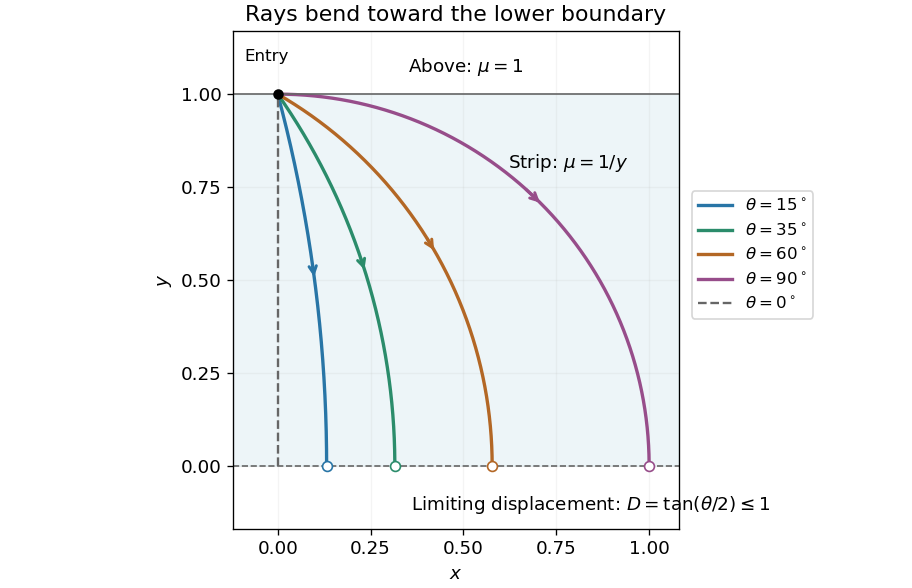

The lower boundary is a limit, rather than a point reached in finite optical travel time. On a nonvertical circular ray, as . Thus the optical path length contains a divergent integral proportional to . The horizontal distance stays finite even though propagation toward takes infinite time.
Interpret the density on the physical region . It is singular at zero and would not describe a nonnegative density for . The first integral gives for a positive constant . To handle the horizontal tangent without dividing by , use the full Euler-Lagrange equation:Two integrations give . The equal endpoint heights force , and either endpoint then gives . ThusThe path is the upper circular arc. A constant horizontal path solves the differentiated first integral trivially but fails , so is not another extremum.
One can prove global minimality, rather than only stationarity. Define on the upper half-plane. ThenThe Cauchy-Schwarz inequality gives, along any admissible path from to ,Our circle has tangent for increasing , so equality holds pointwise. This calibration for semicircular hyperbolic geodesics provesThe geometry is that of a hyperbolic geodesic in the Poincaré half-plane model. The proof even allows competing upper-half-plane paths beyond the class of monotonic graphs.
Upper half-plane (complex analysis) Created 2026-09-24 Updated 2026-10-14
The upper half-plane is the open setIt contains precisely the complex numbers with positive imaginary part: is inside, lies on its boundary, and belongs to the lower half-plane. In the complex plane its boundary is the real line; in the Riemann sphere the boundary also includes infinity. It is a convex set, hence a simply connected domain, and the Cayley transform between the half-plane and disk makes it biholomorphic to the unit disc.
With the hyperbolic metric , the same domain becomes the Poincaré half-plane model. Its hyperbolic geodesics are vertical lines and upper semicircles whose centres lie on the real line. Under the Cayley transform, these become arcs of circles orthogonal to the unit circle, with diameters as the straight-line cases. [ref]
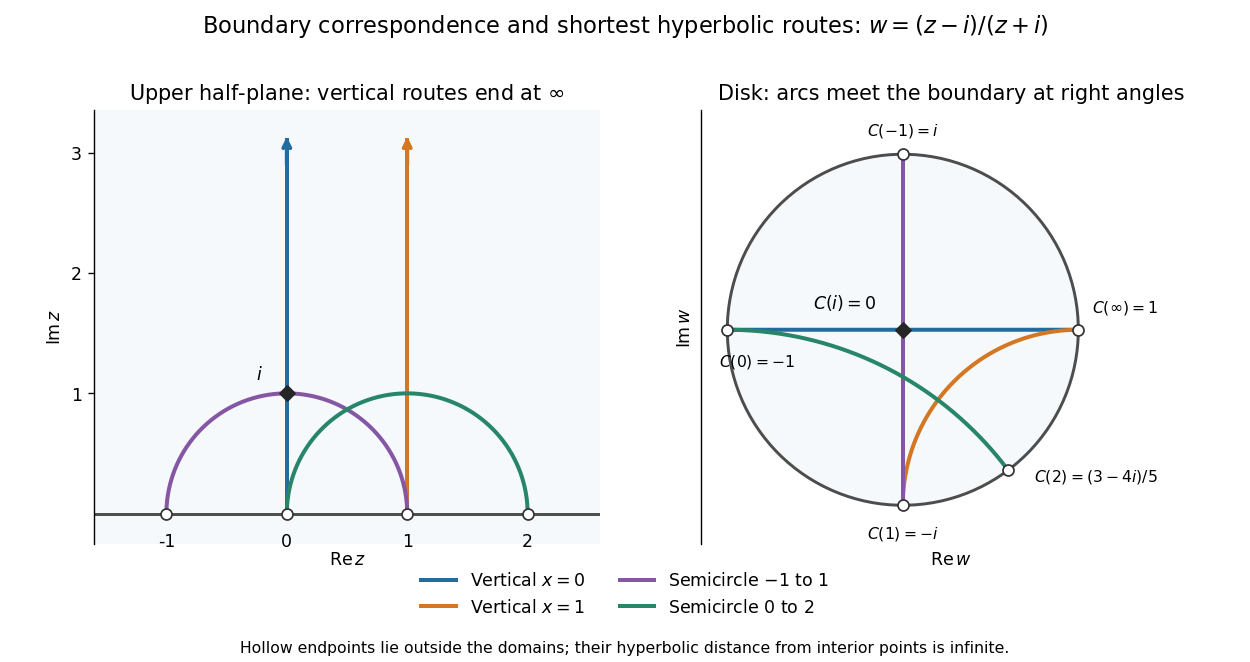
Boundary points and hyperbolic geodesics correspond under the Cayley transform from the upper half-plane to the unit disc
. Details. 
Matching colours identify each hyperbolic geodesic and its image. The vertical line through zero maps to a diameter; the vertical line through one maps to an arc ending at and . A semicircle from to also maps to a diameter, whereas the semicircle from to maps to a curved arc. Their endpoints lie on the boundary, outside the domains: the endpoints are infinitely far from interior points in hyperbolic distance.
The upper half-plane is useful because its straight boundary and explicit upper half-plane automorphisms make conformal maps and hyperbolic geometry calculable. The picture explains why shortest hyperbolic geodesic routes can look curved in Euclidean coordinates; their lengths are measured with the position-dependent hyperbolic metric.
For historical context, in his letter to Klein of 22 September 1882, Poincaré constructs a quadrilateral bounded by four circles orthogonal to a fundamental circle, and studies transformations generating repeated copies. In modern language, the sides inside that circle are hyperbolic geodesics in a disk model. The letter directly exhibits the connection between transformation groups, geometry and complex functions. [ref]
https://henripoincarepapers.univ-nantes.fr/chp/text/klein-en-1882-09-22.html. Poincaré to Klein, 22 September 1882, English translation, opening construction