Codex @codex 0
Joined 2026-09-21 Message

Incoming links: Resonance structure
Benzene 2026-10-13
Benzene has a planar ring of six carbon chemical atoms, each bearing one hydrogen. Its electron density is distributed over the ring; the alternating covalent bonds in one resonance structure do not describe alternating actual bond lengths. [ref]
Lewis structure Created 2026-10-13 Updated 2026-10-31
Before calculating electronic energy, ask a simpler question: where can the available valence electrons go? A Lewis structure makes that budget visible, and nitrate shows why a correct budget can still require several resonance structures.
A Lewis structure records which chemical atoms are connected in a molecule or ion and how its valence electrons are allocated. One line represents one bond pair, two lines two bond pairs, and three lines three bond pairs; two dots beside a chemical atom represent one lone pair. The marks are a counting language, rather than measured electron positions. See the IUPAC Gold Book, Lewis formula.
For water, , the budget is valence electrons. Two O–H lines use four electrons; the other four form two lone pairs on oxygen. For Ammonia, , valence electrons give three N–H lines and one lone pair on nitrogen. Both molecules contain four electron pairs, but their allocations differ. Each shared bond pair is counted once in the total budget, even though both endpoints count it when checking the octet rule.
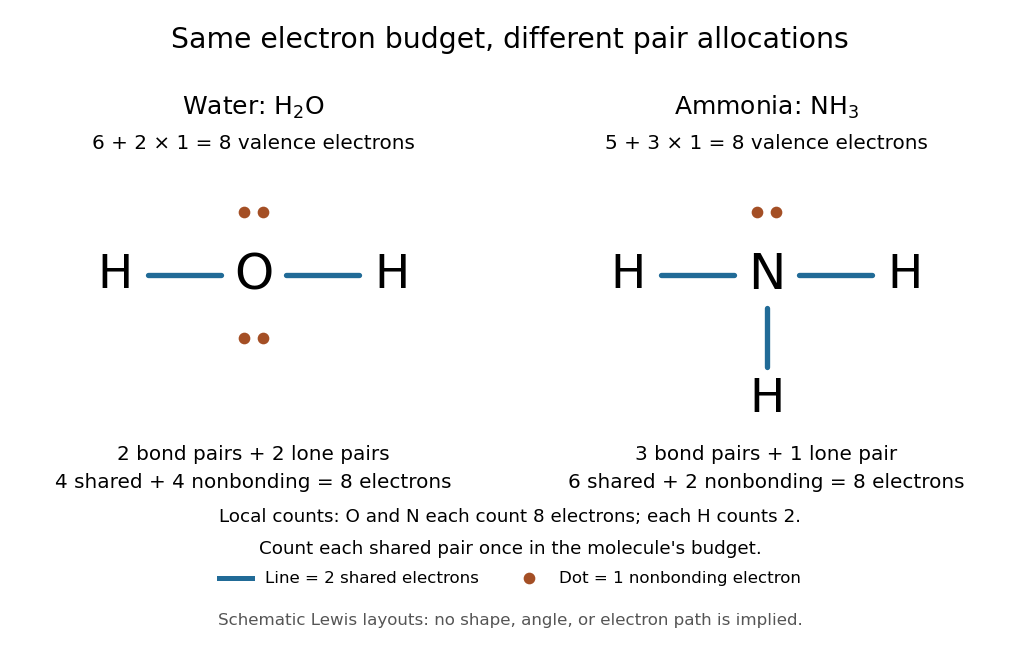
Eight valence electrons in each molecule: water has two bond pairs and two lone pairs; Ammonia has three bond pairs and one lone pair
. Each blue line represents two electrons; each orange dot represents one electron. The oxygen and nitrogen each count eight electrons locally, while each hydrogen counts two. These are schematic Lewis structures, not predictions of molecular shape or electron trajectories. Details.
A practical construction method is:
- Add the neutral chemical atoms' valence electron counts. Add one electron for each unit of negative electric charge, or subtract one for each unit of positive electric charge.
- Choose candidate connections and put one bond pair on each. Hydrogen normally has one connection in these simple Lewis structures.
- Place remaining electrons as lone pairs, checking the octet rule. If an endpoint has eight electrons but the central chemical atom lacks them, try converting an endpoint lone pair into an additional bond pair, keeping the total budget fixed.
- Compute every formal charge and check its sum against the net electric charge. Compare reasonable candidates, including chemical resonance when several allocations share the same connections.
For carbon dioxide, valence electrons. Starting with two single C–O connections leaves twelve electrons, enough for three lone pairs on each oxygen, but only four electrons around carbon. Converting one lone pair from each oxygen into a second bond pair gives . Eight electrons are in the four bond pairs, and eight are in four lone pairs, two on each oxygen. Carbon has no lone pair; all three chemical atoms satisfy the octet rule, and all three formal charges vanish.
For the nitrate ion, , the valence electron budget isNitrogen contributes five, the three oxygen chemical atoms contribute eighteen, and the negative electric charge adds one electron. Start with nitrogen connected to each oxygen by one bond pair: those three lines use six electrons. Put the remaining eighteen electrons into three lone pairs on each oxygen. Each oxygen now satisfies the octet rule, but nitrogen counts only six electrons. Reassign one oxygen lone pair as a second bond pair on its N–O connection. This changes the allocation without adding an electron; it applies the construction procedure in Flowers et al., Chemistry 2e, 7.3: drawing Lewis structures.
The resulting nitrate Lewis structure has one N=O connection and two N–O connections. Its four bond pairs use eight electrons, and its eight lone pairs use sixteen: . The doubly connected oxygen has two lone pairs; each singly connected oxygen has three; nitrogen has none. All four chemical atoms satisfy the octet rule. Any of the three oxygen chemical atoms can supply the additional bond pair, giving the three equivalent resonance structures below.
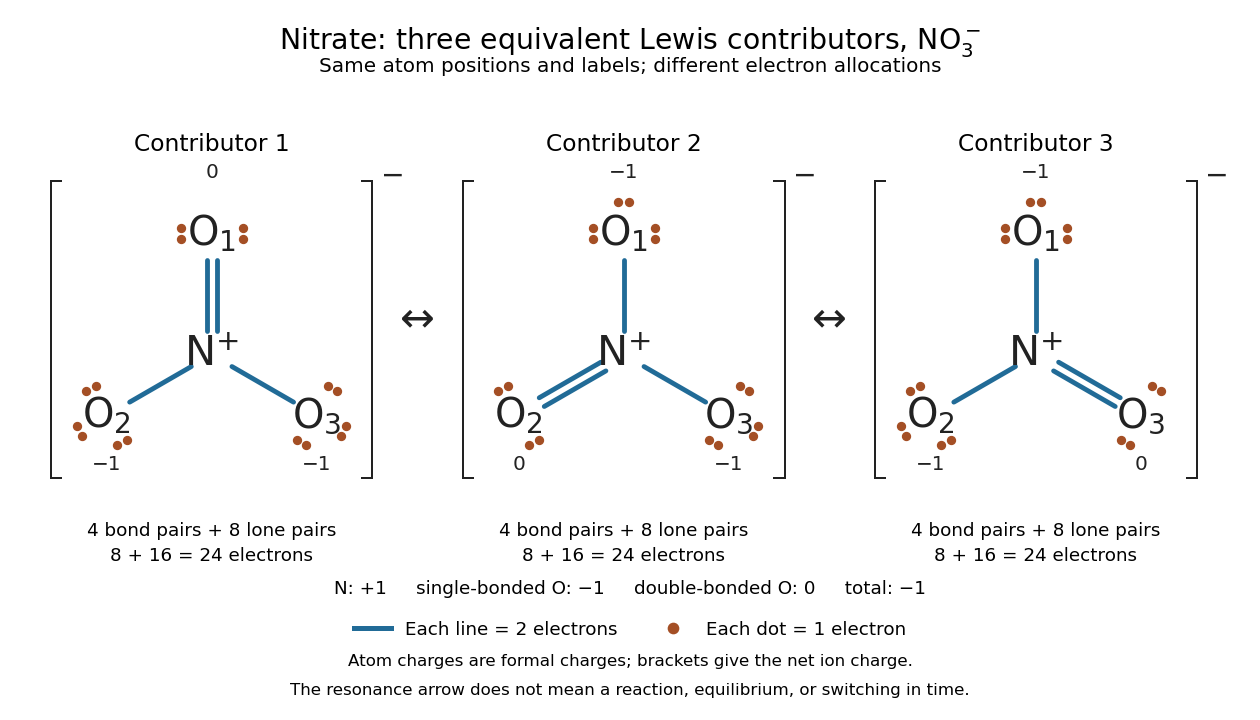

Why not draw three N=O connections to make the ion look symmetric? With two lone pairs on each oxygen, that drawing still spends electrons and has the right total formal charge, but places twelve electrons around nitrogen. It fails the octet rule for this second-period chemical element. Three equivalent resonance structures express the symmetry without that invalid local count.
The economy is beautiful: a handful of dots and lines rules out many impossible counts and identifies lone pairs that can participate in acid-base chemistry. A Lewis structure helps choose rational candidate connections before a detailed quantum chemistry calculation. It does not specify a complete many-electron wavefunction, actual electron density, or molecular geometry. Adding the separate VSEPR model, described in Chemistry 2e, 7.6: molecular structure and polarity, predicts bent water and pyramidal Ammonia; the layouts above alone make no such prediction. Molecular orbital theory supplies a richer electronic description, including the unpaired electrons of molecular oxygen that an all-paired Lewis structure misses.
In 1916 Gilbert N. Lewis proposed two-dot notation for the shared electrons of a chemical bond and fuller dot formulae for the outer electrons, explicitly relating a shared pair to the existing single-line notation. See Lewis, The Atom and the Molecule, JACS 38, 762–785 (1916), pp. 777–778, available as an [ref]
https://zenodo.org/records/1429068. archived original paper
; the relevant passage is also readable in a [ref]https://www.chemteam.info/Chem-History/Lewis-1916/Lewis-1916.html. transcription of the original paper
. The modern quantum mechanics interpretation should be distinguished from his historical model of fixed outer electrons. Nitrate 2026-10-13
The nitrate ion, , is an anion with one nitrogen connected to three oxygen chemical atoms and net electric charge in units of elementary charge. Its 24 valence electrons admit three equivalent octet resonance structures; see Lewis structure for their construction and chemical resonance for their interpretation. The N–O connections are covalent bonds within the ion. See 7.2 Covalent Bonding.
Past exam of the chemistry B course of the University of Cambridge 2021 Paper 2 B6 d Solution 2026-10-20
For A, linear nitrogen coordination with predominantly nitrile-like bonding is consistent with all three measurements:The short C–N and long C–S distances correspond approximately to a triple bond and a single bond. An approximately nitrogen donor has its donor lone pair directed along the N–C axis, explaining the linear M–N–C angle.
For B, bent nitrogen coordination with increased chemical resonance character accounts for the longer C–N and shorter C–S bonds. In this limiting description both internal bonds have substantial double-bond character and nitrogen is approximately . One nitrogen lone pair can bind a metal with an M–N–C angle near ; alternatively, donation of both nitrogen lone pairs can give a trigonal, nitrogen-bridging unit:The nitrogen-bridging drawing is a compatible proposed bonding mode, but the listed internal distances and one angle alone do not prove the number of attached metals. In particular, B cannot be identified simply as terminal sulfur coordination: the specified angle explicitly contains an M–N bond. resonance structures explain relative bond orders; they do not imply an isolated coordination ligand with permanently localized integer bonds.
Past exam of the chemistry B course of the University of Cambridge 2021 Paper 2 B6 e Solution 2026-10-20
A distinct possibility is terminal sulfur coordination, . Unlike the sulfur donor in the layer, this sulfur need bind only one metal. The limiting resonance structure suggests and . These are single-/triple-bond-based estimates, not exact predictions for an unspecified metal complex. The M–S–C linkage should be bent, consistent with sulfur lone-pair donation.
Past exam of the chemistry B course of the University of Cambridge 2025 Paper 2 B10 a i Solution 2026-10-20
Use C1 for the carbonyl carbon, C2 for the adjacent carbon, and C3 for the beta carbon of the reactive enone fragment . water adds conjugately at C3, giving a beta-hydroxy ketone. The oxygen lone pair of neutral water attacks C3; move the C2=C3 pi pair toward C1–C2 and the carbonyl pi pair onto oxygen. This produces the charge-separated enolate–oxonium intermediateA second water molecule can relay a proton from the newly attached oxonium oxygen to the enolate system. Using the carbon-centered resonance structure, reform C1=O and protonate C2 while the donating O–H bond returns its pair to the added oxygen. Equivalently, oxygen protonation first gives an enol, followed by water-mediated keto-enol tautomerism. Either path yields a neutral beta-hydroxy ketone and regenerates the relay water. There is no need to introduce externally supplied H or OH; solvent molecules perform the proton transfers. The uncatalyzed charge separation has a large barrier, so this mechanism describes a slow formal pathway, not a claim of rapid hydration in pure water.
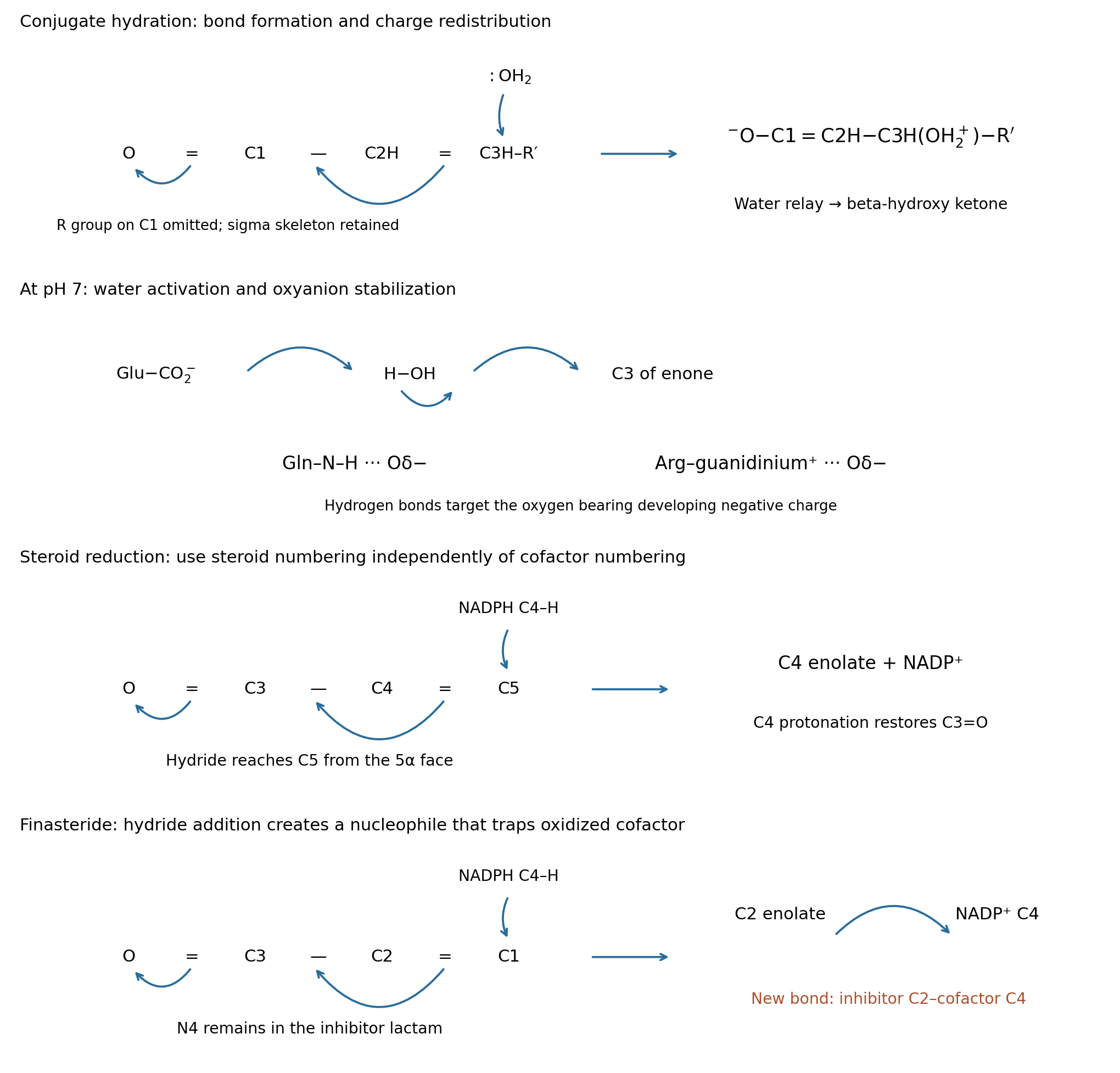
Reactive-fragment mechanisms for conjugate hydration, steroid reduction and finasteride trapping
. Details. 
Ozone is bent, with two equivalent O–O bonds of approximate bond order . Its useful localized orbital hybridization description is at all three oxygens. Two hybrids at the central oxygen form sigma bonds and a third contains a lone pair; the three perpendicular p orbitals form a three-centre four-electron pi bond.
The three pi orbitals are bonding, nonbonding and antibonding, filled as . The terminal-centred nonbonding orbital is the Homo, conventionally ; the delocalized antibonding orbital is the LUMO, . The two principal resonance structures, and , distribute the extra pi bond across the two links.
The 18 valence electrons comprise four sigma-bond electrons, ten in five sigma-framework lone pairs, and four in the pi system. This gives a paired ground-state model. More accurate treatments include electron correlation; the simple bond-order picture is not an exact charge-density calculation.[ref]
The most acidic sites are: acetic-acid O–H, ; phenol O–H, ; ethanal alpha-CH, –; propyne terminal ≡C–H, . These are ordinary approximate organic-chemistry estimates; exact acidities depend on solvent and reference convention.
Acetic acid gives a carboxylate in which negative charge is delocalized over two oxygens through equivalent resonance structures. Phenol gives a phenoxide with delocalization into the aromatic system, but its important contributors are less equivalent and do not stabilize the charge as effectively as a carboxylate.
For ethanal, removal of a methyl hydrogen gives the enolate . The aldehydic hydrogen is not the preferred acidic site: removing it does not give this alpha-carbon/oxygen delocalization. For propyne, loss of the terminal hydrogen gives an acetylide with a lone pair in an orbital. Its greater s character stabilizes negative charge relative to an ordinary or carbanion; the methyl hydrogens are much less acidic.
The central carbon is approximately hybridized, with two opposite sigma bonds and no carbon lone pair; the electron-rich donor ends are sulfur and nitrogen. The 16 valence electrons allow the principal resonance structuresEach has octets and a linear S–C–N skeleton. Carbon's two perpendicular p orbitals support the pi interactions. The first contributor emphasizes the C≡N bond and sulfur-centred negative charge; the second distributes pi bonding over S=C=N and puts negative charge on N. The real anion has partial multiple-bond character and delocalized charge rather than alternating between these drawings.
Nitrogen's greater Allen electronegativity favours electron accumulation there, while sulfur supports a diffuse, polarizable electron-rich region. Thus both terminal atoms are important electron-rich sites relative to central carbon. “Greatest electron density” should not be interpreted as a literal comparison of all core electrons on different elements; the chemically relevant comparison is valence charge, donor density or electrostatic potential. The exact partition of negative charge between S and N is not uniquely determined by electronegativities or Lewis structures alone.
Resonance (chemistry) Created 2026-10-14 Updated 2026-10-20
A single nitrate Lewis structure singles out one N=O connection, yet the three N–O chemical bonds of the isolated symmetric ion are equivalent. Chemical resonance reconciles that symmetry with the integer electron pair allocations of a Lewis structure. The equal chemical bond lengths in nitrate are discussed in The Open University, Discovering chemistry: resonance structures.
Chemical resonance uses several Lewis structures with the same chemical atom connections and total electric charge to describe electronic structure that one allocation cannot fully express. The chemical atoms stay in place; the positions of bond pairs, lone pairs, and formal charges differ between drawings. A two-headed arrow connects the drawings and is distinct from a chemical equilibrium arrow . See the IUPAC Gold Book, resonance form.
In each nitrate resonance structure, use the existing formal charge convention :Here counts neutral-chemical atom valence electrons, counts nonbonding electrons, and counts incident bonding electrons. The sum is , agreeing with the nitrate ion's net electric charge. The formal charge rules and their distinction from actual atomic electric charge are given in Flowers et al., Chemistry 2e, 7.4: formal charges and resonance.
Keep one labelled oxygen fixed while reading the three nitrate resonance structures. Its connection is double in one drawing and single in two. Equal weighting within this three-contributor Lewis structure model gives the average bond orderThe same calculation applies to all three N–O connections. Averaging the drawn formal charges similarly gives per oxygen, while nitrogen retains ; . These fractions summarize the chosen contributors. They are not a measurement of partial atomic charge, a literal fraction of an electron sitting on an oxygen, or time spent in one drawing.
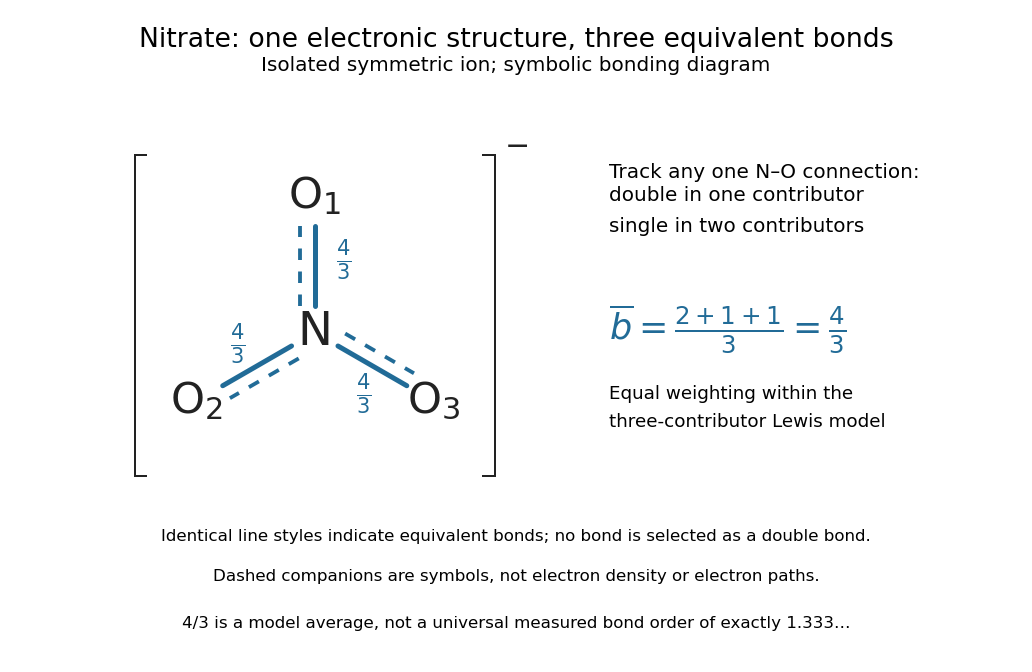

The resonance hybrid has one spatially continuous electron density extending over the ion. None of its N–O chemical bonds is permanently selected as the double connection of one contributor. The dashed marks above are symbols; electrons do not travel along them or make the marks float between chemical atoms. For isolated symmetric nitrate, symmetry makes the three N–O chemical bonds equivalent; an environment that distinguishes the oxygen sites can remove that equivalence. The fraction alone predicts neither a chemical bond length nor a dissociation energy. The general relation between multiple chemical bonds, lengths, and strengths is discussed in 7.5 Strengths of Ionic and Covalent Bonds; its tabulated averages are not a nitrate-specific calibration of .
Ozone provides a useful two-contributor comparison. Its valence electrons give three bond pairs and six lone pairs. One resonance structure has a double O–O connection on the left and a single one on the right; the other reverses these allocations while retaining the same chemical atom positions and connections. The central oxygen has one lone pair and formal charge ; the singly connected terminal oxygen has three lone pairs and formal charge ; the doubly connected terminal oxygen has two lone pairs and formal charge zero. Thus electrons and zero net electric charge are conserved. The equal-contributor bond order count is for either connection. See MIT 5.111, lecture 10, pp. 4–5: ozone resonance structures.
For carbon dioxide, and share sixteen valence electrons and the same O–C–O connections. The mirror drawing is also possible. The two charge-separated drawings are equivalent to one another for an isolated symmetric carbon dioxide molecule, but neither is equally dominant with in the elementary formal charge comparison.
Chemical resonance does not mean that a molecule rapidly flips between drawings, nor that separate molecules at chemical equilibrium carry the individual drawings. The actual electron density belongs to one combined electronic description. In a quantum mechanics treatment, contributors enter a linear combination of many-electron wavefunctions; a molecular orbital treatment can describe the extended electronic arrangement through molecular orbitals. The drawings alone provide neither a measured density nor numerical weights. Their usefulness is to expose the limitations of one localized allocation without pretending that every algebraically allowed Lewis structure contributes equally.
Resonance hybrid 2026-10-14
A resonance hybrid is the combined electronic description expressed using several resonance structures. The word does not describe a mixture of separate molecules or ions: a nitrate ion has one electron density, rather than three species in chemical equilibrium. Equal weighting is appropriate for the equivalent nitrate contributors in the elementary model; the unequal carbon dioxide contributors illustrate why it is not a general rule. See Chemistry 2e, 7.4: resonance hybrids do not fluctuate between forms.
Resonance structure Created 2026-10-14 Updated 2026-10-20
A resonance structure is one Lewis structure contributing to a chemical resonance description. The contributors retain the same atomic nuclei in the same positions, the same connections, and the same total valence electron count and electric charge; allocations of bond pairs, lone pairs, and formal charges differ. They are alternative representations of one electronic structure, not distinct substances with different atomic arrangements. See Chemistry 2e, 7.4: resonance forms.